
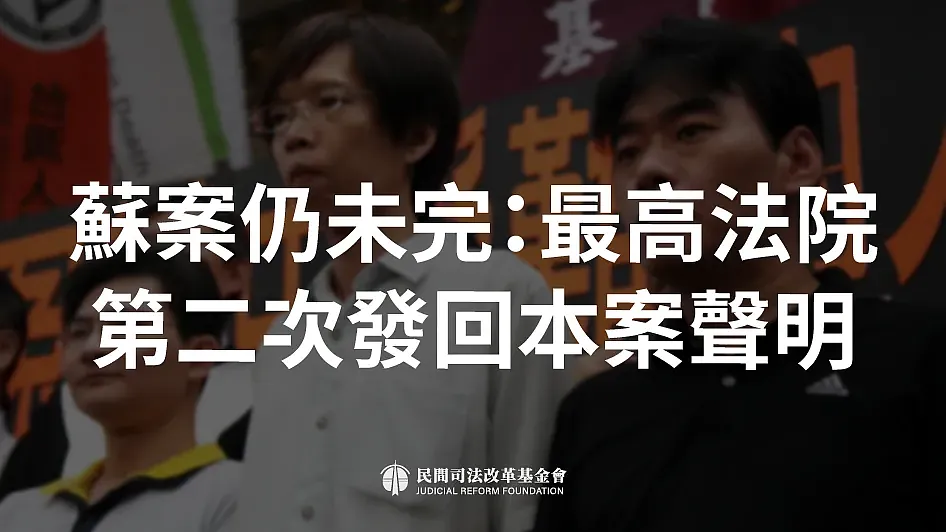
The Su Case is Still Not Over: Statement on the Supreme Court's Second Remand of the Case
Last edited: 2026-08-23
Regarding the damage compensation case involving Su Chien-ho, Liu Bin-lang, Chuang Lin-xun, and their families, the Supreme Court announced the main text of its ruling on the Judicial Yuan's Main Text Announcement Inquiry System on August 21, 2025: "The original judgment is set aside, and the case is remanded to the Taiwan High Court."
This is the second time the Supreme Court has set aside and remanded this case. The volunteer legal team expresses its deep regret that the judiciary has failed to promptly stop the losses in the lives of the wrongful conviction victims Su Chien-ho, Liu Bin-lang, Chuang Lin-xun, and their families, whose lives have been heavily impacted by the wrongful conviction in this case, and issues the following statement:
1. The Su Case is Still Not Over: How Many 35 Years Can an Ordinary Person Have?
This case is one of Taiwan's most prominent wrongful death penalty cases. In 1991, Su Chien-ho, Liu Bin-lang, and Chuang Lin-xun were implicated in the murder of the Wu couple in Hsichih Township, Taipei County. Without objective evidence proving that the three men were involved in the murder, and based on confessions obtained through torture, the courts wrongly convicted the three men in 1995, sentencing each to two death penalties and lifelong deprivation of civil rights. Fortunately, on May 18, 2000, through the persistent efforts of the volunteer legal team, the High Court ruled to initiate a retrial. After the Supreme Court remanded the retrial case to the High Court for retrials three times, the High Court finally delivered a retrial-plus-three judgment on August 31, 2012, ruling that Su Chien-ho and the other two men did not participate in the crime in question, and acquitting them definitively.
From the moment Su Chien-ho and the other two were accused of the crime, from the ages of 18 to 39, they spent 21 years proving their innocence. However, today, nearly 35 years later, nearly 13 years after their criminal acquittal became definitive, and 5 years after the Supreme Court's first remand, Su Chien-ho and the other two are still facing a criminal-attached civil damage compensation lawsuit brought by the victims' family members, still trying to prove to the judicial system that the three of them are the true victims of the judiciary.
After the criminal case became definitive, the civil courts heard the subsequent proceedings. Both the first and second-instance courts ruled that Su Chien-ho, the other two men, and their families did not need to bear damage compensation liability. On August 26, 2020, the Civil Division of the Supreme Court set aside the case for the first time and remanded it to the High Court. The reasoning for the remand—stating that "the original trial court's reasoning—that because the prosecutor failed to fulfill the burden of proof regarding the absence of torture during the criminal case proceedings, it was insufficient to establish that Su Chien-ho was not subjected to torture—particularly confuses the burden of proof between criminal parties and civil parties"—severely highlighted the judicial system's lack of sufficient awareness of the state's responsibility to prevent torture.
The reasoning for this current remand is not yet known, but Su Chien-ho and the others continue to drift within the judicial system.
2. The Principle of Speedy Trial Cannot Be Ignored: Judicial Delays Equate to Secondary Victimization
The "The Criminal Speedy Trial Act" clearly stipulates that if a case remains undecided for more than 8 years from its submission to the first-instance court, it may infringe upon the defendant's right to a speedy trial. Although civil litigation has no identical provision, the 13-year delay in the civil litigation of this case has severely infringed upon the rights and interests of the parties involved, amounting to secondary victimization.
The state has an obligation to provide "speedy" judicial relief procedures, regardless of whether they are criminal, civil, or administrative cases. This 35-year judicial ordeal has not only caused immense suffering to the parties involved but has also severely wasted massive judicial resources. Upon receiving the judgment, the volunteer legal team will carefully review the reasons for the remand and continue to fight for Su Chien-ho and others, as well as for fairness and justice in Taiwan's judiciary.
3. Confront the Harm of Torture and Promptly Pass the "Enforcement Act of the Convention against Torture"
The reason Su Chien-ho and the other two became victims of a wrongful conviction lies fundamentally in the police's repeated torture of Su Chien-ho and others in order to obtain criminal confessions in this case. In this regard, the Control Yuan had previously censured the Ministry of Justice and the National Police Agency. In the final judgment acquitting Su Chien-ho and the others, the court also comprehensively considered "testimony from witnesses sharing the same detention cell," "physical examination results upon entering the detention facility," and "records of painkillers dispensed," concluding that Su Chien-ho and the others had indeed been subjected to torture and that acts of torture existed.
The United Nations Convention against Torture and Other Cruel, Inhuman or Degrading Treatment or Punishment (CAT) requires all state parties to take effective measures to prevent acts of torture and to prohibit the use of evidence obtained through torture in legal proceedings.
Drafts of the "Enforcement Act of the Convention against Torture," which domesticates the principles of the Convention, were submitted to the Legislative Yuan for review in both 2018 and 2020. In May 2022, the Executive Yuan released the "National Human Rights Action Plan," and the government once again promised to list the "Enforcement Act of the Convention against Torture" as a priority bill to be passed as soon as possible.
Furthermore, during the 2024 legislator-at-large elections, the Judicial Reform Foundation raised seven questions on judicial reform. All major political parties responded that eradicating torture and establishing a national preventive mechanism for torture are cross-party consensus items, promising to support the passage of the draft "Enforcement Act of the Convention against Torture" in the Legislative Yuan upon election.
However, to this day, the draft "Enforcement Act of the Convention against Torture" remains merely a draft.
The volunteer legal team hereby calls upon all political parties across the political spectrum and the administrative authorities to promptly fulfill their pre-election promises to the people and to human rights, promote the passage of the draft "Enforcement Act of the Convention against Torture," grant domestic legal effect to the principles of the Convention, establish systematic mechanisms to prevent the occurrence of torture and repair damages arising from torture, and ensure that Taiwan's judiciary does not repeat the tragedy of the Su Chien-ho case.
Press Contacts
Chang Hua-che, Director of Case Action Department, Judicial Reform Foundation
02-2523-1178#22, 0932-725962
ven@jrf.org.tw
This article is an AI-generated translation of the original Chinese text. In the event of any discrepancy, the Chinese version shall prevail.