
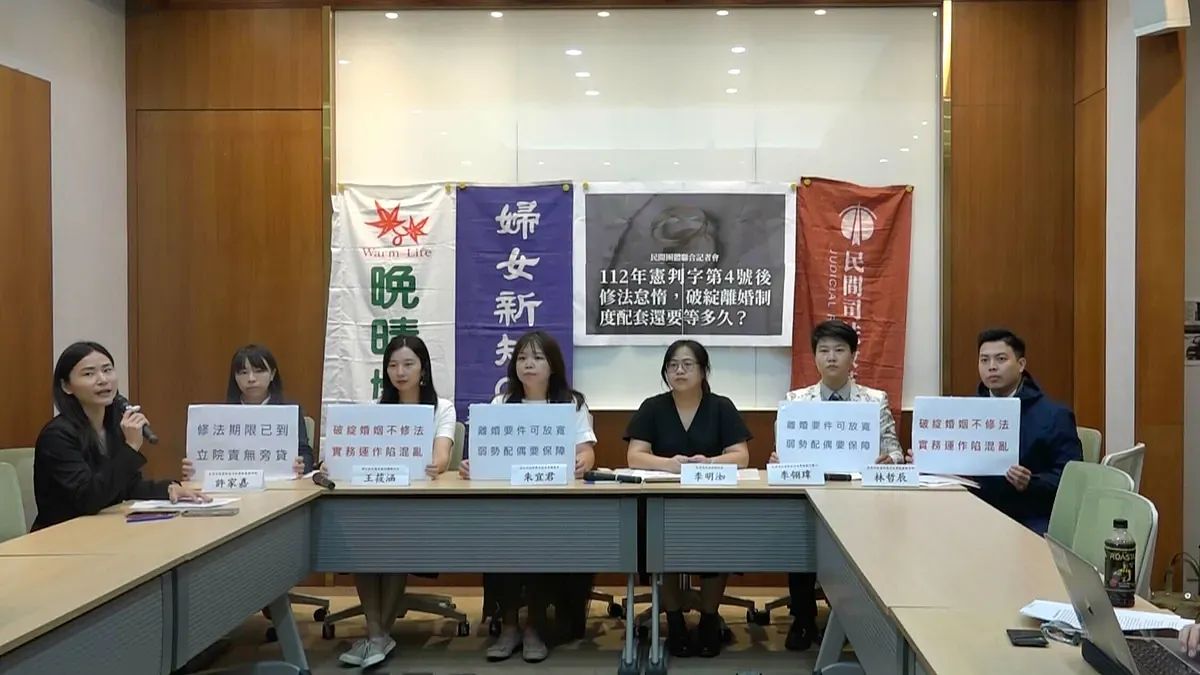
Joint Press Conference | Legislative Delay Following Constitutional Interpretation No. 4 of 2023: How Much Longer Must We Wait for Complementary Measures in the Breakdown-Based Divorce Regime?
Last edited: 2026-08-23
Xin-Qing (Awakening Foundation and Taipei Wan-Ching) Draft Version
Advancing judicial reform requires the executive, legislative, and judicial branches to perform their respective duties to thoroughly protect people's rights. After the Constitutional Court delivers a judgment and mandates legal amendments within a specific timeframe, other political branches must actively take action, communicate, and formulate concrete policies; conversely, a failure to amend laws will severely impact people's rights. Following the longest extended legislative session in history, the Legislative Yuan will usher in a new session in September. Civil society organizations call upon all political parties in the Legislative Yuan to actively schedule key bills whose amendment deadlines following Constitutional Court judgments have already passed (including: Interpretation No. 13 of 2022 on the National Health Insurance Database, the breakdown-based divorce case under Interpretation No. 4 of 2023, Interpretation No. 9 of 2023 on the search of law firms, and Interpretation No. 13 of 2023 on drug offenses, among others).
This press conference addresses the breakdown-based divorce case under Constitutional Interpretation No. 4 of 2023 (hereinafter "Interpretation No. 4"), for which the statutory deadline for amendments expired as early as March of this year. In response, the Judicial Reform Foundation, Awakening Foundation, and Taipei Wan-Ching Women's Association held a joint press conference regarding the amendment of breakdown-based divorce laws, proposing two demands:
1. The amendment of the Civil Code Part IV Family has been severely delayed; civil society organizations solemnly call upon the Legislative Yuan to actively schedule it for review in the upcoming session.
2. Various organizations have already proposed drafts and opinions; complementary designs must actively incorporate civil society input to protect disadvantaged spouses in divorce.
I. Amendment of the Civil Code Part IV Family has been severely delayed; civil society organizations solemnly call upon the Legislative Yuan to actively schedule it for review in the upcoming session
On March 24, 2023, the Constitutional Court rendered Constitutional Interpretation No. 4 [Restriction on the Solely-at-Fault Spouse's Right to Petition for Judicial Divorce]. The judgment relaxed the restrictions on a solely-at-fault spouse petitioning for judicial divorce and ordered the legislature to complete the legal amendments within two years from the date of the judgment announcement—meaning the legal amendments should have been completed by March 23, 2025.
However, the Executive Yuan delayed submitting its draft amendment to the Civil Code Part IV Family until February 20, 2025. As of the date of this press conference, the Executive Yuan's draft still has not been submitted to the Legislative Yuan for scheduling and review. In the Legislative Yuan, only draft amendments proposed by certain legislators have passed their first reading, without being sent to the Judiciary and Organic Laws and Statutes Committee for review. Furthermore, except for a few legislators' draft amendments to the Civil Code Part IV Family that were submitted to the Procedure Committee just before the March 23 deadline before being reported to the plenary session to complete the first reading procedure, all other amendment drafts were submitted after March 23 (see the table below). In other words, the legislative branch failed to take the amendment deadline proposed by the Constitutional Court seriously, thereby violating the constitutional requirement set by the Constitutional Court to "mandate legal amendments within a specified period." Currently, family court judges can only rely on Interpretation No. 4 as the basis for adjudicating divorces, directly applying the intent of the constitutional interpretation to "divorce conditions."
| Date | Proposing Legislator | Related Document |
|---|---|---|
| March 7, 2025 | Cheng Tien-tsai | Yuan General No. 20, Legislator Proposal No. 11009381 |
| March 21, 2025 | Fan Yun, Chuang Jui-hsiung | Yuan General No. 20, Legislator Proposal No. 11009913 |
| March 21, 2025 | Shen Fa-hui, Lin Yueh-chin | Yuan General No. 20, Legislator Proposal No. 11009886 |
| April 18, 2025 | Lin Yi-chin | Yuan General No. 20, Legislator Proposal No. 11010771 |
| April 18, 2025 | Tsai Yi-yu, Chuang Jui-hsiung, Wang Mei-hui | Yuan General No. 20, Legislator Proposal No. 11010458 |
| April 18, 2025 | Lin Yueh-chin | Yuan General No. 20, Legislator Proposal No. 11010321 |
| April 25, 2025 | Huang Jie | Yuan General No. 20, Legislator Proposal No. 11010331 |
| April 25, 2025 | Chen Su-yueh, Wu Li-hua | Yuan General No. 20, Legislator Proposal No. 11010253 |
| May 2, 2025 | Lai Hui-yuan, Chen Pei-yu | Yuan General No. 20, Legislator Proposal No. 11011155 |
| May 16, 2025 | Wu Li-hua | Yuan General No. 20, Legislator Proposal No. 11012548 |
| June 13, 2025 | Fan Yun, Chen Ting-fei | Yuan General No. 20, Legislator Proposal No. 1101322 |
However, in addition to requiring Taiwan's marital system to move toward a legislative model based on breakdown-of-marriage, Interpretation No. 4 also emphasizes that when expanding the "exit" of freedom to divorce, the legislative branch must deliberate on corresponding complementary systems: "To look after the livelihood of the non-faulty or disadvantaged spouse and minor children after divorce, comprehensive complementary measures must also be in place." In other words, the right to divorce is not only the exercise of the freedom of rights but also includes the protection of marital equality. A comprehensive review and amendment must be conducted regarding the current statutory property regime, claims for alimony, child support for minor children, and damage compensation systems related to divorce.
To elaborate, "making divorce easier" will not cause a severe impact on the economically disadvantaged or non-faulty spouse within a marriage. What is severe is when divorce becomes easier "without a corresponding complementary compensation mechanism." The longer the amendment deadline is exceeded, the longer the vacuum period of "having only the freedom to divorce without complementary protection" will persist. Every year, approximately 2,500 judicial divorce cases enter family courts in Taiwan (2,532 cases in 2022, 2,535 cases in 2023, and 2,412 cases in 2024). Once entering the litigation process, however, it often profoundly impacts spouses and children within the family. Civil society organizations call upon the Legislative Yuan to face the impact of the complementary vacuum on people's rights. In addition to submitting the Executive Yuan's draft version to the Legislative Yuan as soon as possible and scheduling it for joint review alongside the versions proposed by legislators, public hearings should also be held to widely incorporate the voices of civil society, thereby making the amendment of the Civil Code Part IV Family more comprehensive.
II. Various organizations have already proposed drafts and opinions; complementary designs must actively incorporate civil society input to protect disadvantaged spouses in divorc
(1) JRF emphasizes: The statutory design of provisions on separation and alimony requires thorough discussion and prudent plannin
First, according to the intent of Interpretation No. 4, the Grand Justices demand that relevant authorities, when amending the law, review and improve the current judicial divorce system and properly design legal norms in response to social changes and various shifts in modern marital relationships. This includes looking after the livelihood of disadvantaged spouses and minor children after divorce and ensuring comprehensive complementary measures.
There are two key amendments in the Executive Yuan's draft regarding the right to claim alimony (referring to the amended Article 1057 of the Civil Code). First, the requirements for claiming alimony are no longer limited to "one party falling into financial hardship due to divorce"; it also adds "those whose employment capacity has diminished or whose employment opportunities have decreased upon divorce," to be distributed according to the evaluation factors under the amended Article 1057-1 of the Civil Code. Civil society organizations affirm this amendment direction because, in past practice, because alimony claims were strictly limited to financial hardship, claiming alimony was overly stringent. When alimony is characterized as marital compensation rather than merely an extension of post-divorce maintenance for the disadvantaged party, it will be fairly and equitably evaluated as a contribution by the party whose employment capacity or opportunities were diminished due to sacrifices and dedication to the family.
However, civil society organizations oppose the second amendment direction of the Executive Yuan's draft, which provides under Article 1057-3 of the Civil Code that the right to claim alimony is extinguished upon the remarriage and death of the alimony obligee. The primary reason for opposition is that if alimony is regarded as marital compensation at the time of divorce, the fact of remarriage does not automatically negate a spouse's sacrifices and dedication in the previous marriage, nor does it negate the compensation for the diminished job opportunities or employment capacity caused by the marriage. In other words, remarriage is merely the establishment of another marital relationship and does not affect a spouse's right to claim alimony for diminished employment opportunities caused by marriage.
Therefore, the JRF advocates that the requirements for claiming alimony should be divided into the "opportunity cost type" and the "falling into financial hardship type." The former is characterized as marital compensation at the time of divorce, while the latter is an extension of living maintenance. Consequently, regarding the grounds for extinguishing the right to claim alimony—aside from extinguishment by death—only the alimony claim of the "falling into financial hardship type" shall be extinguished in the event of remarriage, which does not include the alimony claim of the "opportunity cost type." This typology-based approach is currently supported by the legislative proposals of Legislators Lin Yueh-chin and Wu Li-hua.
Furthermore, according to the intent of Interpretation No. 4, the Grand Justices emphasized that the legal amendments should protect disadvantaged spouses in divorce, rather than merely relax the at-fault spouse's petition for divorce. For example, in addition to the current right to claim the distribution of surplus property, under the consideration of protecting disadvantaged spouses in divorce and the best interests of minor children, the other spouse's proportion of statutory property surplus distribution can be increased, and a higher proportion of child support for minor children can be borne. This enables disadvantaged spouses and minor children to receive timely and effective legal protection and remedies in judicial divorce proceedings and obtain fair substantive compensation.
However, the draft proposed by the Executive Yuan only strengthens the obligation to disclose marital property regarding surplus property distribution, using the request for the other party to submit an inventory of property to implement the surplus property distribution claim; whether this can improve or protect economically disadvantaged divorced spouses still leaves room for discussion.
The JRF believes that there is still a significant gap between the current Executive Yuan draft and most legislator-proposed versions compared to the legislative guidelines suggested by the Grand Justices. Currently, only Fan Yun's draft version plans to incorporate occupational pensions into the scope of surplus property distribution claims. In other words, the opportunity for this Civil Code amendment should not merely be to expand or relax the requirements for divorce petitions, but also to comprehensively plan the current judicial divorce system, providing more thorough complementary measures for disadvantaged spouses and minor children in divorce.
Finally, comparing the current Executive Yuan draft with the institutional design reverting to divorce petitions, the Executive Yuan draft deletes the restriction that the petitioner must be free of fault in accordance with the intent of Interpretation No. 4, while adding a "separation clause"—"if spouses have accumulated a separation period reaching three years within five years, either party may petition for divorce"—and adding a "manifestly unfair clause," meaning that if the court deems that the divorce would be manifestly unfair to the spouse refusing the divorce, it may dismiss the divorce petition as necessary to maintain the marriage. Looking at legislative precedents, this mimics the design of the "hardship clause" in the German Civil Code, shifting legal reform from a passive breakdown-of-marriage system to an active breakdown-of-marriage system.
The JRF believes that the "separation clause" in the draft still carries a certain degree of interpretive uncertainty. Coupled with the fact that the Civil Code lacks a system of "legal separation," this requires thorough discussion and planning from all sectors. For instance, regarding the commencement and method of the separation system, the Ministry of Justice has not provided detailed explanations or relevant complementary measures, currently leaving it to individual family judges to exercise their own judgment and inner conviction. In practice, however, economically disadvantaged family members actually have less economic conditions to engage in "de facto separation." Therefore, the JRF believes that whether the determination of separation should be interpreted leniently or strictly will pose a major challenge for frontline family judges.
In addition, regarding the legislative rationale of the "manifestly unfair clause," the Ministry of Justice exemplifies whether dissolving the marital relationship would cause the spouse refusing divorce or minor children to fall into extreme and exceptionally harsh circumstances. The JRF advocates that if divorce reform moves toward an active breakdown-of-marriage system, minor children should not be used as an obstacle to the dissolution of marriage. Therefore, when applying the "manifestly unfair clause," family courts must not only break away from the determination of fault or non-fault in divorce, but also exclude minor children as an obstacle to dissolving marriage, preventing minor children from being used by parents in court as a bargaining tool to refuse judicial divorce.
Moreover, because the majority of family court judgments are not public, under unclear standards, parties or lawyers must spend more time and effort in litigation to grope for the application standards of the "separation clause" and the "manifestly unfair clause." Consequently, this is also highly likely to create a burden on the litigation efficiency of the courts. Based on this, the JRF advocates that the legislature should list in detail or explicitly exemplify possible application scenarios in the legislative rationale to assist judges in determining standards, or require the Judicial Yuan in legislative ancillary resolutions—after the amended Civil Code provisions are passed—to conduct statistical surveys on court cases concerning divorce petitions and commission scholars and experts to conduct legal empirical research to produce relevant reports, thereby facilitating judges, lawyers, and the public in supervising and tracking subsequent practical operational standards.
(2) Awakening Foundation emphasizes: The draft should incorporate the amendment on the distribution of occupational pensions in divorce
In the Executive Yuan's current draft amendment, provisions concerning post-divorce economic claims only include alimony. However, anyone who has experienced divorce litigation knows that among the monetary payments involved in a judicial divorce, the claim that affects the amount the most and is often the hardest to handle is the scope of surplus property distribution. Whether the distribution method and scope of surplus property are equitable largely reflect the soundness of the divorce legal system's design.
Gender disparities still exist in Taiwan's labor market. After getting married and having children, women often interrupt their employment or adjust their original work status due to shouldering caregiving responsibilities. For caregivers, in addition to the investment of labor, caregiving work often substantially impacts the caregiver's economic capacity and autonomy, and this type of caregiving input is frequently unpaid labor within the household, which cannot be reflected in the caregiver's actual wage earnings.
The second pillar of occupational pensions in Taiwan's pension system is designed to maintain income stability for retirees, and the level of benefits highly reflects the recipient's labor market achievements before retirement. Therefore, it should be included within the scope of claims for the distribution of matrimonial surplus property, thereby affirming the contribution made by disadvantaged divorced spouses to family life during the marriage and the costs borne in the labor market, and rectifying the pension inequality issues derived from the distribution of labor market and family caregiving responsibilities.
Regarding such pension inequality issues, General Recommendation No. 29 of the Convention on the Elimination of All Forms of Discrimination against Women (CEDAW) also sets forth the following principle: "To achieve formal and substantive property equality upon the dissolution of marriage, States parties should be strongly encouraged to provide for: the calculation of the present value of deferred-compensation, pension or other post-dissolution payments earned during the marriage as part of the divisible marital property." In the concluding observations and recommendations of the international review of Taiwan's 4th CEDAW State Report published in 2022, members of the international review committee also explicitly recommended this amendment direction in paragraph 85.
Under current regulations, the military, public servant, and public school teacher pension system within the second-pillar pension framework has already been amended to be included within the scope of surplus property distribution in divorce. However, other types of occupational pensions (such as labor pensions) lack equivalent provisions, leading to a disparity in the scope of distribution rights when persons covered by different occupational pensions claim surplus property distribution upon divorce, due to differing legal norms.
We believe that the right to distribute occupational pensions upon divorce should not differ due to inconsistent regulatory provisions governing various occupational pensions. Articles 1030-1 and 1041 of the Civil Code should be amended so that all types of occupational pensions can be directly included in the scope of surplus property distribution pursuant to the Civil Code, thereby avoiding the uncertainties caused by separate amendments to the governing regulations of various occupational pensions.
The Awakening Foundation reiterates that while the amendment of divorce requirements in the current revision of the Civil Code Part IV Family is certainly important, the reform of the divorce legal system should have more complete complementary measures regarding provisions related to post-divorce economic claims. The government should not ignore the disparity in rights regarding the distribution of occupational pensions in divorce under the current legal system; it should incorporate the reform of surplus property distribution provisions into this Civil Code amendment to eliminate inequality among different occupational pensions while complying with the intent of CEDAW.
(3) Taipei Wan-Ching Women's Association reiterates: Reform of the divorce legal system must protect disadvantaged spouses in divorce
Both the regulatory authority and the legislature responsible for amending the Civil Code Part IV Family must face the importance of divorce legal reform and must not overlook complementary measures that protect the rights and interests of disadvantaged spouses in divorce.
The Xin-Qing draft amendment to the Civil Code Part IV Family was jointly proposed by us and the Awakening Foundation. In the reform of alimony, we hope to use whether it causes one spouse to suffer "diminished employment capacity or decreased employment opportunities" as the requirement for a claim, shifting away from the current excessively high requirement of "falling into financial financial hardship," so that the alimony system can truly fulfill its function as "marital compensation" and protect the party who has suffered career development impacts or economic disadvantages due to marriage or divorce. Beyond the transformation of alimony, the Xin-Qing draft also incorporates reforms to numerous provisions concerning post-divorce economic claims, including the aforementioned reasonable distribution of occupational pensions after divorce mentioned by the Awakening Foundation, as well as amendments concerning divorce damage compensation.
The Taipei Wan-Ching Women's Association reiterates that amendments to provisions concerning divorce in the Civil Code Part IV Family should comprehensively consider the soundness of the divorce legal system and whether post-divorce complementary measures are complete. The amendment plans of the Ministry of Justice and the Legislative Yuan should actively incorporate the demands of civil society organizations and amend the law as soon as possible to balance the rights and interests of both parties in a marriage and implement the protection of economically disadvantaged spouses within marriage.
Xin-Qing (Awakening Foundation and Taipei Wan-Ching) Draft Version
Press Conference Time
Monday, August 29, 2025, 09:30
Press Conference Location
Room 101, Chung-Hsin Building, Legislative Yuan (No. 3-1, Sec. 1, Jinan Rd., Zhongzheng Dist., Taipei City)
Attendees
Lee Ming-ju|Deputy Executive Director, Judicial Reform Foundation
Li Ling-wei|Deputy Convener, Gender Judicial Reform Special Committee, JRF
Wang Hsiao-han|Director of Advocacy Department, Awakening Foundation
Chu I-chun|Standing Director and Pro Bono Lawyer, Taipei Wan-Ching Women's Association
Hsu Chia-chia|Pro Bono Lawyer, Gender Judicial Reform Special Committee, JRF
Lin Che-chen|Pro Bono Lawyer, Gender Judicial Reform Special Committee, JRF
Co-signing Organizations
Judicial Reform Foundation
Awakening Foundation
Taipei Wan-Ching Women's Association
Press Contacts
Lin Cheng-ching, Assistant Bill Researcher, Legal Policy Department, Judicial Reform Foundation
Phone: 02-2523-1178#14
Email: kacan@jrf.org.tw
Wang Hsiao-han, Director of Advocacy Department, Awakening Foundation
Phone: 02-2502-8715
Email: hanwang@awakening.org.tw
This article is an AI-generated translation of the original Chinese text. In the event of any discrepancy, the Chinese version shall prevail.