
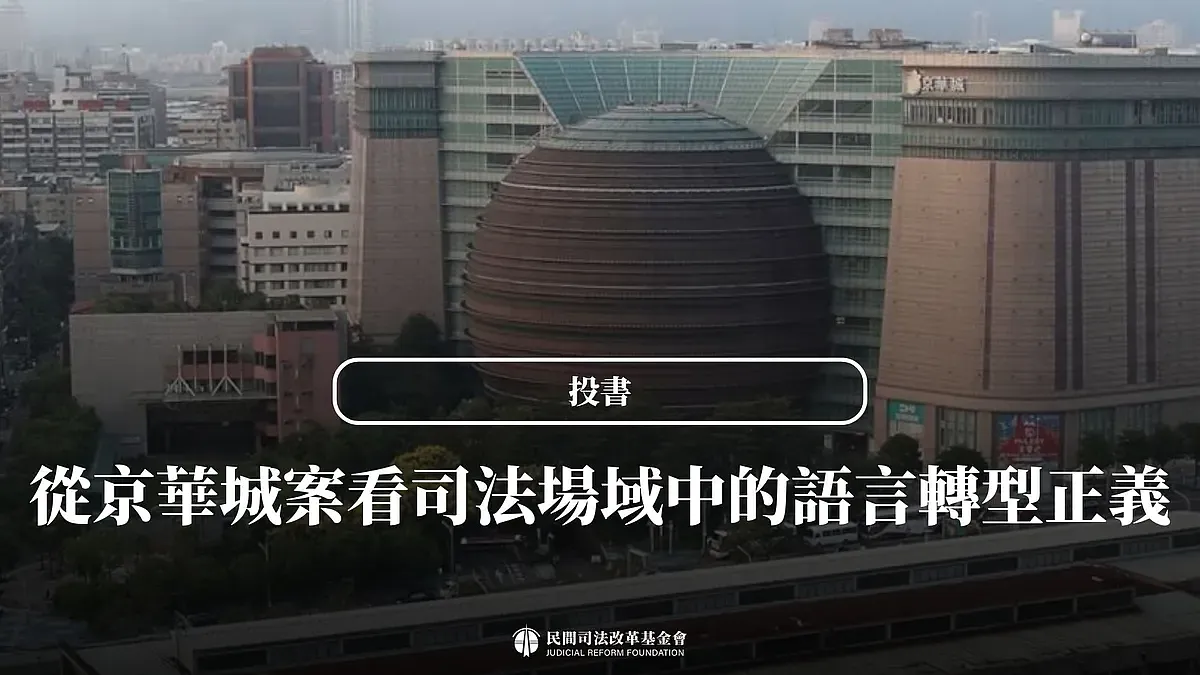
Op-Ed | Reflections on Linguistic Transitional Justice in the Judicial Sphere through the Core Pacific City Case
Last edited: 2026-08-23
Recently, the Taipei District Court has been trying the Core Pacific City corruption case, which has been mired in controversy from investigation to trial. In addition to sparking public doubts regarding the Taipei District Prosecutor's Office's violation of the principle of non-disclosure of investigations, the Taiwan People's Party (TPP) proposed amendments in the Legislative Yuan to delete the detention ground of "having a risk of colluding with accomplices or witnesses" as Ko Wen-je's detention approaches one year, causing an uproar in the legal community. Unexpectedly, during the recent review of the prosecution's interrogation recordings by the Taipei District Court, another controversy broke out: Did the prosecutor's use of Taiwanese during the interrogation violate the Court Organization Act?
According to reports, while playing the interrogation video in court, Sheen Ching-jing's defense attorney Hsu Lu-ping pointed out that prosecutor Lin Chun-yen questioned the witness Pong Cheng-sheng entirely in Taiwanese, arguing that this act violated Article 97 of the Court Organization Act, which stipulates that "the National Language shall be used for judicial trials." In response, public prosecutor Chiang Chang-chih countered by saying, "Do not discriminate against Taiwanese people's mother tongue," while Hsu Lu-ping clarified that he had no discriminatory intent and was merely asking the prosecutors to handle the case in accordance with the law.
However, Attorney Hsu's accusation of "illegality" overlooks the history of the promotion of linguistic transitional justice in Taiwan. Since Tsai Ing-wen was elected president in 2016, the Legislative Yuan successively passed the Indigenous Languages Development Act and the Development of National Languages Act in 2017 and 2018, respectively. Article 1 of the Indigenous Languages Development Act explicitly declares: "Indigenous languages are national languages," while Article 3 of the Development of National Languages Act further stipulates: "National languages refer to the natural languages used by the various indigenous groups of Taiwan and Taiwan Sign Language."
In other words, Taiwan's national languages should no longer be limited to Mandarin Chinese, but naturally include Taiwanese (Hokkien), Hakka, indigenous languages, Taiwanese Sign Language, and other natural languages used by various indigenous groups. Furthermore, Article 4 of the Development of National Languages Act also establishes anti-discrimination regulations: "National languages are all equal, and citizens shall not be discriminated against or restricted in their use of national languages."
In addition, pursuant to Article 13 of the Indigenous Languages Development Act, which provides that "When government agencies (institutions) handle administrative, legislative, and judicial proceedings, indigenous people may state their opinions in their indigenous languages, and the respective government agencies (institutions) shall hire interpreters for translation," and Article 11 of the Development of National Languages Act, which provides that "When citizens participate in administrative, legislative, and judicial proceedings of government agencies (institutions), they may use the national language of their choice," it is indicated that individuals have the right to choose to use their mother tongue when participating in administrative, legislative, and judicial proceedings, because these indigenous languages are also national languages.
Therefore, the provisions of the Court Organization Act regarding the "use of the National Language" should be interpreted in conjunction with the relevant provisions of the Indigenous Languages Development Act and the Development of National Languages Act, understanding "National Language" as "the natural languages used by the various indigenous groups of Taiwan and Taiwan Sign Language," rather than referring exclusively to Mandarin Chinese.
From this perspective, we believe that the prosecutor's use of Taiwanese to conduct the interrogation was not only lawful, but actively practiced Taiwan's linguistic transitional justice within the judicial sphere, reflecting on the historical process under the rule of the Japanese colonial government and the Kuomintang (KMT) regime—specifically how the "National Language Policy" suppressed and persecuted Taiwan's native languages, further causing the loss and decline of contemporary native languages.
Building upon this, we advocate that whether in the investigative court or the courtroom, as long as the parties are able to fully understand and communicate—such as through the interpretation and translation system under Article 98 of the Court Organization Act—everyone should be free to use the natural language of their indigenous group. Therefore, expanding the interpretation and understanding of "use the National Language" in the Court Organization Act is entirely acceptable.
Finally, we reiterate that, provided it does not disrupt courtroom order and the rights and interests of the parties involved, the expression of using native languages in the judicial sphere deserves to be emulated by more legal professionals.
※ This article was published in TaiSounds on 2025/08/29
This article is an AI-generated translation of the original Chinese text. In the event of any discrepancy, the Chinese version shall prevail.