
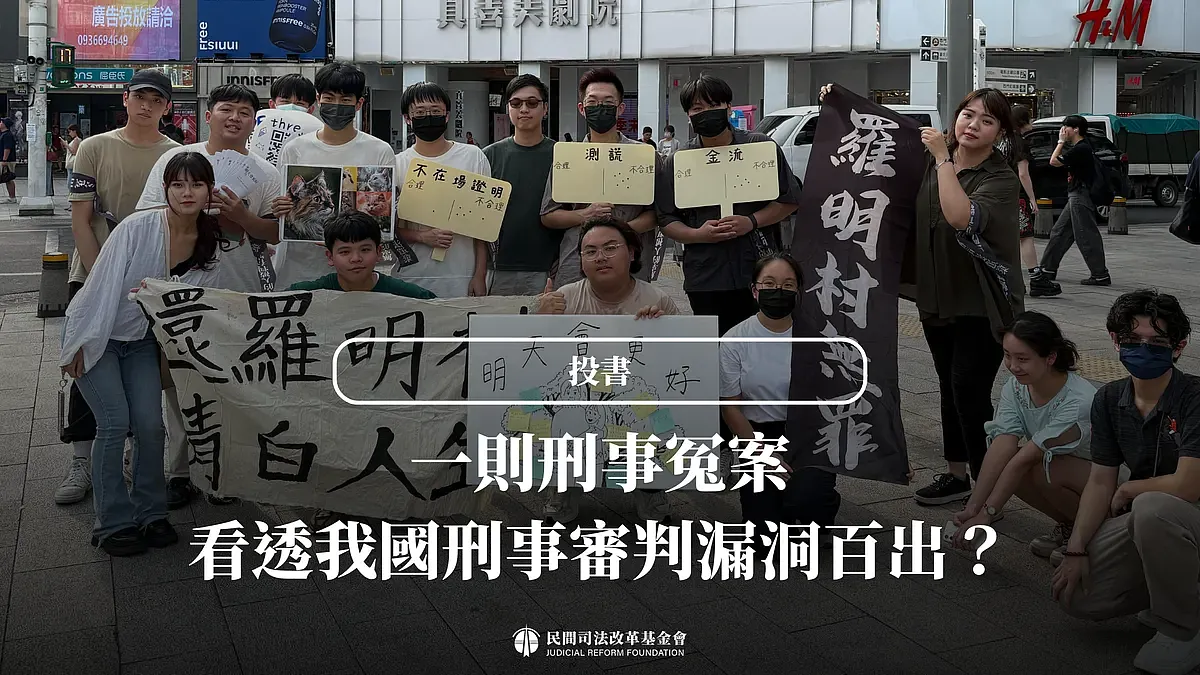
Op-Ed | A Criminal Miscarriage of Justice: Exposing the Loophole-Riddled Criminal Trial System in Taiwan?
Last edited: 2026-08-23
A seismograph of the Constitution / Applied constitutional law / Implementing legislation of the Constitution / The Great Charter of the rule of law...
The statements above appear on the back cover of a scholar's textbook on the Code of Criminal Procedure, conveying that as the procedural statute utilized by the state to prosecute crimes, the Code of Criminal Procedure is often the most direct test of whether a country's constitutional protection of human rights is being fulfilled. And when asked about Taiwan's "implementation record," the author believes that the "Lo Ming-ts'un case" may serve as one of the representative cases for examination.
I. Brief Overview of the "Lo Ming-ts'un Case"
Lo Ming-ts'un was originally a police officer who once served as the head of the Criminal Investigation Division of the Taipei County Sanchung Police Precinct (now New Taipei City Police Department Sanchung Precinct). Following two shooting incidents that occurred successively in Shulin, Taipei County in 1997, he participated in the investigative proceedings for both cases.
Unexpectedly, after the two shooting incidents (hereinafter referred to as the "prior case" and the "subsequent case") resulted in final convictions by the courts, Lo Ming-ts'un was inexplicably found to have accepted NT$500,000 in bribes in the prior case, and to have agreed to accept NT$500,000 in bribes while orchestrating a surrogate to take the blame for the actual perpetrator in the subsequent case, thus constituting the offenses of accepting bribes in breach of official duties and agreeing to accept bribes in breach of official duties, respectively.
II. What Flaws in Taiwan's Criminal Procedure Are Highlighted by the "Lo Ming-ts'un Case"?
Nevertheless, the Lo Ming-ts'un case contains numerous aspects worthy of discussion in terms of adjudication (such as the court's unwillingness to credit Lo Ming-ts'un's alibi, the inconsistent monetary amounts stated in witnesses' testimonies, and the use of coercive language by interrogators, etc.). However, as the purpose of this article is to examine issues at the level of the criminal justice system, the discussion will focus on systemic pathologies:
(1) Are "Polygraph" Results Reliable?
Influenced by many films, television shows, and animated works, many people may believe that "polygraphs" possess the capability to "accurately discern whether a subject is lying," and even consider this to be a form of "scientific evidence." But is this really the case?
According to literature, some studies suggest that the accuracy rate of polygraphs is as high as 98%, while other studies suggest an accuracy rate of only about 64%[1]. From this, we can understand that whether polygraphs are accurate in themselves is a highly controversial issue.
Consequently, under foreign legal systems, such as in the United States, federal courts and the majority of states rule that polygraph tests lack evidentiary capability (meaning they cannot be used as evidence to establish a defendant's guilt)[2], and the view of the Federal Constitutional Court of Germany is that polygraphs are fundamentally unsuitable as an "evidentiary method" in criminal trial proceedings[3].
In contrast, in Taiwan, because the Code of Criminal Procedure contains no explicit provisions on whether polygraphs can be used as criminal evidence, the courts hold divergent views on the matter, ranging from opinions that they must not be used as evidence, to conditional acceptance, or views that they cannot serve as the sole piece of evidence.
Returning to the Lo Ming-ts'un case, because Lo Ming-ts'un himself suffered from a heart-related condition (which could lead to inaccurate results from the instrument's use), he was nonetheless required to undergo a polygraph test. Moreover, during the test, Lo Ming-ts'un asked to stop due to physical discomfort; ultimately, however, polygraph charts were still produced, not to mention that the entire polygraph duration lasted a mere 29 minutes (polygraph tests should normally run from half an hour to two hours)[4].
Such an unscientific evidentiary method was originally stipulated in the Judicial Yuan's draft amendments last year (2024) not to be usable as "evidence for establishing criminal facts"; however, due to strong opposition from agencies such as the Ministry of Justice, the legislative amendments failed to pass. This has left one of the long-standing, unresolved problems in Taiwan's criminal justice system plagued by old malpractices.
(2) Flaws in Identification Procedures
"Identification" is frequently an investigative method in criminal proceedings that can assist investigative units in clarifying potential individuals involved in a case, and even peeling back the layers to uncover the true suspect. However, because human memory is sometimes not entirely accurate and is easily susceptible to suggestion, practical experience is rife with miscarriages of justice caused by mistaken identifications[5]. Therefore, "how to properly conduct an identification" to ensure its credibility is of paramount importance.
Nevertheless, a thorough search of Taiwan's Code of Criminal Procedure reveals no direct regulations regarding identifications; they are primarily governed by the non-statutory Directions for Police Agencies in Implementing the Identification of Criminal Suspects (hereinafter referred to as the Identification Directions). Within these Identification Directions, there are merely 10 brief points roughly prescribing basic operational requirements for identifications (for example, during photographic identifications, single photographs must not be provided for identification).
Compared to foreign legal systems, the United States has engaged in extensive legal discussions regarding identifications to prevent investigative coercion or procedural oversight in law enforcement, such as "whether counsel should be notified to be present during identifications"[6] and "further employing sequential lineups to increase the credibility of identifications"[7], among others. It is evident that Taiwan's measures for preventing errors in identifications are manifestly inadequate.
As for the Lo Ming-ts'un case, an interrogated person once stated during questioning that they could not recognize who Lo Ming-ts'un was, yet the investigator went so far as to prompt, "You can't recognize him? Lo Ming-ts'un looks just like me, doesn't he?", and even directly played a video clip asking, "Take a look at this video, does it remind you which one is Lo Ming-ts'un?" Yet, the court still admitted this identification as evidence[8].
(3) The Buck-Passing Between "Retrial" and "Extraordinary Appeal"
Currently, under Taiwan's criminal procedures, if parties believe that a final judgment requires relief and overturning, they may respectively petition for a "retrial" or file an "extraordinary appeal." The distinction between the two is that a "retrial" targets "errors in the determination of facts" in the original judgment, whereas an "extraordinary appeal" targets "errors in the application of law." Furthermore, petitioning for a retrial requires applying to the court, whereas filing an "extraordinary appeal" requires petitioning the Prosecutor-General to initiate it.
In fact, distinguishing whether a specific case dispute truly belongs to an "error in the determination of facts" or an "error in application of the law" is not always easy. This also leads to a situation where, if agencies determine that the problem in a specific case does not fall under their own institutional jurisdiction to handle, they will pass the case back and forth to each other. Some scholars have compared this phenomenon of "agencies instructing parties to seek relief from other agencies" to a "phantom directive" offering no actual avenues for relief[9].
The phenomenon of agencies passing the buck was present in the prior proceedings of the Lo Ming-ts'un case. When Lo Ming-ts'un made more than 40 requests for the Prosecutor-General to file an extraordinary appeal, they were all rejected on the grounds that: "Lo Ming-ts'un should petition the court for a retrial, not an extraordinary appeal." Conversely, the court dismissed Lo Ming-ts'un's petition for a retrial on the grounds that: "The prosecutor's appeal was filed past the statutory deadline; by law, an extraordinary appeal should be requested from the Prosecutor-General." This highlights the absurdity of such a dual-track relief mechanism resulting in no relief whatsoever.
Conclusion
Readers reaching this point may wonder why Taiwan's criminal justice system suffers from so many flaws, and why an outstanding police officer like Lo Ming-ts'un was driven to utter such heartbreaking words: "My whole life has been spent defending the country and the people, but the judiciary has abandoned me."
The author believes that the causes of this problem are far too diverse and complex to be attributed in a simplistic manner. However, if there is any aspiration regarding the current state of affairs, the author will use Mr. Lo Ming-ts'un's words as the final footnote to this article: "My life has already been ruined because of this. I only hope that I will be the last person, and that there will never be another Lo Ming-ts'un."
[1] See: Wang Jaw-perng, Chang Ming-wei, and Lee Rong-geng, co-authors, Code of Criminal Procedure (Part II), 2023 ed., p. 553. / Wang Jaw-perng, <Re-thinking the Evidentiary Capability of Polygraphs>, The Taiwan Law Review, No. 135, July 2006, pp. 137-138.
[2] Wang Jaw-perng, <Re-thinking the Evidentiary Capability of Polygraphs>, The Taiwan Law Review, No. 135, July 2006, p. 143.
[3] Yang Yun-hua, <Selected Review of Important Practical Opinions on Criminal Evidence in Recent Years—Retroactivity of Procedural Law and the Evidentiary Capability of Polygraph Results>, The Taiwan Law Education, No. 40, February 2006, pp. 50-51.
[4] This grave flaw in the polygraph results was later recognized by the Supreme Court upon appeal in the "subsequent case" of the Lo Ming-ts'un proceedings, which held that the polygraph test in question should be excluded as evidence (though, combining other evidence, the court still concluded that Lo Ming-ts'un had agreed to accept bribes).
[5] A classic case in Taiwan's judicial history is the 1995 "Taxi Wolf" case.
[6] See: Chin Meng-hua, <Constructing Evaluative Methods for Identification Evidence in Taiwan Through Psychological Research>, Academia Sinica Law Journal, No. 13, September 2013, p. 289. / Fu Mei-hui, <A Preliminary Discussion on the Construction of Identification Jurisprudence in Criminal Proceedings>, Aletheia Law Review, Vol. 22, March 2018, p. 13.
[7] See: Wang Jaw-perng, Chang Ming-wei, and Lee Rong-geng, co-authors, Code of Criminal Procedure (Part II), 2023 ed., p. 383.
[8] In fact, the Identification Directions stipulate: "4. Prior to identification, no suggestive or directive instructions or information shall be provided to the identifier, and the identifier shall be informed that the criminal suspect may not necessarily be among the persons presented for identification." However, the court opted to admit the evidentiary force of the identification on the grounds that "surveillance cameras and audio recordings did not capture this."
[9] Lin Yu-hsiung, <Loopholes and Remediation in Taiwan's Extraordinary Criminal Relief System—With a Commentary on Cheng Hsing-tse's Retrial Petition Case>, Taiwan Law Journal, No. 223, May 2013, pp. 98-114.
*This article was published in Up Media on Sept. 12, 2025
Unexpectedly, after the two shooting incidents (hereinafter referred to as the "prior case" and the "subsequent case") resulted in final convictions by the courts, Lo Ming-ts'un was inexplicably found to have accepted NT$500,000 in bribes in the prior case, and to have agreed to accept NT$500,000 in bribes while orchestrating a surrogate to take the blame for the actual perpetrator in the subsequent case, thus constituting the offenses of accepting bribes in breach of official duties and agreeing to accept bribes in breach of official duties, respectively.
II. What Flaws in Taiwan's Criminal Procedure Are Highlighted by the "Lo Ming-ts'un Case"
Nevertheless, the Lo Ming-ts'un case contains numerous aspects worthy of discussion in terms of adjudication (such as the court's unwillingness to credit Lo Ming-ts'un's alibi, the inconsistent monetary amounts stated in witnesses' testimonies, and the use of coercive language by interrogators, etc.). However, as the purpose of this article is to examine issues at the level of the criminal justice system, the discussion will focus on systemic pathologies:
(1) Are "Polygraph" Results Reliable?
Influenced by many films, television shows, and animated works, many people may believe that "polygraphs" possess the capability to "accurately discern whether a subject is lying," and even consider this to be a form of "scientific evidence." But is this really the case?
According to literature, some studies suggest that the accuracy rate of polygraphs is as high as 98%, while other studies suggest an accuracy rate of only about 64%[1]. From this, we can understand that whether polygraphs are accurate in themselves is a highly controversial issue. Consequently, under foreign legal systems, such as in the United States, federal courts and the majority of states rule that polygraph tests lack evidentiary capability (meaning they cannot be used as evidence to establish a defendant's guilt)[2], and the view of the Federal Constitutional Court of Germany is that polygraphs are fundamentally unsuitable as an "evidentiary method" in criminal trial proceedings[3].
In contrast, in Taiwan, because the Code of Criminal Procedure contains no explicit provisions on whether polygraphs can be used as criminal evidence, the courts hold divergent views on the matter, ranging from opinions that they must not be used as evidence, to conditional acceptance, or views that they cannot serve as the sole piece of evidence.
Returning to the Lo Ming-ts'un case, because Lo Ming-ts'un himself suffered from a heart-related condition (which could lead to inaccurate results from the instrument's use), he was nonetheless required to undergo a polygraph test. Moreover, during the test, Lo Ming-ts'un asked to stop due to physical discomfort; ultimately, however, polygraph charts were still produced, not to mention that the entire polygraph duration lasted a mere 29 minutes (polygraph tests should normally run from half an hour to two hours)[4].
Such an unscientific evidentiary method was originally stipulated in the Judicial Yuan's draft amendments last year (2024) not to be usable as "evidence for establishing criminal facts"; however, due to strong opposition from agencies such as the Ministry of Justice, the legislative amendments failed to pass. This has left one of the long-standing, unresolved problems in Taiwan's criminal justice system plagued by old malpractices.
(2) Flaws in Identification Procedures
"Identification" is frequently an investigative method in criminal proceedings that can assist investigative units in clarifying potential individuals involved in a case, and even peeling back the layers to uncover the true suspect. However, because human memory is sometimes not entirely accurate and is easily susceptible to suggestion, practical experience is rife with miscarriages of justice caused by mistaken identifications[5]. Therefore, "how to properly conduct an identification" to ensure its credibility is of paramount importance.
Nevertheless, a thorough search of Taiwan's Code of Criminal Procedure reveals no direct regulations regarding identifications; they are primarily governed by the non-statutory Directions for Police Agencies in Implementing the Identification of Criminal Suspects (hereinafter referred to as the Identification Directions). Within these Identification Directions, there are merely 10 brief points roughly prescribing basic operational requirements for identifications (for example, during photographic identifications, single photographs must not be provided for identification).
Compared to foreign legal systems, the United States has engaged in extensive legal discussions regarding identifications to prevent investigative coercion or procedural oversight in law enforcement, such as "whether counsel should be notified to be present during identifications"[6] and "further employing sequential lineups to increase the credibility of identifications"[7], among others. It is evident that Taiwan's measures for preventing errors in identifications are manifestly inadequate.
As for the Lo Ming-ts'un case, an interrogated person once stated during questioning that they could not recognize who Lo Ming-ts'un was, yet the investigator went so far as to prompt, "You can't recognize him? Lo Ming-ts'un looks just like me, doesn't he?", and even directly played a video clip asking, "Take a look at this video, does it remind you which one is Lo Ming-ts'un?" Yet, the court still admitted this identification as evidence[8].
(3) The Buck-Passing Between "Retrial" and "Extraordinary Appeal"
Currently, under Taiwan's criminal procedures, if parties believe that a final judgment requires relief and overturning, they may respectively petition for a "retrial" or file an "extraordinary appeal." The distinction between the two is that a "retrial" targets "errors in the determination of facts" in the original judgment, whereas an "extraordinary appeal" targets "errors in the application of law." Furthermore, petitioning for a retrial requires applying to the court, whereas filing an "extraordinary appeal" requires petitioning the Prosecutor-General to initiate it.
In fact, distinguishing whether a specific case dispute truly belongs to an "error in the determination of facts" or an "error in application of the law" is not always easy. This also leads to a situation where, if agencies determine that the problem in a specific case does not fall under their own institutional jurisdiction to handle, they will pass the case back and forth to each other. Some scholars have compared this phenomenon of "agencies instructing parties to seek relief from other agencies" to a "phantom directive" offering no actual avenues for relief[9].
The phenomenon of agencies passing the buck was present in the prior proceedings of the Lo Ming-ts'un case. When Lo Ming-ts'un made more than 40 requests for the Prosecutor-General to file an extraordinary appeal, they were all rejected on the grounds that: "Lo Ming-ts'un should petition the court for a retrial, not an extraordinary appeal." Conversely, the court dismissed Lo Ming-ts'un's petition for a retrial on the grounds that: "The prosecutor's appeal was filed past the statutory deadline; by law, an extraordinary appeal should be requested from the Prosecutor-General." This highlights the absurdity of such a dual-track relief mechanism resulting in no relief whatsoever.
Conclusion
Readers reaching this point may wonder why Taiwan's criminal justice system suffers from so many flaws, and why an outstanding police officer like Lo Ming-ts'un was driven to utter such heartbreaking words: "My whole life has been spent defending the country and the people, but the judiciary has abandoned me."
The author believes that the causes of this problem are far too diverse and complex to be attributed in a simplistic manner. However, if there is any aspiration regarding the current state of affairs, the author will use Mr. Lo Ming-ts'un's words as the final footnote to this article: "My life has already been ruined because of this. I only hope that I will be the last person, and that there will never be another Lo Ming-ts'un."
[1] See: Wang Chao-peng, Chang Ming-wei, and Li Jung-keng, co-authors, Code of Criminal Procedure (Part II), 2023 ed., p. 553. / Wang Chao-peng, <Re-thinking the Evidentiary Capability of Polygraphs>, The Taiwan Law Review, No. 135, July 2006, pp. 137-138.
[2] Wang Chao-peng, <Re-thinking the Evidentiary Capability of Polygraphs>, The Taiwan Law Review, No. 135, July 2006, p. 143.
[3] Yang Yün-hua, <Selected Review of Important Practical Opinions on Criminal Evidence in Recent Years—Retroactivity of Procedural Law and the Evidentiary Capability of Polygraph Results>, The Taiwan Law Education, No. 40, February 2006, pp. 50-51.
[4] This grave flaw in the polygraph results was later recognized by the Supreme Court upon appeal in the "subsequent case" of the Lo Ming-ts'un proceedings, which held that the polygraph test in question should be excluded as evidence (though, combining other evidence, the court still concluded that Lo Ming-ts'un had agreed to accept bribes).
[5] A classic case in Taiwan's judicial history is the 1995 "Taxi Wolf" case.
[6] See: Chin Meng-hua, <Constructing Evaluative Methods for Identification Evidence in Taiwan Through Psychological Research>, Academia Sinica Law Journal, No. 13, September 2013, p. 289. / Fu Mei-hui, <A Preliminary Discussion on the Construction of Identification Jurisprudence in Criminal Proceedings>, Aletheia Law Review, Vol. 22, March 2018, p. 13.
[7] See: Wang Chao-peng, Chang Ming-wei, and Li Jung-keng, co-authors, Code of Criminal Procedure (Part II), 2023 ed., p. 383.
[8] In fact, the Identification Directions stipulate: "4. Prior to identification, no suggestive or directive instructions or information shall be provided to the identifier, and the identifier shall be informed that the criminal suspect may not necessarily be among the persons presented for identification." However, the court opted to admit the evidentiary force of the identification on the grounds that "surveillance cameras and audio recordings did not capture this."
[9] Lin Yu-hsiung, <Loopholes and Remediation in Taiwan's Extraordinary Criminal Relief System—With a Commentary on Cheng Hsing-tse's Retrial Petition Case>, Taiwan Law Journal, No. 223, May 2013, pp. 98-114.
*This article was published in Up Media on Sept. 12, 2025
This article is an AI-generated translation of the original Chinese text. In the event of any discrepancy, the Chinese version shall prevail.