
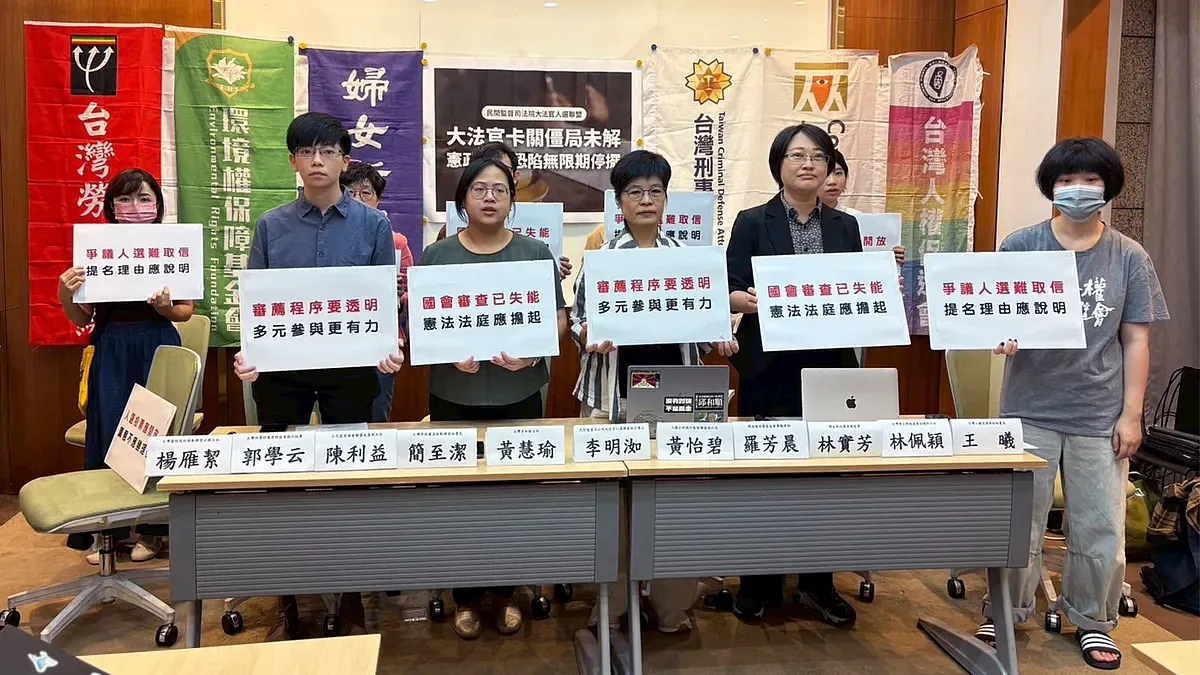
Press Release | Impasse Over Grand Justices Unresolved, Constitutional Order Faces Risk of Indefinite Paralysis
Last edited: 2026-08-23
Following the opposition alliance's joint passage of the amendments to the Constitutional Court Procedure Act, which took effect on January 25, 2025, the Constitutional Court has been paralyzed for 235 days. After the Legislative Yuan voted down the nominees for Grand Justices on July 25 of this year, the impasse remains unresolved, and the prospect of the Constitutional Court filling its vacancies and resuming normal operations appears indefinitely distant.
To maintain the normal operation of our constitutional order, the Alliance for Citizen Monitoring of Judicial Yuan Grand Justice Nominees issues the following statement:
1. The Constitutional Court should expeditiously hear the case concerning the Constitutional Court Procedure Act to resolve the constitutional impasse.
2. The President should enhance the transparency and participation of the screening process to garner broader social support.
3. The Legislative Yuan should conduct rational reviews and refrain from using Grand Justices as sacrifices for partisan confrontation.
1. The Constitutional Court should expeditiously hear the case concerning the Constitutional Court Procedure Act to resolve the constitutional impasse
Since the paralysis of the Constitutional Court began, various sectors of society have held differing opinions on whether the Constitutional Court, currently composed of 8 Grand Justices, can still function and render judgments. Examining the opinions of the legal academic community, while acknowledging concerns regarding insufficient personnel and legitimate doubts, mainstream opinion still holds that, in light of principles such as the "uninterrupted exercise of powers by constitutional organs," the Constitutional Court is not inherently restricted by the unreasonable provisions of the new Constitutional Court Procedure Act. However, after holding a public briefing on May 12 of this year, the Grand Justices have remained silent until now.
Although legal reasoning has not changed drastically, given the prolonged paralysis of the Constitutional Court and the reality that the appointment of new Grand Justices remains remote, we believe the Constitutional Court not only "must respond" but also bears the responsibility to promptly review the Constitutional Court Procedure Act case with its existing members in order to address the constitutional impasse.
Observing the previous two processes for exercising the consent power regarding Grand Justice nominees, it is evident that certain candidates actually received affirmation from the opposition alliance. Many nominees with backgrounds as judges or prosecutors were not even subjected to questions regarding their suitability. Nevertheless, the result of the exercise of the consent power was opposition from the opposition alliance without reason. Even more absurdly, ruling party legislators—belonging to the same party as the President—actually moved to block candidates who might have been supported and passed by the opposition alliance, thereby ensuring that no nominees would pass.
This political impasse points to a single fact: the opposition alliance does not wish to see a Constitutional Court capable of checking the Legislative Yuan operate normally. From this perspective, whether a nominee "supports the abolition of the death penalty" or has a "distinct political stance" are merely superficial reasons. As long as the Constitutional Court remains unable to fulfill its constitutional function of monitoring and checking the legislative and executive powers, the most effective way for the opposition alliance to evade oversight is to categorically block all Grand Justice nominees. In short, the fact that the Constitutional Court is paralyzed actually provides the opposition alliance with the incentive to continue blocking nominations. On the other hand, to avoid the side effects of a small number of nominees passing, the ruling party has also chosen to engage in strategic blocking. Under such an environment, no matter how exceptional a nominee may be, they cannot pass through the Legislative Yuan.
Precisely because of this, there is no other choice to resolve this impasse of a paralyzed constitutional organ than for the Constitutional Court to shoulder the responsibility and respond, so that it may have a chance to resume its function of monitoring and checking under the principle of the separation of powers. Otherwise, the Constitutional Court is likely to face an endless paralysis over the next three years.
2. The President should enhance the transparency and participation of the screening process to garner broader social support
In the past, the list of Grand Justice nominees put forward by the President was compiled by a review committee composed of the Vice President and four to five former Grand Justices or heavyweights from the legal community, who publicly solicited recommendations from all sectors before proposing a list of nominees to the President. Although the members serving on the review committee possess profound seniority, they inevitably exhibit higher homogeneity due to their professional backgrounds and generations. Among the members of the 2014 review committee (translator's note: referring to the Republic of China calendar year 113), aside from Vice President Hsiao Bi-khim, all other members were male.
Given that the personnel appointments for Grand Justices have stalled twice and the impasse remains unresolved, we expect that during the screening procedure, the size of the review committee should be expanded and more diverse representatives should be included, thereby further enhancing the transparency and reasoning of the screening process and winning broader social support.
Although the President holds the nomination power for Grand Justices, we believe President Lai Ching-te should provide a more thorough explanation for the nomination reasons, particularly clarifying the choices for the President and Vice President. Especially during the first two Grand Justice nomination procedures, there was no shortage of highly controversial nominees for President and Vice President (such as Mr. Yao Li-ming, who possesses a heavier political color, and Mr. Tsai Chiu-ming, who comes from a prosecutor background), which has led to intense public questioning of the President's motives and reasons for nominating these individuals. However, regarding these controversies and doubts, neither President Lai nor the Presidential Office has ever provided a sufficiently thorough explanation to address external concerns and misgivings.
In this regard, this Alliance calls upon President Lai Ching-te to more actively and exhaustively explain the reasons for his nominations in order to secure greater social support, as the President and Vice President of the Judicial Yuan are heads of organs possessing significant powers under the separation of powers, and external observers will heavily scrutinize the suitability of these nominees.
3. The Legislative Yuan should conduct rational reviews and refrain from using Grand Justices as sacrifices for partisan confrontation
Regarding these two personnel consent bills for Grand Justices, various party caucuses in the Legislative Yuan cast collective votes for individual candidates through "bloc voting" methods, and even resorted to the most severe measure of "expulsion from the party for defecting on a vote." Clearly, what legislators are currently considering in their votes is not the suitability of the candidates, but rather submission to partisan will under vicious competition.
To address this, first, when implementing written inquiries, party caucuses should not only require nominees to clearly explain their constitutional and human rights philosophies prior to the review, but should also publicly release the nominees' responses together upon receiving the questionnaires, allowing the public to understand the quality of questioning and answering between "caucus inquiries" and "nominee responses"; second, the Legislative Yuan should invite nominees to attend public hearings to undergo scrutiny by civil society groups and experts; third, the inquiry procedure should be thoroughly overhauled to avoid wasted time and fragmented answers; finally, various parties should clearly state their voting reasons and standards to implement responsible politics, rather than prioritizing party will.
We sincerely appeal that the nomination and review of the next wave of Grand Justice personnel consent powers should take reference from this Alliance's recommendations, conducting a comprehensive prior review of the perfunctory screening procedures of the past; furthermore, various party caucuses should allow legislators free votes and thoroughly examine the nominees' moral character, constitutional and human rights philosophies, as well as their scholarship and professionalism, and must not repeat past mistakes by allowing the constitutional rights of the people to continue being held hostage by partisan will.
Press Conference Time
Wednesday, September 17, 2025, 10:00 AM
Press Conference Location
Room 101, Legislative Yuan Researcher Building (Chung-Hsing Building), No. 3-1, Sec. 1, Jinan Rd., Zhongzheng Dist., Taipei City
Attendees
Lee Ming-ju | Deputy Convenor, Alliance for Citizen Monitoring of Judicial Yuan Grand Justice Nominees; Deputy Executive Director, Judicial Reform Foundation
Huang Yi-bi | Executive Director, Covenants Watch
Chien Chih-chieh | Secretary-General, Taiwan Alliance to Promote Civil Partnership Rights
Lin Shih-fang | Supervisor, Awakening Foundation
Wang Hsi | Deputy Secretary-General, Taiwan Association for Human Rights
Lin Pei-ying | Director of Advocacy Department, Taiwan Labor Front
Chen Li-yi | Director of Policy Department, Citizen Congress Watch
Yang Yen-chieh | Legal Director, Taiwan Alliance to End the Death Penalty
Huang Hui-yu | Deputy Director, Taiwan Forever Association
Lo Fang-chen | Staff Attorney, Environmental Jurists Association
Kuo Hsueh-yun | Executive Secretary, Taiwan Association of Criminal Defense Lawyers
Press Contact
Attorney Lu Cheng-yen, Executive Secretary, Alliance for Citizen Monitoring of Judicial Yuan Grand Justice Nominees
Phone: 02-2523-1178#37
Email: elvin@jrf.org.tw
This article is an AI-generated translation of the original Chinese text. In the event of any discrepancy, the Chinese version shall prevail.