
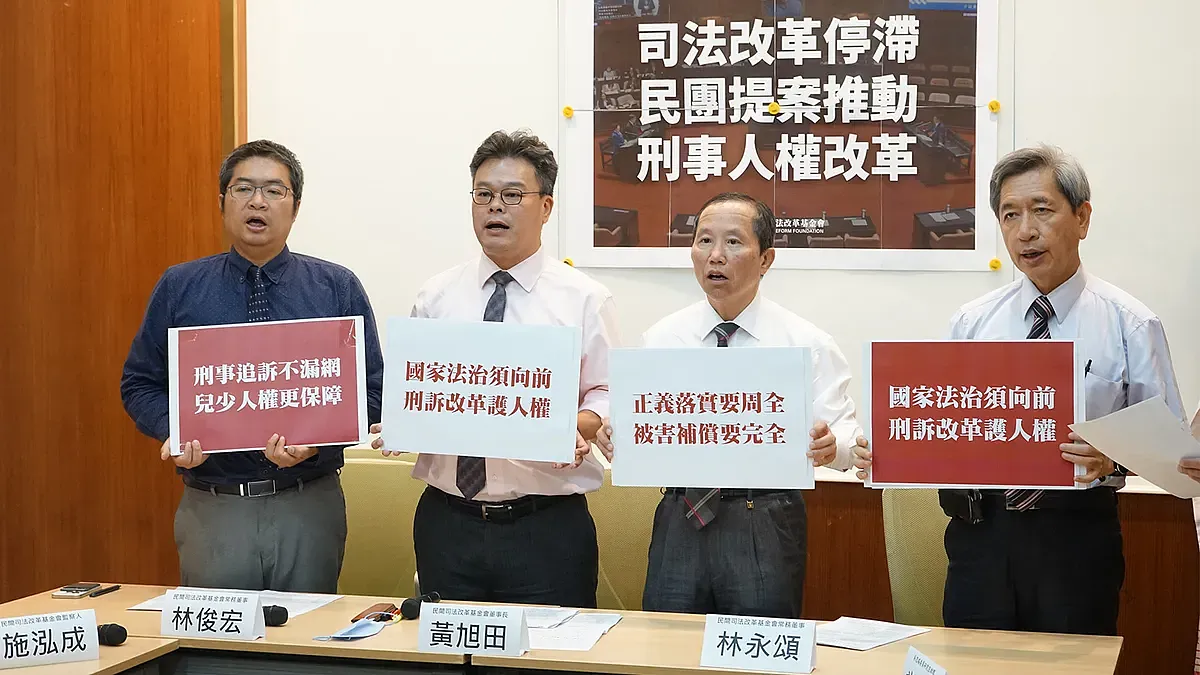
Press Release | Judicial Reform Stagnant: Civil Society Groups Propose Criminal Human Rights Reforms
Last edited: 2026-08-23
This month marks the opening of the new legislative session of the Legislative Yuan, the fourth session since President Lai Ching-te took office. Since President Lai assumed office, the Executive Yuan has not proactively proposed bills or plans for judicial reform. As for the Judicial Yuan, active measures have been lacking due to consecutive boycotts against the nominee for the new President. Conversely, the Public Interest Whistleblower Protection Act was finally passed this year under the leadership of the opposition parties; although there was insufficient discussion during the legislative process, the ruling party's assertions that the bill "should be thoroughly studied" and "should not be legislated hastily" ring hollow against the backdrop of this law being delayed for more than a decade.
Our Foundation believes that the ruling party holds administrative resources and bears the inescapable, primary responsibility for advancing judicial reform. Regardless of whether the ruling party holds a majority in the Legislative Yuan, there remains ample room for action on issues such as alleviating judicial burnout and protecting crime victims. However, over the past year and more in power, we have not seen the Lai Ching-te administration reflect deeply or put forth a vision for judicial reform and human rights protection.
Of course, judicial reform is the responsibility of the government rather than the exclusive domain of the ruling party. Therefore, we have compiled the "Criminal Human Rights Bills" that our Foundation has focused on in recent years. These encompass directions such as safeguarding the criminal human rights of defendants, protecting crime victims, prohibiting torture, reforming forensic science, and implementing the principle of non-publicity of investigations. We urge various party caucuses and legislators in the Legislative Yuan to reference these civil society proposals and continue advancing judicial reform. We propose the following 6 reform recommendations:
1. Amend the Code of Criminal Procedure to defend criminal justice human rights
2. Extend the statute of limitations for defendants of sexual offenses against minors
3. Review the limitation period for claiming "crime victim compensation" to rectify past overly harsh errors
4. Implement the principle of non-publicity of investigations and thoroughly hold accountable the leakage of investigative information
5. Pass the Enforcement Act of the Convention Against Torture and Other Cruel, Inhuman or Degrading Treatment or Punishment and Its Optional Protocol to actively prevent state and police violence
6. Establish a "National Forensic Science Commission" to address deficiencies in forensic science
1. Amend the Code of Criminal Procedure to defend criminal justice human rights
Civil Society Draft of the Code of Criminal Procedure
Whenever major criminal cases hit the media, they spark discussions regarding searches and interrogations. Particularly during the defense-prosecution sparring process, discussions and controversies surrounding the methods used by prosecutors and investigators are frequent occurrences.
In fact, controversies surrounding search and interrogation procedures and the resulting doubts regarding the protection of defendants' rights to a defense do not occur solely in high-profile cases, but are part of an ongoing "investigative routine." We believe this not only fails to adequately protect defendants' rights, but also damages the credibility of investigative agencies through repeated reporting, ultimately evolving into skepticism toward the entire judicial procedure.
In response, after consulting experts, attorneys, and scholars, the Judicial Reform Foundation has proposed legislative recommendations and a complete civil society draft covering five major directions: (1) human rights protections in investigative procedures; (2) defendants' right to counsel; (3) special compulsory measures (technological investigation); (4) translation of judicial documents; and (5) the criminal forensic science system. We hope to resolve and clarify several common procedural issues and improve the protection of human rights for criminal defendants.
As for the "detention system," which has recently received significant social attention, we are also stepping up the drafting of our civil society reform proposal, which we will publicize upon completion to seek guidance from all sectors of society and promote discussion.
2. Extend the statute of limitations for defendants of sexual offenses against minors
Civil Society Draft of the Criminal Code and the Enforcement Act of the Criminal Code
Meanwhile, following repeated calls for legal amendments by civil society groups and legislators, the Ministry of Justice finally announced a draft amendment regarding this issue on August 12 of this year. Our Foundation also deliberated on a civil society draft concerning this topic and advocates for expanding the scope of protection. In the draft amendment proposed by the Ministry of Justice, the types of offenses for which the limitation period is excluded until the victim reaches adulthood are "offenses under Articles 221 to 227, 228, 229, Paragraph 2, Subparagraph 2 of Article 332, Paragraph 2, Subparagraph 2 of Article 334, and Paragraph 2, Subparagraph 1 of Article 348" (meaning the definition of "sexual assault crimes" under Article 2 of the Crime Victim Rights Protection Act).
However, we believe that in addition to the aforementioned cases, crimes under the Child and Youth Sexual Exploitation Prevention Act that force children or youths into sexual intercourse or obscenity with others should also have their statute of limitations extended (for details, see our Foundation's statement of August 27, 2025).
Simultaneously, regarding cases where the limitation period had not expired in the past, the Ministry of Justice draft holds that provisions regarding the "most favorable to the perpetrator (i.e., the defendant)" between the old and new laws should apply pursuant to Paragraph 1 of Article 8-1. Nevertheless, we believe that for cases where the "limitation period is ongoing but unexpired" in this legislative amendment, the calculation of the limitation period should be governed by the amended new law.
The purpose of this legislative amendment is to consider that when children or youths suffer from sexual assault or obscenity, they may not realize at the time that they are being violated, or may face ignorance or other factors making it difficult to exercise their rights, thus rendering them unable to pursue legal action for the sexual crimes they suffered, resulting in the statute of limitations expiring by the time they bring legal action years later. To thoroughly fulfill the legislative purpose of this amendment, cases whose statute of limitations has not yet expired after the implementation of this amendment should be governed by the amended limitation provisions.
3. Review the limitation period for claiming "crime victim compensation" to rectify past overly harsh errors
Civil Society Draft of the Crime Victim Rights Protection Act
Before and after the amendments to the Crime Victim Rights Protection Act, victims or the families of deceased victims who suffered death, severe injury, or sexual assault due to crimes could legally claim compensation from the state. However, such claims must be made within a certain period after knowing about the incident; otherwise, compensation will be denied. This "certain period" was 2 years under the old law and is 5 years under the current law. Furthermore, regardless of the circumstances, once 5 years have passed (10 years under the new law), compensation is entirely barred.
In contrast, the aforementioned "statute of limitations for criminal prosecution" of serious crimes spans 20, 30 years, or more. As long as it has not expired, victims may file complaints with prosecutors, who can then investigate, prosecute, and convict the perpetrator.
Consequently, a highly contradictory scene emerges: A victim files a criminal complaint with the prosecutor at the district prosecutors office, and the prosecutor concludes that a crime has been committed and indicts the defendant. However, because the limitation period for compensation is significantly shorter, if the victim applies for compensation relatively late, the compensation review committee of the very same district prosecutors office will deny compensation entirely. In practice, sexual assault victims who have been denied compensation due to this are not isolated cases (for details, see our Foundation's press release of March 21, 2025).
Regarding such an outcome, some might say: "The victim let their rights sleep." Yet, why can the government not provide more conscientious care for victims or deceased families who suddenly suffer major crimes? Why is it not the "legally savvy" state that assists every victimized citizen experiencing major trauma? Is it the victim who fell asleep, or the government that failed in its duty of care?
We believe the Crime Victim Rights Protection Act should be amended once again:
- For cases concluded by prosecutors determining that a crime has been committed against the victim, the time limit for claiming compensation should be correspondingly relaxed.
- Remedial measures should be legislated for victims who were previously denied compensation on this basis.
4. Implement the principle of non-publicity of investigations and thoroughly hold accountable the leakage of investigative information across 5 major directions
When major criminal cases occur, especially when involved individuals include politicians and celebrities, investigative information that ought not to be made public can frequently be seen circulating widely in the media. The chaotic situation of the massive public disclosure of investigations in the Ko Wen-je case last year was utterly absurd. However, regarding our Foundation's 9 questions, relevant agencies have yet to respond, and the High Prosecutors Office has had no follow-up after the Supreme Prosecutors Office referred the matter to them for clarification.
Adherence to the principle of non-publicity of investigations concerns the fundamental human rights of defendants and public trust in the judiciary, yet today it can be said to exist in name only. To address this, we propose the following 5 major directions to help ensure that this principle is effectively implemented
- Investigative agencies must establish a spokesperson system, and all press releases must be issued through this system. Case handlers and judicial police personnel must not arbitrarily contact news media or release information.
- An independent and impartial third-party investigative body should be established to handle investigations and determinations regarding violations of the principle of non-publicity of investigations, and to receive complaints from injured individuals.
- If case contents during the investigative stage are reported by news media without being released via the spokesperson system, and it is discernible during the court's first-instance public trial stage that the reports match the investigative findings, it shall be presumed that the investigative process violated the principle of non-publicity of investigations.
- Where cases handled by investigative agencies violate the principle of non-publicity of investigations, the supervisory responsibility of the agency head shall be held accountable.
- In state compensation cases arising from state agencies violating the principle of non-publicity of investigations, the burden of proof for the plaintiff (i.e., the injured individual) should be appropriately alleviated, and a punitive damages system should be introduced.
5. Pass the Enforcement Act of the Convention Against Torture and Other Cruel, Inhuman or Degrading Treatment or Punishment and Its Optional Protocol to actively prevent state and police violence
Torture is the most cruel and degrading act against human dignity that a member of human society can inflict upon another. Society as a whole should collectively support victims of torture and work together to ensure no one is subjected to such treatment. Torture is not merely a thing of the past in Taiwan; an investigative report published by the Control Yuan in September 2023 pointed out that the Taipei Prison was allegedly involved in illegally abusing and torturing inmates, which not only violated the domesticated International Covenant on Civil and Political Rights, but also breached the Convention against Torture and Other Cruel, Inhuman or Degrading Treatment or Punishment, which still awaits passage by the Legislative Yuan.
Furthermore, the Convention against Torture and Other Cruel, Inhuman or Degrading Treatment or Punishment is designed to protect not only inmates; young children, students, persons with disabilities, and institutional residents may all face mistreatment and thus require a more comprehensive system for protection.
The Legislative Yuan received the draft Enforcement Act of the Convention Against Torture and Other Cruel, Inhuman or Degrading Treatment or Punishment and Its Optional Protocol submitted by the Executive Yuan in 2018 and 2020 respectively, but both failed to undergo deliberation and discussion, ending due to the "rule of lapse." We urge legislators to promptly propose and enact the Enforcement Act of the Convention Against Torture and Other Cruel, Inhuman or Degrading Treatment or Punishment and Its Optional Protocol, and to construct a more comprehensive system based thereon. This includes establishing a clear crime of torture, regulating "cruel, inhuman, or degrading treatment or punishment," strengthening the investigation and prosecution of the crime of torture, and setting up a "National Preventive Mechanism against Torture" to prevent systemic human rights violations through mechanisms such as regular and irregular visits.
6. Establish a "National Forensic Science Commission" to address deficiencies in forensic science
Civil Society Draft of the Organic Act of the National Forensic Science Commission
Currently, our country's forensic practice lacks uniform scientific standards and methods, as well as a unified laboratory accreditation system. Consequently, severe errors still occur, such as the "2020 Kaohsiung Medical University Drug Testing Incident," which involved widespread erroneous testing of emerging drugs. The subsequent labor, time, and costs required for a special investigative team to review related cases, resend samples for testing as appropriate, file for retrials, and conduct new proceedings were eventually expended to return rightful judgments to numerous defendants.
To prevent such problems from recurring, improving the forensic science system is the most vital foundation. Pursuant to the resolutions of the "2016 National Congress on Judicial Reform," cross-ministerial and cross-agency resources between the Executive Yuan and Judicial Yuan should be integrated to establish a "National Forensic Science Commission." This commission would formulate and promote forensic technical specifications, forensic institution accreditation and personnel licensing, re-testing and verification mechanisms for inspection reports, and error reporting channels. However, in the 9th year since this resolution was passed, the problems within our country's forensic system still lack fundamental measures to effect improvement.
In this regard, our Foundation has drafted the Organic Act of the National Forensic Science Commission. The government should promptly pass legislation to establish a national forensic science organization, integrating resources to advance forensic science policies.
In addition to the aforementioned proposals for safeguarding criminal human rights, addressing the issue of judicial burnout is also an area where the Lai administration or the Judicial Yuan should immediately formulate effective countermeasures within their authority. The implementation of related policies does not necessarily require submission to the Legislative Yuan for deliberation. Over the past few years, the overworked environment for judges, prosecutors, court clerks, and other court personnel has approached its limit, and exceptional talent has begun leaving in droves. If government agencies remain unable to produce effective methods to alleviate workloads and appropriately evaluate and supplement manpower, the consequences and costs will be unimaginable.
Press Conference Time
Friday, September 19, 2025, 10:00
Press Conference Venue
Room 101, Legislative Yuan Researchers' Building (Chung-Hsing Building), No. 3-1, Sec. 1, Jinan Rd., Zhongzheng Dist., Taipei City
Attendees
- Huang Hsu-tien | Chairperson, Judicial Reform Foundation
- Lin Yung-sung | Standing Board Director, Judicial Reform Foundation
- Lin Chun-hung | Standing Board Director, Judicial Reform Foundation
- Shih Hung-ch'eng | Supervisor, Judicial Reform Foundation
- Ch'en Ching-jung | Assistant, Office of Legislator Wu Tsung-hsien
- Hsu Min-kai | Assistant, Office of Legislator Wu Szu-yao
Media Contact
Lyu Jheng-yan, Attorney-at-Law, Director of the Legal Policy Department, Judicial Reform Foundation
Phone: 02-2523-1178#37
Email: elvin@jrf.org.tw
This article is an AI-generated translation of the original Chinese text. In the event of any discrepancy, the Chinese version shall prevail.