
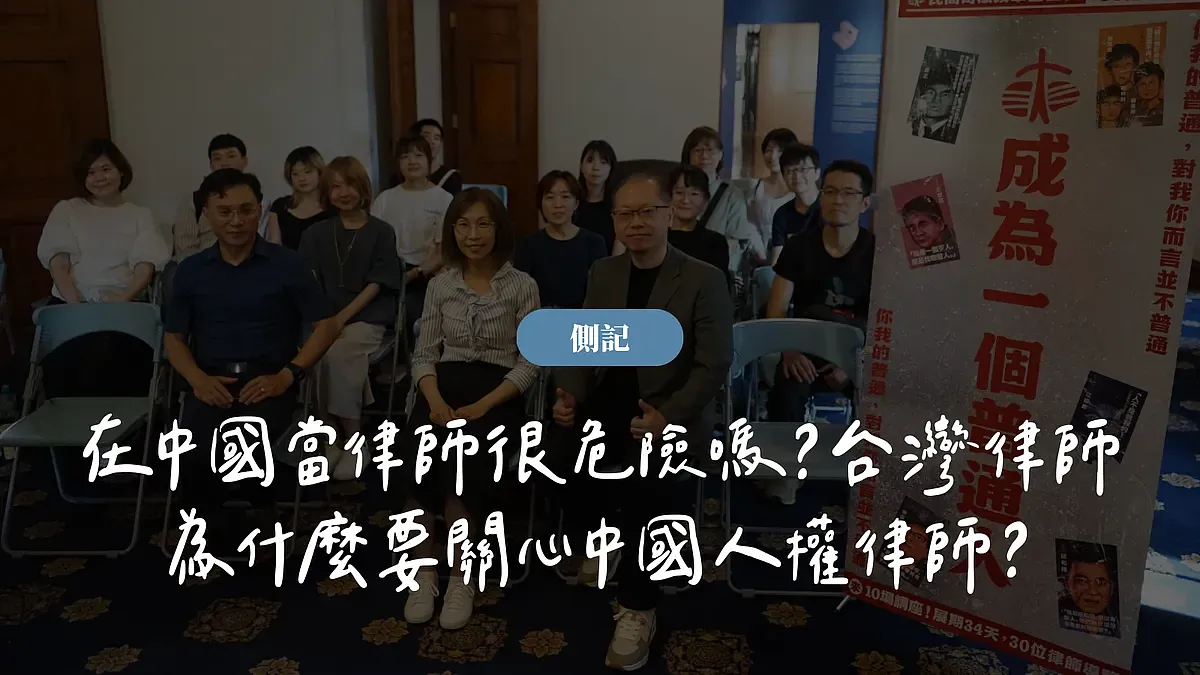
Sidelights|Is It Dangerous to Be a Lawyer in China? Why Should Taiwanese Lawyers Care About Chinese Human Rights Lawyers?
Last edited: 2026-08-23
Moderator|Chang An-ting (Standing Executive Member, Judicial Reform Foundation; Attorney, Tun-Yin Law Firm)
Discussant|Shih Hung-cheng (Standing Executive Member, Judicial Reform Foundation; Attorney, Sanho Law Firm)
In the "Pen" exhibition area of the "Becoming an Ordinary Person" exhibition, we can observe the history of defendants' human rights and the right to counsel.
"What the public wants to know" and "what the public ought to know" are two different things. In high-profile cases, releasing information to the outside world at the very beginning may instead hinder investigations or affect the fairness of subsequent trials.
Cases monitored by the JRF in the past include: the Love and Bloodshed Project and the Mommy House murder case, among others. The JRF has continuously received "complaints" from the public regarding individual cases where police, prosecutors, and investigators violated the principle of non-disclosure of investigations. It has formed a working group to watch television news daily, compile situations where "investigative authorities" are suspected of violating the principle of non-disclosure of investigations, and periodically report these to officials. Until the new "Regulations Governing Non-Disclosure of Investigations" came into effect in 2019, the JRF was repeatedly criticized by the media for allegedly acting against the people's right to know.
However, taking the most recent Ko Wen-je case as an example, reporting on the Ko case not only fails to aid in the prosecution of crimes, but may also raise concerns about prompting collusion among suspects and leaking the contents of evidence. From a social perspective, the premature leakage of the investigative contents in this case not only exacerbated chaos and polarization in the political sphere, but may also concomitantly cast doubt on the public's confidence in the fairness of judicial trials. The press release on the nine questions concerning the non-disclosure of investigations issued by investigative authorities at the end of 2024 has, to this day, only received evasive responses.
Why is the non-disclosure of investigations not being implemented? And how should the public's "right to know" be balanced? By reviewing past cases and operational problems within the prosecutors' offices, we will explain the practical operation of "open investigations" as well as the resistance to and turning points for reform. For this session, we invited Attorney Shih Hung-cheng, convener of the JRF's Non-Disclosure of Investigations Working Group, to deliver the keynote speech, with interspersed questions from Attorney Chang An-ting, to reflect and converse with everyone.
The second lecture in the series held during the "Becoming an Ordinary Person" exhibition shifted the focus from domestic judicial reform to more regional democratic and rule-of-law issues, highlighting the proactive role the international community expects Taiwan to play in East Asia.
This session was moderated by Attorney Chiang Jung-hsiang. At the opening, Attorney Chiang pointed out that the "709 crackdown on Chinese human rights lawyers" began in the early hours of July 9, 2015, when Chinese public security and state security officers suddenly detained Wang Yu, a lawyer at Beijing Fengrui Law Firm, along with her husband Bao Longjun and son Bao Zhuoxuan (Bao Mengmeng). A total of 316 rights-defense lawyers, law firm staff, human rights defenders, and their family members in mainland China were summoned, forcibly interviewed, restricted from leaving the country, subjected to residential surveillance or criminal detention, or forcibly disappeared and arrested. Among them, 36 remained in detention or enforced disappearance. This year marks the tenth anniversary of the "709 crackdown on Chinese human rights lawyers." Over the past decade, the arrests and detentions of lawyers, human rights workers, and their families in China have not ceased, and the professional environment continues to deteriorate. The seminar began with an interview video edited by the JRF, followed by joint discussions and comprehensive deliberation by Attorneys Chiang Jung-hsiang and Chen Yu-fan.
Ten Years Later: Are They Doing Well?
The lecture began with the screening of a video edited by the JRF. In the video, Chinese lawyers such as Zhou Shifeng, Liu Shiqing, Qin Yongpei, Wu Lei, Fang Xiangui, and Yu Pinjian, alongside Luo Shengchun (wife of lawyer Ding Jiaxi), as well as Taiwanese lawyers Hsieh Meng-yu, Huang Hsu-tien, Li Yen-jung, and Li Hsuan-i, shared their respective observations on the current situation of human rights lawyers in China.
Experiences across different regions and case types interweave into a common thread—when lawyers act to defend religious freedom, the right to housing, property rights, and procedural justice, they often become direct targets of the state apparatus; meanwhile, the pressure and isolation borne by their families are equally heavy.
Discussion by Attorney Chen Yu-fan: Comparing the Crackdown on Chinese Lawyers with Taiwan's Authoritarian History as a Self-Reminder for Taiwanese Society
Attorney Chen Yu-fan was invited as a discussant for this session. She recalled that during her time working at the JRF, through Taiwan-Hong Kong civil society networks and exchanges with Chinese lawyers, she often accompanied them to observe proceedings at the Beijing Intermediate and High People's Courts, discussing wrongful convictions and land expropriation, and listening to Chinese lawyers ask the most straightforward question: "When we submit our legal briefs, do they really reach the hands of the judges?" This demonstrated the fundamental differences between the judicial systems of Taiwan and mainland China.
She also recalled that around the time of the "709" incident in 2015, Attorney Yu-fan and her peers initiated a joint signature press conference using photographs from Chien-san-chiang, wearing their lawyers' robes inside out in front of the White Terror Memorial, symbolizing that they must at least turn their robes to "the people's side."
Attorney Yu-fan also shared her assessment of why the Chinese authorities have been so relentless in exterminating rights-defense lawyers—this group possesses organization, social mobilization capacity, public opinion influence, and international connections, and is therefore perceived by the Beijing government as a "dangerous collection of capabilities." Notably, the rights-defense lawyers are actually safeguarding the very rights guaranteed by the international human rights conventions that the Chinese government itself has signed.
Placing Taiwan back into the coordinate system, during the authoritarian era from 1945 to 1992, the *Statute for the Punishment of Sedition* and Article 100 of the Criminal Code also used the name of "law" to deal with political prisoners; the difference between the two places lies in whether individuals were forced to make public confessions and whether trial procedures were rendered mere formalities, but the nature of the methods and effects are somewhat similar.
Attorney Yu-fan advocates viewing "solidarity with 709" as a movement: on the one hand, it is a condemnation of China's human rights violations and support for frontline lawyers and their families; on the other hand, it serves as a self-reminder for Taiwanese society—recognizing the totalitarian essence without harboring illusions. Caring about Chinese lawyers is, in fact, defending our own future.
Discussion by Attorney Chiang Jung-Hsiang: Is China's Rule of Law Truly Rule by "Law"?
Attorney Chiang Jung-Hsiang continued the discussion, returning to his commentary in newspapers and magazines from 2019: "When the Cross-Strait Tourism Exchange Association of China unilaterally announced the suspension of individual travel, rights-defense lawyers pointed out that the association was not a truly authorized administrative entity. Such surprise policy changes exceeding authorization further erode the government's credibility." At the same time that article was published, social movements in Hong Kong were boiling over, and Hong Kong civil society groups condemned the police force for dereliction of duty and abuse of power. If viewed solely from geopolitics, these news events resemble international struggles; but viewed from the logic of the rule of law, they are scenes where the three regions each contend with "the law."
Attorney Jung-Hsiang believes that China's "administration according to law" often appears formally complete, but in reality, it uses the law as a tool to consolidate rule: for example, the unilateral suspension of mainland filmmakers from participating in the Golden Horse Film Awards appeared to be the Film Bureau administering according to law; however, under the principles of Western rule of law, these actions narrow the rights of the people, lack a legitimate purpose, and violate proportionality and transparent procedures.
Attorney Jung-Hsiang went on to point out that in 2018, the Central Committee of the Chinese Communist Party established the "Comprehensively Rule the Country by Law Commission." Named rule by law, it actually explicitly declared: "adhere to the path of socialist rule of law with Chinese characteristics," placing the law under the leadership of the Party to serve political purposes. This is also why environmental or livelihood litigation occasionally achieves victories, but once it touches the core of the regime, rights-defense lawyers "step on the dragon's reverse scales." When compared with the "formal constitutionality of wicked laws" during the Nazi era, this further highlights that the content of such laws is extremely unjust, and even if they comply with procedures, these so-called laws should be examined according to the "Radbruch formula" to deny their legitimacy.
Returning to Taiwan, Attorney Jung-Hsiang advocates completing defensive democracy and strictly regulating cross-border agents; the legal professional community should also not detach itself from public responsibility. In the past, the Taipei Bar Association has spoken out in solidarity with Chinese rights-defense lawyers, the Hong Kong student movement, the Lee Ming-che case, and China's persecution of Muslims, but there is an even greater need for national professional groups to stand together so that the words in the oath—"safeguarding human rights, realizing social justice, and promoting democracy and the rule of law"—are not merely words on a wall.
Q&A Session
Entering the Q&A session, someone raised a question: The total number of lawyers in China has risen from 200,000 to 250,000 in 2015 to 750,000 today, mostly aged in their thirties and forties—while their numbers have grown, active human rights lawyers seem scarcer. Why is that?
The lawyers responded that, to their understanding, surface numbers do not equate to professional efficacy: restrictions on lawyer-client meetings, suppression, and license revocations remain routine, and there is a huge gap between the role the law requires lawyers to play and reality. China's overall rule of law still has room for improvement, and the key lies in whether the system allows professionals to act according to the law.
Someone also asked about the reaction of public opinion at the time of the 709 incident. To this, the lawyers responded that, based on their understanding, the media at the time were ordered to uniformly repost articles from Xinhua News Agency and CCTV, and the bar association even issued a circular requiring lawyers to "guarantee not to discuss it." Although there were different voices among the public, they were quickly banned from social media and investigated. While discussions could be seen on overseas social media platforms, the interior of China was blocked off.
At this tenth anniversary, being able to discuss and show solidarity with this issue in Taiwan is also considered exceptionally precious. At the end of the lecture, Attorney Chiang expressed gratitude on behalf of everyone and urged that Taiwanese legal professionals must not be absent; they should record the stories of Chinese rights-defense lawyers, keep their voices echoing, guard Taiwan's own system closely, and prevent wicked laws from being used to target human rights lawyers.
This article is an AI-generated translation of the original Chinese text. In the event of any discrepancy, the Chinese version shall prevail.