
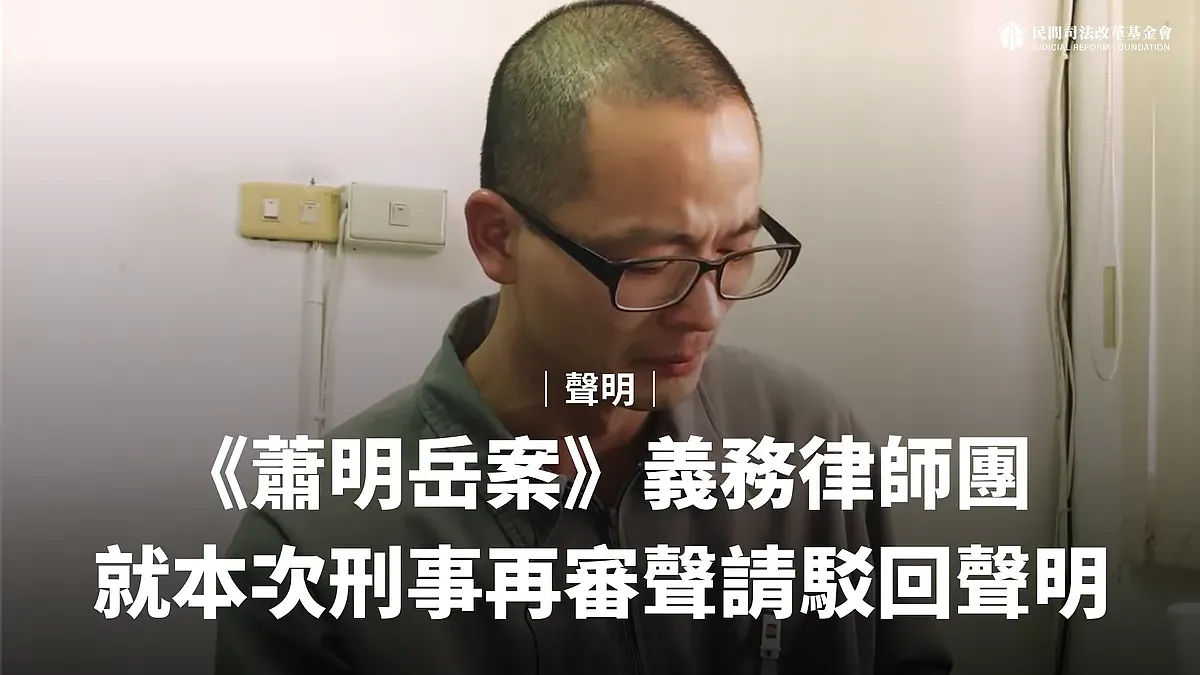
Statement | Pro Bono Legal Team for the Hsiao Ming-yueh Case Issues Statement on the Dismissal of the Criminal Retrial Motion
Last edited: 2026-08-23
Regarding the wrongful drug trafficking conviction of Hsiao Ming-yueh, the Supreme Court on September 4, 2025, rendered the 114-Tai-Kang-1453 Criminal Ruling, dismissing the interlocutory appeal filed by the pro bono legal team on behalf of Hsiao Ming-yueh, thereby finalizing the dismissal.
The Judicial Reform Foundation and the pro bono legal team for this case express deep regret over this decision and issue the following statement:
1. Co-defendants Have Recanted, Yet the Road to Exoneration Remains Distant and Endlessly Long
Hsiao Ming-yueh, a real estate agent with no prior criminal record, was implicated in a transnational drug smuggling case in 2009 (ROC Year 98). The courts concluded that Hsiao gave remote instructions to accomplices to travel to Cambodia to negotiate drug transactions and subsequently mail heroin concealed within books back to Taiwan. However, this case not only lacks any direct evidence proving Hsiao's involvement, but the testimonies of other co-defendants—upon which the court relied to find Hsiao guilty—were also successively recanted in subsequent trial proceedings. Even so, Hsiao was sentenced to life imprisonment in 2013 (ROC Year 102) by a self-rendered judgment of the Supreme Court, and has now spent 12 years imprisoned.
The Supreme Court's current ruling dismissing the interlocutory appeal and the Taiwan High Court Taichung Branch Court's ruling dismissing the present motion for a retrial (114-Sui-Tsai-22 Criminal Ruling) both held that the pro bono legal team failed to present new evidence sufficient to shake the original final judgment. Although co-defendants Sung O-hsien and Sung O-hua repeatedly recanted their statements after the original judgment became final, stating that Hsiao Ming-yueh indeed did not participate in this case, during the investigation period for the current retrial motion, the courts uniformly held that "the original final judgment had already weighed and evaluated the successive statements of Sung O-hsien and Sung O-hua," without summoning Sung O-hsien and Sung O-hua to appear in court to explain and clarify the facts. The pro bono legal team expresses deep regret over this.
2. Relief for Wrongful Convictions Faces Immense Obstacles; We Urgently Call for the Swift Implementation of the Resolutions of the National Consultative Conference on Judicial Reform to Establish a "Wrongful Conviction Relief Committee"
Although Taiwan's criminal retrial system was amended and relaxed in 2015 (ROC Year 104) to explicitly state that the time of existence for "new facts or new evidence" is not limited to those that existed or were established before the final judgment and went uninvestigated or unconsidered, and codified the "comprehensive judgment theory" in order to avoid miscarriages of justice; according to statistical annual reports by the Judicial Yuan, from 2015 to 2023, the reopening rate for retrials remains under 2%. The lack of effective relief for wrongful convictions has long been a difficult problem that Taiwan's judiciary urgently needs to overcome.
Resolution No. 5-4 of the 2017 (ROC Year 106) National Consultative Conference on Judicial Reform previously resolved: "Establish a 'Criminal Final Case Review Mechanism' independently exercising its powers (such as the independent mechanisms in the UK and Norway, namely the Criminal Cases Review Commission system), dedicated to the investigation of finalized guilty cases, to apply for or prompt the opening of retrials for the innocent." Based on this, the Judicial Reform Foundation also proposed the citizen-version draft of the "Four Acts for Miscarriage of Justice Relief," hoping to implement the system of the "Wrongful Conviction Relief Committee" in Taiwan's judiciary through amendments to our Control Act, Organic Act of the Control Yuan Committees, Court Organization Act, and Code of Criminal Procedure.
Although the Ministry of Justice enacted the Operational Guidelines for Prosecutors' Offices in Handling Review Cases of Finalized Guilty Verdicts in 2017 (ROC Year 106) and established the "Review Committee for Finalized Guilty Cases" to discover the truth and prevent wrongful injustices, this mechanism lacks a legal basis, restricting investigative measures merely to reviewing old case files and failing to initiate compulsory investigation. In practice, because review committee members only receive attendance fees without sufficient administrative resource support, it is difficult for them to conduct detailed reviews amidst complex case files and evidence, often forcing them to rely solely on the opinions of the handling prosecutors. Coupled with the absence of statutory time limits for the proceedings, the initiation of relief is slow and random, yielding extremely limited effectiveness. Taking Hsiao Ming-yueh's case as an example, even though the case lacks direct conviction evidence and key co-defendants have recanted, such major doubts still failed to obtain relief through this mechanism.
The pro bono legal team also calls out here that the exoneration of wrongful convictions is justice delayed, and if the state cannot even provide justice delayed, it will fail the public's trust in the judiciary. Relevant authorities should squarely face the damage caused to the fair and just image of the judiciary by Hsiao Ming-yueh's years of suffering under an unjust charge, swiftly implement the resolutions of the National Consultative Conference on Judicial Reform, and establish a "Wrongful Conviction Relief Committee" to prevent more "Hsiao Ming-yueh"s from emerging.
The pro bono legal team will also continue to research and discuss matters concerning subsequent retrials and extraordinary remedies for this case, and keep striving for Hsiao Ming-yueh's innocence.
Press Contacts
Chang Chia-chi, Legal Specialist, Case Action Department, Judicial Reform Foundation
Telephone: 04-2329-2372#14
Email: jc@jrf.org.tw
Chang Hua-che, Director, Case Action Department, Judicial Reform Foundation
Telephone: 02-2523-1178#22
Email: ven@jrf.org.tw
This article is an AI-generated translation of the original Chinese text. In the event of any discrepancy, the Chinese version shall prevail.