
Sidelights | Digital Bill of Rights: Building the Legal Infrastructure for Digital Freedom from the Bottom Up
Last edited: 2026-08-23
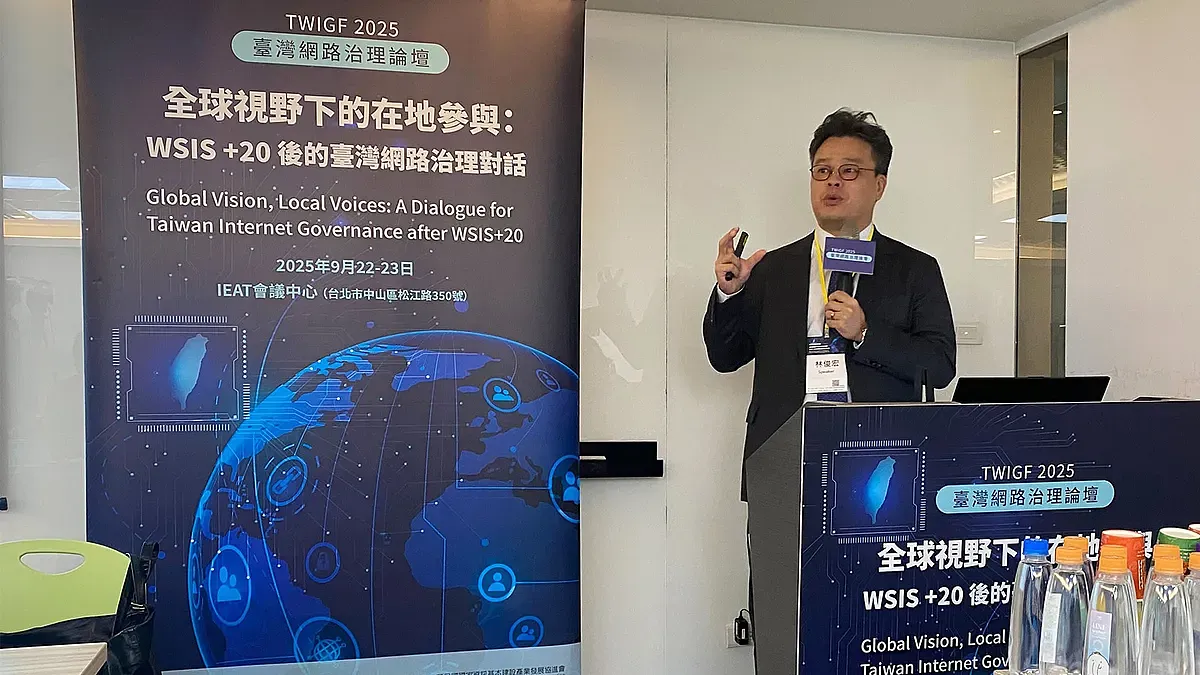
The Taiwan Internet Governance Forum hosted the conference "Local Participation from a Global Perspective: Taiwan's Internet Governance Dialogue Post-WSIS+20." During the first session on the morning of September 23, 2025, titled "Digital Bill of Rights: Building the Legal Infrastructure for Digital Freedom from the Bottom Up," the Judicial Reform Foundation introduced the draft Digital Bill of Rights to attendees.
The speaker, Attorney Lin Chun-hung, first explained the legislative background of the draft Digital Bill of Rights. In modern society, digital threats are becoming increasingly severe, personal data is collected and utilized on a massive scale, and current regulations are inadequate with a lack of comprehensive protection mechanisms and regulatory standards. Furthermore, private enterprises hold a high degree of control over personal information and digital applications, meaning corporate responsibilities have yet to be established. Therefore, the Judicial Reform Foundation hopes to promote the draft Digital Bill of Rights.
Attorney Lin Chun-hung stated: "As governments and private enterprises acquire and control more and more digital information, the people's freedom of secret communication will be eroded. Moreover, under the operation of algorithms and precision marketing, people are unable to access diverse information; instead, they are fed pre-determined content, leading to a narrowing of accessible information. In addition, information in the digital environment may affect physical and mental health—such as short videos leading to internet addiction and the deprivation of attention spans. Therefore, the state and enterprises should guarantee the basic digital rights mentioned in Article 2 of the draft."
Elaborating on basic digital rights, Attorney Lin Chun-hung explained that digital privacy is a type of basic digital right, including but not limited to informational self-determination, the right to anonymity, confidentiality, and the right to be forgotten. The right to data minimization is also a form of basic digital right, requiring governments or enterprises to minimize the collection, processing, and utilization of personal data, without exceeding the necessary scope. If this scope is exceeded, the user's consent shall be deemed invalid. Furthermore, individuals have the right to choose whether to use and participate in digital services, and the government should provide non-digital services. For example, the government should not require all citizens to use apps exclusively for filing taxes and making tax payments; it should also provide over-the-counter services for tax filing and payment. In addition, the government must provide the public with opportunities for digital education, ensuring people have sufficient capacity to participate in the digital environment. Finally, regarding the development of artificial intelligence, Article 7 of the draft lists 10 fundamental digital rights for individuals concerning artificial intelligence.
The second speaker, Chiang Po-jen, introduced Chapter 2 of the draft. Chiang Po-jen noted: "When the government takes restrictive measures against the internet, it must comply with certain due process requirements." Article 9 of the draft addresses due process when the government implements internet restrictions. The government may not restrict internet use without legal authorization, nor may it indirectly direct or require businesses to restrict internet use. Furthermore, it must provide the affected party an opportunity to state their opinions, and any restrictive measures implemented must be retroactively approved by a dispute-resolution institution. Regarding special emergency situations such as major natural disasters, epidemics, or armed conflicts, Article 12 of the draft stipulates that while the government may take necessary measures based on the public interest, there must still be an immediate review mechanism, establishing a committee to audit legality and necessity. Once such situations end, the government must conduct reviews and report to the Legislative Yuan.
Chiang Po-jen further explained that building diverse and decentralized internet infrastructure is crucial. Therefore, Article 13 of the draft requires the government to guarantee internet resilience, ensuring that Taiwan can maintain internet services even in scenarios such as severed submarine cables or burned server rooms. Specific obligations to guarantee internet resilience include establishing mechanisms and drills, supporting civil society in voluntarily promoting digital civil defense, internet resilience, and decentralized server promotion campaigns. Chiang Po-jen also mentioned that beyond government action, Article 11 of the draft requires industry operators to engage in self-regulation, such as establishing self-regulatory codes, providing users with online dispute-resolution channels, and publishing transparency reports.
Chiang Po-jen also introduced the remaining articles of the draft, which include the government's duty to maintain digital market freedom and protect public participation rights (Article 14), the principle of public code (Article 15), ensuring digital market competition (Article 16), diversification of digital services (Article 17), social responsibility in digital transformation (Article 18), support for non-profit organizations (Article 19), and fostering a sound digital environment (Article 20).
Towards the end of the conference, addressing a question from moderator Specialist Leslie on how to lobby lawmakers and civil society groups, Attorney Lin Chun-hung stated that advocacy requires emphasizing the impact of digital society on people's rights and introducing the contents of the draft using simple terminology to make it more accessible. The Judicial Reform Foundation also gathered feedback from in-person and online participants. Moderator Specialist Leslie expressed gratitude for everyone's input and questions, noting that the Digital Rights Bill Working Group will discuss and study the feedback collected today.
This article is an AI-generated translation of the original Chinese text. In the event of any discrepancy, the Chinese version shall prevail.