
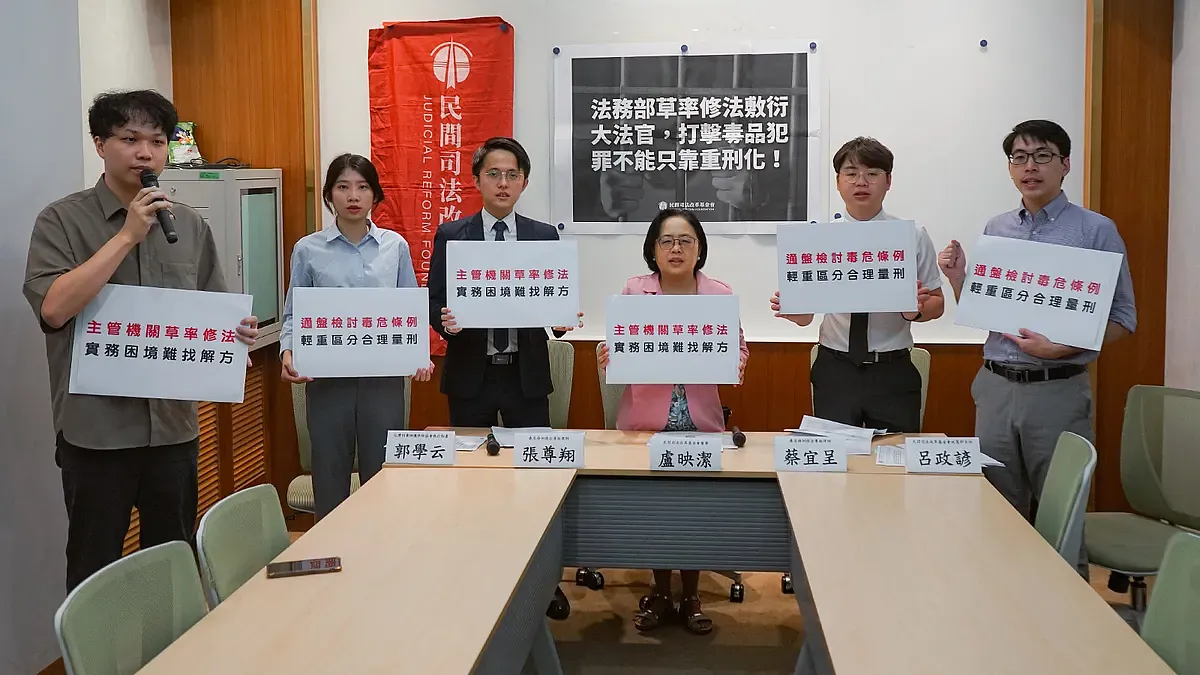
Press Release | Ministry of Justice's Hasty Legislative Amendments Brush Off the Constitutional Court: Combating Drug Crime Cannot Rely Solely on Extreme Punitiveness
Last edited: 2026-08-23
Full Text of the NGO Version Draft
On August 11, 2023, the Constitutional Court issued TCC Judgment 112-Hsien-Pan-13 (2023) ("Case on the Penalty for Selling Category One Narcotics"). The reasoning of this judgment stated that Article 4, Paragraph 1 of the current Narcotics Hazard Prevention Act, which stipulates that "[w]hoever traffics Category 1 drugs shall be sentenced to death or life imprisonment," even when Article 59 of the Criminal Code of the Republic of China is applied to mitigate the sentence, still results in excessive penalties—where the punishment outweighs the gravity of the offense—in cases where the circumstances are extremely minor. Consequently, this leads to a disproportionality between culpability and punishment, and the relevant authorities were ordered to amend the law.
In response to this constitutional judgment, our Foundation launched the "Narcotics Hazard Prevention Act Amendment Working Group" last year. Beyond examining the issue of "excessively heavy penalties for minor cases of trafficking Category 1 drugs" raised in the judgment, the working group also comprehensively reviewed numerous issues within the Narcotics Hazard Prevention Act and proposed the "NGO Version of the Amendment Draft to the Narcotics Hazard Prevention Act." Regarding our legislative demands, our Foundation issues the following statement:
1. An extremely punitive drug control policy is manifestly unfair.
2. The Ministry of Justice's legislation is hasty and turns a blind eye to the practical dilemmas raised in TCC Judgment 112-Hsien-Pan-13 (2023).
3. The penalty standards under the Narcotics Hazard Prevention Act are overly rigid; statutory penalties should be comprehensively reviewed by taking other factors into consideration.
4. Various legislative defects should be comprehensively reviewed to mitigate the imbalance of punishments in drug cases.
1. An extremely punitive drug control policy is manifestly unfai
Looking at the current extreme punitiveness policy, one can observe that in cases with no prior criminal record, and where both the quantity trafficked and the consideration involved are extremely minimal, constrained by the statutory penalty for the "crime of trafficking Category 1 drugs," which has a minimum sentence of life imprisonment, even if the courts grant sentence mitigation, applicants are still lawfully sentenced to fixed-term imprisonment of 15 years or more. Comparing these criminal circumstances and sentencing, from both legal and general societal perspectives, this indeed constitutes an excessively severe punishment. In other words, the aforementioned cases do not involve the "drug lords" imagined by the general public; furthermore, regarding "drug trafficking syndicates" or cases where circumstances are not minor, this judgment does not alter the standards for punishment and sentencing. In fact, this offense carries the heaviest punishment in our country; even major violent crimes such as homicide, kidnapping for ransom, and hijacking public transport carry statutory penalties lighter than this offense.
Because the statutory penalties are manifestly disproportionate, this offense is also the provision for which Article 59 of the Criminal Code of the Republic of China is applied most frequently for sentence mitigation. In this regard, Grand Justice Lin Chun-i pointed out that while the mitigation provision of "sympathetic circumstances" under Article 59 of the Criminal Code of the Republic of China was originally intended to be applied very strictly in practice, in these types of cases, applying Article 59 of the Criminal Code of the Republic of China has instead become the norm!
Referring to statistical data published by the Ministry of Justice, out of the 12,130 individuals convicted of the "crime of trafficking Category 1 drugs" over the decade from 2008 to 2018, only 1.1% were sentenced to the "minimum penalty" of life imprisonment. Although it cannot be said that the remaining 99% of cases had their sentences reduced solely due to "sympathetic circumstances" (surrender, confession during investigation and trial, and informing on upstream suppliers can also lead to mitigation), it nonetheless demonstrates that in practice, judges universally encounter situations where they find the penalties too severe and are unable to pass such sentences. Referring to the table below, one can glimpse a corner of this practical dilemma:
| Applicant Prior Criminal Record Circumstances of Trafficking Category 1 Drugs Quantity of Drugs Trafficked Consideration (NTD) Sentence (Fixed-Term Imprisonment) | |||||
|---|---|---|---|---|---|
| Wu ○○ | Unknown | Jointly trafficked 1 time | 0.45 grams | NT$3,000 (payment not collected) | 15 years |
| Chi ○○ | Theft, Robbery | Jointly trafficked 1 time | Unknown weight | NT$1,000 | 17 years |
| Ch'en ○○ | Unknown | Jointly trafficked 2 times | 0.4 grams 0.4 grams | NT$500 NT$500 | 7 years 8 months 15 years 1 month |
| Chou ○○ | Prior drug offenses | Individually trafficked 2 times | 0.073 grams 0.023 grams | NT$800 NT$1,000 | 15 years 2 months 15 years 2 months |
| Yang ○○ | Unknown | Individually trafficked 3 times | Unknown weight Unknown weight Unknown weight | NT$3,000 NT$1,000 NT$1,000 | 16 years 2 months 16 years 16 years |
| Liu ○○ | Unknown | Jointly trafficked 1 time Individually trafficked 2 times | 0.8456 grams Unknown weight Unknown weight | NT$3,000 NT$2,000 NT$2,000 | 16 years 15 years 15 years |
From a legislative perspective, aside from the "extremely minor" cases highlighted by the Grand Justices, the current law subjects both "drug trafficking syndicates" and "sporadic individual trafficking by users" to the same heavy penalties, which manifestly raises concerns of excessive severity for the latter. This imbalance does not align with the criminal policy ideology of "balancing leniency and strictness," and an immediate review is necessary.
2. The Ministry of Justice's legislation is hasty and turns a blind eye to practical dilemmas raised in TCC Judgment 112-Hsien-Pan-13 (2023
In response to the Constitutional Court's order to amend the law, the Ministry of Justice also announced proposed amendments last July. However, the Ministry of Justice's amendment draft merely added Article 17-1: "Whoever commits the crime of trafficking Category 1 drugs under Article 4, Paragraph 1, whose behavioral patterns, quantity, consideration, and other circumstances are minor, who is manifestly deserving of sympathy and pity, and whom the court deems that mitigating punishment pursuant to Article 59 of the Criminal Code of the Republic of China remains excessively heavy, may have their punishment discretionarily reduced. However, this shall not apply to those who have a past conviction confirmed by a final judgment." This means that if the circumstances of trafficking Category 1 drugs are minor, and mitigation under Article 59 of the Criminal Code of the Republic of China is still too heavy, the punishment may be further reduced, but this does not apply to those with a prior criminal record.
Our Foundation believes that the Ministry of Justice's amendment draft for the Narcotics Hazard Prevention Act this time can be described as hasty, and arguably reflects a disdain for the judgment of the Constitutional Court.
First, regarding the subject matter and intent of TCC Judgment 112-Hsien-Pan-13 (2023), the judgment directly pointed out the overly rigid sentencing problem concerning the trafficking of Category 1 drugs under the Narcotics Hazard Prevention Act, and further stated that "the relevant authorities should appropriately review the statutory penalties they regulate, such as incorporating fixed-term imprisonment alongside the death penalty and life imprisonment, or setting different penalty levels based on the quantity or frequency of trafficking." Operating within the role of judicial interpreters, the Constitutional Court is inevitably unable to delve into intricate technical details of legal formulation, and can only offer generalized suggestions based on rough elements. However, this does not mean that the Ministry of Justice, as the competent authority for regulations, is permitted to hastily "copy and paste" words from the constitutional judgment such as "behavioral patterns, quantity, and consideration" without establishing legislative techniques for such factors (for example: what quantity of drugs can be deemed minor). This can be described as a failure to fulfill the institutional obligation of perfecting legal norms. Furthermore, the Ministry of Justice shockingly displayed no intent whatsoever to review the statutory penalties for the "crime of manufacturing, trafficking, and transporting Category 1 drugs," which remain limited solely to the "death penalty and life imprisonment."
Moreover, the proviso in the newly added article stating, "However, this shall not apply to those who have a past conviction confirmed by a final judgment," which excludes individuals with prior records from qualifying for sentence mitigation, is also improper legislation. The Ministry of Justice stated in the draft's explanatory notes: "The current policy of severe penalties and heavy punishment for the drug supply end naturally requires narrowing the exceptional circumstances where sentences may be mitigated. Therefore, in accordance with the intent of the aforementioned Constitutional Court judgment, this proviso is added to exclude all persons who have violated criminal laws and whose convictions have been finalized from the provisions permitting sentence mitigation." However, according to the intent of TCC Judgment 112-Hsien-Pan-13 (2023), the condition that the offense be committed "without other criminal acts" was cited as merely one of the preconditions describing a situation as "manifestly deserving of sympathy and pity." This means the constitutional judgment did not consider individuals "with prior records" to be inherently unqualified as having "extremely minor circumstances." The legislation enacted by the Ministry of Justice can be said to unnecessarily add restrictions not found in the constitutional judgment. Furthermore, categorically barring individuals with finalized criminal convictions from applying this mitigation provision would exclude even minor offenses such as "negligent injury caused in a traffic accident" from the scope of mitigation, which clearly runs counter to the intent of TCC Judgment 112-Hsien-Pan-13 (2023). In response to this, after the Ministry of Justice announced its draft, our Foundation also submitted our critical comments in writing on July 25, 2024.
Overall, apart from failing to construct concrete standards within the Narcotics Hazard Prevention Act to gauge the severity or triviality of offenses, the Ministry of Justice's amendment draft additionally incorporated unreasonable exclusionary clauses. Consequently, cases deserving sentence mitigation fail to have their sentences adjusted solely due to possessing a prior record. This constitutes defective legislation and is deeply regrettable.
3. Penalty standards under the Narcotics Hazard Prevention Act are overly rigid; statutory penalties should be comprehensively reviewed by taking other factors into consideratio
In our country's Narcotics Hazard Prevention Act, criminal punishments for major drug offenses primarily use the "drug category" involved in the crime as the primary basis for setting statutory penalties (only the "crime of drug possession" has rough weight standards). However, because drug cases often involve complex social facts, measuring the culpability of drug offenses solely by drug categories easily leads to misjudgments in evaluation. For instance, under current law, the act of "trafficking 0.5 grams of Category 1 drugs" (constituting the crime of trafficking Category 1 drugs) carries a statutory penalty of "death or life imprisonment"; whereas the act of "trafficking 500 kilograms of Category 4 drugs" (constituting the crime of trafficking Category 4 drugs) carries a penalty of "fixed-term imprisonment between 5 and 12 years." The social harm caused by the latter is clearly much higher, yet the statutory penalties for both are entirely disproportionate, demonstrating that their normative evaluation function is manifestly defective.
To resolve the aforementioned evaluation imbalance dilemma within the Narcotics Hazard Prevention Act, our Foundation's special working group on drug law amendment referenced sentencing norms in foreign legislative examples (for instance, the UK and United Kingdom set sentencing standards based on "drug weight"). Building upon our country's existing drug classification system, we established a "hazard level judgment standard" that integrates both "category" and "weight" factors as the basis for evaluating the social harm caused by drug offenses, hoping to remedy the long-standing imbalance in our country's drug policy.
4. Various legislative defects should be comprehensively reviewed to mitigate the imbalance of punishments in drug cases
In addition to the aforementioned defects of evaluation imbalance caused by excessive emphasis on drug categories, our Foundation's drug law working group also put forward legislative recommendations regarding practical ills arising from the structural provisions of other articles in the Narcotics Hazard Prevention Act.
For example: In practice, the definitions of the constitutive elements for "manufacturing drugs," "transporting drugs," and "trafficking drugs" all have questionable aspects. Does "mixing drugs with juice powder" (without generating other chemical substances) constitute the manufacturing of drugs? This is controversial in practice. And exactly how much distance must one travel while carrying drugs to distinguish between transporting drugs and possessing drugs? This remains a habitual practical dilemma. As for why selling drugs "at cost price" still frequently constitutes drug trafficking? This has long been a perplexing controversy in practice.
After reviewing numerous practical controversies concerning the Narcotics Hazard Prevention Act, our Foundation's special working group studied solutions to these contentious issues and proposed them together in this amendment draft. Our Foundation also calls upon the Ministry of Justice and legislators across party lines to comprehensively review the disproportionate sentencing caused by various legislative defects in the Narcotics Hazard Prevention Act, and to comprehensively amend the Act to prevent one injustice after another—where punishment outweighs the gravity of the offense—from repeating itself in our society over and over again.
The aforementioned NGO version of provisions aims primarily to rationalize the statutory penalties for drug crimes in our country, thereby systematically introducing concepts such as the "weight hazard level standard" and "weighted drug weight." This enables the Act to align with the constitutional intent of the principle of proportionality between crime and punishment under the criminal policy philosophy of "balancing leniency and strictness." This is not only a response to the intent of TCC Judgment 112-Hsien-Pan-13 (2023), but also utilizes this opportunity to comprehensively review unreasonable aspects of the Act and promote legal practice and academic research related thereto.
However, given its massive scope of amendments, achieving this in legislative practice is likely no easy task. In terms of legislative practice, responses from proposing authorities in our country to Constitutional Court judgments mostly lean toward "minimalist amendments," frequently failing to take advantage of the amendment opportunity to review numerous issues simultaneously. Taking the amendment proposed by the Ministry of Justice this time as an example, it even ignored and brushed off the problems outlined in TCC Judgment 112-Hsien-Pan-13 (2023).
To address the aforementioned legislative practice reality, in addition to the aforementioned NGO version of provisions, a "fallback option" has been specially drafted and appended to the NGO version draft.
Attendees
Lu Ying-chieh | Director, Judicial Reform Foundation
Lyu Jheng-yan | Director of Policy Department, Judicial Reform Foundation
Tsai I-cheng | Attorney, Hope Law Firm; Member of the Narcotics Hazard Prevention Act Amendment Working Group, Judicial Reform Foundation
Chang Tsun-hsiang | Attorney, Jing-Yeh International Law Firm; Member of the Narcotics Hazard Prevention Act Amendment Working Group, Judicial Reform Foundation
Kuo Hsueh-yun | Executive Secretary, Taiwan Criminal Defense Lawyers Association
Press Contacts
Liao Wei-cheng , Associate Researcher, Legal Policy Department, Judicial Reform Foundation
Telephone: 02-2523-1178 #20
Email: wayne@jrf.org.tw
This article is an AI-generated translation of the original Chinese text. In the event of any discrepancy, the Chinese version shall prevail.