
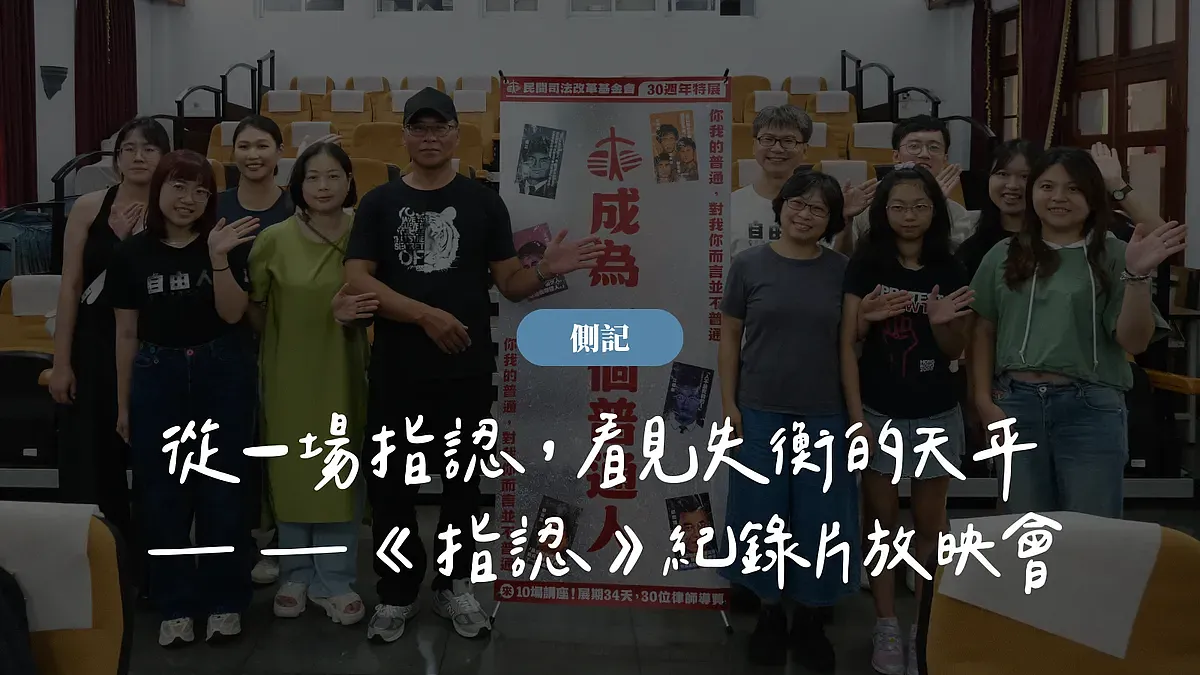
Sidelights | Seeing the Unbalanced Scales Through an Identification: Screening and Forum for the Documentary 'The Identification'
Last edited: 2026-08-23
Moderator | Huang Hsi (Film Critic)
Speaker | Huang Hui-chen (Documentary Director)
Speaker | Tsai Ching-yu (Member of the Volunteer Defense Team for Liu Cheng-fu, Taiwan Association for Innocence; Managing Partner, Yuan-Chu Law Firm)
As part of the 'Becoming an Ordinary Person' exhibition, we specially curated the 'Mirror' section. When we look at the faces of judicial victims reflected in the mirror, we see ourselves as well. Through this perspective, we hope to encourage viewers to reflect on their connection to the innocent. When 'an innocent person is convicted, no one is free,' and anyone can become part of the story.
During the panel discussion, Director Huang Hui-chen shared her original creative intent and the filming process, as well as how she came to truly see 'Liu Cheng-fu' as a person after traversing the injustices he faced. Attorney Tsai Ching-yu analyzed the systemic dilemmas within the case from a professional perspective, while sharing the challenges and significance of wrongful conviction rescue work.
Wrongful convictions are not merely legal issues; they profoundly impact the lives and emotions of the individuals involved and everyone around them, reflecting the complex human nature and social structures behind the system. Through 'The Identification', we hope audiences can recognize the connection and responsibility between the system and themselves through the judicial victimization experiences of others, and contemplate how 'freedom' and 'justice' ought to be safeguarded and realized in our society.
Held as one of the lecture series during the 'Becoming an Ordinary Person' exhibition, this event invited Director Huang Hui-chen, a friend of judicial reform, to share her insights into wrongful convictions.
Liu Cheng-fu, the subject of the documentary 'The Identification', was embroiled in a fatal assault case he did not commit. This entanglement plunged Liu and his family into a twenty-year ordeal, during which he continues to fight for his innocence through the judicial system to this day. In this case, aside from the improper preservation of evidence, there were also flaws in the identification procedure. Through 'The Identification', Director Huang invites everyone to witness the impact that even the slightest negligence in judicial proceedings can have on an ordinary person and their family.
From Case Files and Direct Interviews to Field Research, I Was Convinced of Cheng-fu's Innocence
Following the screening, Director Huang Hui-chen and Attorney Tsai Ching-yu first shared how they came to know Liu Cheng-fu and his case from their respective professional perspectives. Director Huang mentioned that before filming, she obtained the case files to understand Cheng-fu's situation, and came to know him personally as 'Huang Hui-chen' through their interactions. 'The first time I met Cheng-fu, we did an interview at his home. I had never seen a middle-aged man shed tears within just a few sentences of talking to you,' Director Huang recalled of Cheng-fu's expression and physical reactions during the interview. She believed that such reactions were beyond the capability of even a professional actor. '(Liu Cheng-fu) body would tremble and his hair would stand on end when mentioning experiences related to the (case). Combined with the materials I had seen beforehand, I felt that the person before me was someone who could be trusted.' In addition to reading the case files and getting to know Cheng-fu through her senses, Director Huang also conducted local field research during filming, asking local tribal residents to help reenact the scenes at the time. However, the fight that took place in front of the Wanchin Military Camp could not be reenacted, 'because no one in the tribe dared to come and help with this. Because they all claimed they knew what the truth was, and that truth was that Cheng-fu was innocent, but they could not say who the real perpetrator was,' Director Huang stated.
Human Blind Spots Are One of the Causes of Wrongful Convictions
Attorney Tsai began by addressing a question she is frequently asked: 'Are you afraid of saving the wrong person?' She noted that in addition to scientific evidence flaws or violations of due process, another criterion for accepting cases for rescue by the Taiwan Association for Innocence is 'actual innocence.' The association determines whether this criterion is met through case files and face-to-face interviews with the client, and Liu Cheng-fu's case met these standards, leading to the decision to take it on. 'However, humans are limited after all, so there is no need to overly worry about saving the wrong person,' Attorney Tsai remarked, adding that a profound realization from working on wrongful conviction rescue is that humans have limitations and blind spots, which make errors easy to occur. Attorney Tsai then shared that in Liu Cheng-fu's case, there was a piece of audio-visual material that the volunteer defense team had previously requested copies of. However, assuming the material could not be played due to long-term storage or track corruption, they had never reviewed its contents—until the judge in the second retrial remand proceedings informed them that there was indeed a 'viewable' recording of the scene reenactment. Upon viewing it, they found it matched the situation Cheng-fu had described all along. Because of the blind spot of 'assuming it could not be watched,' this material surfaced a full decade after the association took over the case. Through this example, Attorney Tsai hoped to make the audience understand that humans possess numerous limitations and blind spots, which are precisely among the causes of wrongful convictions; therefore, we can never expect to be one hundred percent correct in our actions.
‘I Was Right Beside Him Back Then, and I Know He Was Wronged.’
Director Huang then shared her observation during the filming process regarding Tai Mei-hung (Cheng-fu's spouse, who was his girlfriend at the time of the incident), describing her as 'a very important support and pillar (for Cheng-fu).' For the innocent, 'when facing such an injustice, you truly need someone to believe that you are wronged.'
Director Huang mentioned that she did not intend to make 'The Identification' a romance film and harbored skepticism toward the word 'romance,' noting that she actually enjoys romance films because she knows romance in fiction is rare. 'Yet between Cheng-fu and Mei-hung, I am not sure whether it is romance; perhaps it has already sublimated. They encountered this event when they were very young. Many people might have chosen to leave, but they did not.' Director Huang was initially curious, imagining that had Mei-hung stayed with Cheng-fu, she would easily face gossip and finger-pointing, so why didn't she leave? After getting to know them, she discovered that Mei-hung and Cheng-fu supported each other; it was not a one-way support from Mei-hung to Cheng-fu. Director Huang expressed great admiration for their relationship: 'I tried to understand why someone would make such a decision—to stay by your side through to the very end. Just how heavy is that promise?' she said, before inviting Tai Mei-hung, who was present in the audience, to say a few words.
'Thank you everyone for caring about Cheng-fu's case,' Tai Mei-hung began, expressing gratitude to the audience. She mentioned that because twenty years had passed and the entire event involved too many dimensions, she hardly knew what to say. Addressing Director Huang's question, Mei-hung shared why she told Liu Cheng-fu while he was in prison, 'I refuse (to divorce you), I will stay with you to the very end': 'Because I was right beside him (at the time of the incident), I knew he was wronged. And I knew what I wanted—I wanted to strive to maintain my home.'
Everyone Benefits When We Care About Social Issues
Moderator Huang Hsi asked how one should engage in dialogue with society and respond to public inquiries during legal action? For instance, some might argue that since Liu Cheng-fu has already been released from prison, why not let go of the past and stop pursuing his innocence? Director Huang first responded regarding the 'pursuit of innocence,' arguing that clarifying events and making things clear is 'a basic respect for human beings and a human right.' Addressing 'communication with society,' Director Huang noted that many events often seem unrelated to us, but are they truly unrelated? Taking the Taiwan Railways strike as an example, passengers might have their travel arrangements disrupted and experience great inconvenience at the moment; but from another perspective, Taiwan Railways employees are resorting to a strike to demand improvements due to excessively long working hours and poor labor conditions. If labor conditions improve, it is believed to also benefit transportation safety (such as shorter working hours reducing fatigue, allowing staff to maintain greater focus on duty and promptly detect and respond to emergencies), enabling passengers to travel more safely and with greater peace of mind. 'You don't need to (think of caring about social issues) as something lofty, because the person who ultimately benefits might be you,' Director Huang said. Caring about social issues is not as distant as one might imagine; rather, it is closely intertwined with the daily lives of you and me.
Continuing to Communicate with Society, Continuing to Communicate with Victims' Families
Following up on Director Huang's mention of the vegetable vendor at the traditional market who was accused of riding a scooter and hitting someone, Attorney Tsai said she was reminded of 'Very Ah-ying'—Chang Yueh-ying. Chang Yueh-ying was originally a small-scale market vendor who was embroiled in a hit-and-run case that had nothing to do with her, thereby beginning an extraordinary journey of relief. From Chang's experience, we can see that wrongful convictions are not entirely detached from our lives. Attorney Tsai then discussed social advocacy campaigns for wrongful conviction rescue. Although all wrongful convictions matter regardless of scale, she candidly acknowledged that due to limited resources, cases involving heavier sentences—especially the death penalty and life imprisonment—tend to attract more attention. However, advocacy and institutional promotion within legal action also evolve with the times. For instance, in the earliest days, discussions on wrongful convictions focused heavily on torture; gradually, discussions expanded to identification procedures and evidence preservation. The promotion of these institutions is actually tied to cultural standards and social progress, as societal changes make people care increasingly about these rights.
Attorney Tsai additionally noted, 'We often say a wrongful conviction involves two sets of victims, because wrongful convictions frequently leave the real perpetrator at large, meaning the families of the actual victim cannot learn the truth, while those wrongfully accused (along with their families and friends) also suffer the impacts (of this case).' Knowing that in some cases, the families of victims attend court hearings as observers, the rescue team hopes to use courtroom arguments to convey to the victims' families that defending the client is not about helping them escape punishment, but about bringing the truth to light so that the real perpetrator can be captured. Through this, Attorney Tsai explained that pro bono lawyers' courtroom activities also serve as a form of social communication.
Beyond Accountability, We Must Ultimately Return to the System.
During the Q&A session, an audience member asked whether the police should be held accountable for failing to follow identification procedures by providing photographs to witnesses for identification. Director Huang noted that in Liu Cheng-fu's case, slight mistakes may have been made by individuals at every single stage. Regarding the police investigation stage, she was unsure whether officers were under investigative pressure or performance demands, leading them to take shortcuts. When such situations occur, Director Huang believes accountability is necessary; however, humans remain human and are inevitably prone to omissions. Therefore, we must ultimately return to the system and ponder why the system was designed in a way that led those executing it to act as they did.
Attorney Tsai approached the issue from the perspective of procedural prioritization. Because initiating a retrial in a finalized criminal case is exceptionally difficult, in order to maximize support, the strategic priority is to persuade the judge to grant a retrial rather than pursuing accountability. Attorney Tsai candidly admitted, 'It is a helpless decision, but a trade-off that must be made.' Taking the Cheng Hsing-tzu case as an example, Cheng had been subjected to torture. After his retrial resulted in a finalized acquittal, he filed a state compensation lawsuit, but lost across the board—with the statute of limitations system being one of the major reasons. 'Returning to what I just said, the painful part is that we initially tell the client not to think about accountability yet, to first make these actors allies, to keep them from worrying that their colleagues will face accountability, and to first secure the opening of a retrial. But this creates the problem of the expiration of the statute of limitations,' Attorney Tsai explained. Currently, Cheng Hsing-tzu's state compensation case is petitioning the Constitutional Court for review, in hopes of addressing the issue of the statute of limitations.
Waking Up, an Ordinary Person Is No Longer Ordinary

Finally, the moderator invited the film's protagonist, Liu Cheng-fu, to say a few words to the audience. Cheng-fu recalled that after his case was finalized and before he entered prison to serve his sentence, his daughter Esther, who was a high school student at the time, told him she had found a 'Taiwan Association for Innocence' online and thought they might give it a try. With his daughter's assistance, they filled out a long questionnaire and submitted it. Later, Cheng-fu forgot about it, but about a month later, the executive director of the association contacted him. 'The executive director was quite green back then, running all the way from Taipei to Chaochou (to find me). I saw this young, inexperienced girl—no, I'm just joking, (thinking) could this (person) really pull it off?' Switching from his joking tone in a split second, Cheng-fu continued with an expression of helpless frustration, 'I was just sleeping, and suddenly I had to take the rap for my sister's child (in this case).'
Cheng-fu's experience perhaps shows us how we might become embroiled in a case amidst our unextraordinary daily lives, and how systemic deficiencies and minor oversights by participants at various stages can subject ourselves and our families to the impacts of a case for decades—an ordeal that continues to this day. We invite everyone to continue paying attention to wrongful convictions in ways within your capacity, so that extraordinary events may ultimately become ordinary once more.
Further Reading:
1. Taiwan Association for Innocence, Case Rescue: Liu Cheng-fu (Last accessed: August 3, 2025).
2. National Culture and Arts Foundation Subsidy Archive, 'The Identification' Documentary Short Production Project (Last accessed: August 3, 2025).
3. Taiwan High Court Kaohsiung Branch Court 112-Yuan-Zai-Geng-Er-1 Criminal Judgment (Last accessed: August 3, 2025).
This article is an AI-generated translation of the original Chinese text. In the event of any discrepancy, the Chinese version shall prevail.