
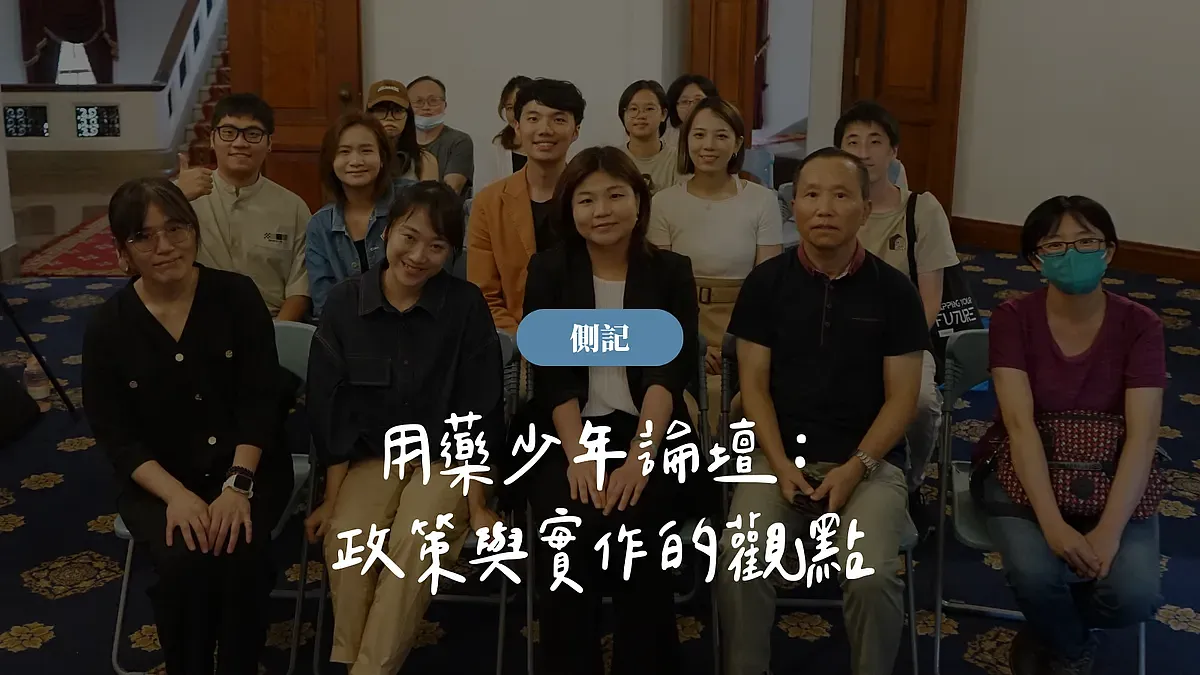
Sidelights | Drug-Using Youth Forum: Perspectives from Policy and Practice
Last edited: 2026-08-23
Moderator | Huang Hsu-Tien (Chairman, JRF)
Panelist | Lin Chun-Ju (Standing Executive Committee Member, JRF; Managing Attorney, Cheng-Li Law Firm)
Panelist | Wang Chien-ling (Reporter, The Reporter)
Panelist | Chen Wen-ju (Associate Professor, Department of Sociology and Social Work, National Taipei University)
Panelist | Peng Tzu-ling (Artistic Director, U-Dog Theatre)
Panelist | Lai Kai-chun (Captain, Narcotics Division, Criminal Investigation Corps, Taipei City Police Department)
Important rights are becoming a part of every "ordinary person's" daily life. Whether it is wrongful conviction rescue, legal education, policy deliberation, strategic litigation, or publication, these are ordinary yet vital everyday tasks for realizing rights.
What should you do when a student shares their story involving drugs with you? What are the legal regulations, and how can we assist students while respecting appropriate boundaries? What are the common issues and prerequisite knowledge required? Approaching the subject from the perspectives of juvenile justice, drug policy, and counseling practice, this lecture guides the audience through issues related to drug-using youth and equips them with the ability to further explore these challenges.
Following the major amendments to the Juvenile Justice Act in 2019 and the implementation of the pre-delinquency youth counseling first mechanism on July 1, 2023, which attracted widespread public attention, education and counseling professionals have also faced entirely new challenges and responsibilities. To help frontline workers understand the system and master practical methods, the JRF brought together practitioners who have long been dedicated to youth work—ranging from theatre workers, juvenile investigators and probation officers, counseling psychologists, guidance teachers, peer support practitioners, university professors, and lawyers to social workers. Together, they focused on "school-based early intervention actions," meeting regularly every month to share experiences. Ultimately, they co-authored a practical handbook for teachers titled *Drug-Using Youth: Campus Regulations and Counseling Practices for Teachers*, which was officially published in October 2023.
As JRF Attorney Huang Hsu-Tien noted regarding the purpose of this book: "Teachers need more knowledge and methods when assisting students. We wanted to write a user manual like 'Teacher, You Can Do This Too' to give frontline teachers a basic understanding of drug issues, conceptualize the legal system, and provide necessary practical reminders to prevent helplessness and confusion when dealing with drug-using youth."
Subsequently, relevant regulations were successively amended: the Juvenile Justice Act was amended again on May 30, 2023, and promulgated on June 21 of the same year, while regulations such as the *Directions for Schools in Establishing Student Counseling and Guidance Measures* were also amended on February 5, 2024, further adjusting campus norms for addressing drug issues. These changes highlight ongoing questions: How is the current counseling-first mechanism operating, and what challenges does it face? How should we think about drug issues, and how should we discuss them with youth and parents? These questions remain central to the campus environment.
Meanwhile, as editor-in-chief and Assistant Professor Lin Chun-Ju reminds us: "This book discusses the current status and patterns of drug use in order to deeply understand the systemic mechanisms and social contexts behind those behaviors. Only by doing so can we find more effective ways to dialogue and accompany them."
Taking this as its theme, this lecture invited the editor and attorney of *Drug-Using Youth: Campus Regulations and Counseling Practices for Teachers*, authors from the social work department and theatre sector, as well as a reporter long concerned with drug policy issues and the captain of the police drug enforcement division, to jointly discuss the concrete realities of drug policy, juvenile justice, and the educational field from diverse perspectives.
In 2023, the JRF brought together practitioners dedicated to youth work—ranging from theatre workers, juvenile investigators and probation officers, counseling psychologists, guidance teachers, peer support practitioners, university professors, and lawyers to social workers. Focusing on "school-based early intervention actions," they met regularly every month to share experiences, ultimately co-authoring the practical handbook *Drug-Using Youth: Campus Regulations and Counseling Practices for Teachers*, which was officially published in October 2023.
The lecture series held during the exhibition "Becoming an Ordinary Person" highlights key themes from the 30-year development of Taiwan's judicial reform, fostering deeper sharing and discussion. For one of the sessions, we invited Attorney Huang Hsu-Tien, Chairman of the JRF, who has always emphasized legal education, to moderate, alongside an exchange between the book's authors, a reporter from The Reporter, and the Captain of the Narcotics Division of the Criminal Investigation Corps, Taipei City Police Department.
Chairman Huang opened the session by noting: How can ordinary people understand the law? How can we try to move society forward together? Sometimes, it is not that teachers are not diligent, but rather that they need help. In the work of judicial reform, how can we help teachers understand student drug use? The book *Drug-Using Youth* attempts to comprehend this issue from the standpoints of counseling, education, and practice, and he then introduced the panelists to share their thoughts with everyone.
(Editor's Note: The following is a summary of the lecture, written in the first person.)
Attorney Lin Chun-Ju: I hope to understand regulations from the perspective of youth and witness the changes they make
As a co-author of this book, today I would like to share the story of youth using the song "Youth in Flight Knows It All Soon."
In reality, everyone plays a certain role within regulatory frameworks, understanding things through our respective roles. However, what is the "youth perspective"? As individuals within the system, what does a "youth-centered" perspective entail? It seems we rarely try to understand this.
For example, viewed from a family perspective, drug use might be a source of a sense of achievement for youth. Coffee-packet drugs are legally mixed substances, but to them, it is an industry; they refer to cannabis as "green gold" and believe they are doing lucrative work. Personal growth is forged through numerous offenses and aversions, developing into a sense of identity.
Under such circumstances, what is the psychology of the so-called "perpetrator" (offender)? As parties involved, their mindset is: how unlucky to have been caught! What constitutes a "problem behavior"? Perhaps it is defined by the law and others as wrong, but in their world, they have not yet comprehended why it is a problem.
Many things happened during my journey of accompanying youth. A youth who read this book told me that they attend night school and work hard to figure out what they want to do in the future. After turning 18, court cases are no longer handled like juvenile offenses resulting in sentencing. Yet, that youth ultimately ended up in prison. Does this mean all our efforts were meaningless? I do not think so. We must understand regulations from the youth's perspective and witness the changes they make.
Reporter Wang Chien-ling: The media's responsibility is to continuously track issues and prevent drugs from invading our young generation
I work in non-profit media, and I personally focus on the medical and pharmaceutical field.
What I want to share is how "etomidate and emerging drugs" have brought about earth-shattering changes to drug use—
Although e-cigarettes are regulated by law, they cannot currently be confiscated. Traces of users can be found in every corner. Addiction medicine practitioners have told me about mothers bringing in their daughters, who suffered from convulsions lying on the floor after vaping for a while. Junior high school students suddenly collapse in the restroom; panicked teachers rush them to the emergency room, running numerous tests without ever identifying the cause.
It has become the premier gateway drug. According to a survey by the National Taiwan University College of Medicine's Forensic Medicine Center, the age of use and the prevalence of mixing emerging drugs are dropping rapidly, with the proportion of junior and senior high school students using them increasing significantly. The male-to-female ratio is gradually shifting to 1:1, and the accessibility of drugs is continually rising.
What symptoms occur with etomidate use? Symptoms include lethargy, delirium, tremors, and others. It may not kill the user immediately, but it can kill others. It clearly affects adrenal function and even impairs steroid absorption. Drug manufacturers have altered chemical formulas, and the use of emerging drugs and anesthetics makes them much more accessible to young people.
The current testing threshold is 50 nanograms per milliliter, and a positive result indicates drug use. Ideally, laboratories should be able to detect down to the lower limit of quantification, but practical difficulties vary across different laboratories.
Protecting adolescents requires cross-ministerial cooperation. On the educational front, we find a lack of unified and effective management methods; on the medical front, adolescents must be encouraged to voluntarily seek help and understand the body's reactions after use. The judicial front also faces difficulties, including threshold-setting dilemmas and very low indictment rates following consumption.
The media's responsibility lies in promoting crucial reform policies, narrating stories from society's corners, continuously tracking issues, and preventing drugs from invading our young generation.
Theatre Worker Peng Tzu-ling: Through theatre, we understand how adolescents are loved and how to anchor an important heart
Our theatre troupe, U-Dog Theatre, engages in arts education, working alongside youth in special circumstances over the long term. We invited a sex therapist to talk with adolescents; what they most wanted to know about were their parents' sexual relationships and stories. They are curious and concerned, seeking to understand how their family of origin influences a child's self-development. Youth remind us of the essence of existence—something adults often overlook, yet these are matters adolescents ponder every single day.
Our theatre collaborates with the Social Welfare Department and the Narcotics Prevention Center. For the theatre, drugs are merely a result. Some people are addicted to mobile phones, sweets, or online shopping. Living is genuinely hard, and they may encounter anxiety and suffering that can be magnified hundreds of times over. High-care and high-risk youth frequently fall ill or experience accidents. Our past anti-drug advocacy has been a failure; after viewing various media information, adolescents find these anti-drug campaigns far too simplistic.
We discuss drugs through acting, but we strive not to provide answers. Using a forum theatre format, we perform experimentally, guiding the audience to participate within the designed plots.
If teachers discover that a student is using drugs, they must report it within 24 hours. Adolescents perceive any reporting simply as punishment. However, what is truly important to them is: how to be loved, and how to have an important heart anchored. We strive to understand the journey of how youth arrived at where they are today, and through theatre, we hope to see fewer and fewer drug-using youth.
Captain Lai Kai-chun of the Police Narcotics Division: Curbing organized crime, cracking down on fraudsters, preventing sexual violence, and strictly guarding against drug pods
Our work focuses on emerging drug issues and prevention—
Current status of e-cigarettes: The current situation is that they are illegal, with penalties imposed on manufacture, import, and advertising. The government has found that you cannot retroactively test confiscated e-cigarettes. Milk tea cups, space dogs—these cute e-cigarettes are outposts for drug contact. Vaping oil is filled into them, and toxic oils may be mixed in. Police collectively refer to these mixed-drug packaging teas as "packet teas"; after importing etomidate, it is turned into packaged tea.
Various types of toxic vape products: Cannabis vape carts (vape carts containing cannabis extracts, heated and atomized for inhalation). Thailand legalized cannabis, and the law cannot keep up. Etomidate (originally a medical anesthetic; users experience hallucinations, anesthesia, muscle spasms, and other side effects) has been officially gazetted as a Category 2 narcotic. Rainbow cigarettes (Category 3 narcotics; synthetic cathinones often mixed into tobacco and made into paper cigarettes, available in various fruit flavors). Coffee-packet drugs consist of narcotics mixed with juice powder, enhanced with flavoring agents to brew and consume.
Various internet application software: TikTok, Telegram, Hi dating apps, and even so-called "dead drops" (where drugs are buried in the soil, photos and locations are sent, and buyers dig them up from the earth).
Our work is to prevent youth from being exposed to hazardous environments. The focus of law enforcement includes: curbing organized crime, cracking down on fraudsters, preventing sexual violence, strictly guarding against drug pods, and strengthening the investigation of adult-juvenile joint-offense cases.
Professor Chen Wen-ju, Department of Social Work, National Taipei University: In the process of retelling their stories, they will walk out of their own lives
Regarding the educational issue of children and youth drug use on campus, as just mentioned regarding dead drops, similar cases already existed in drug rehabilitation villages 20 years ago.
Today, in this exhibition "Becoming an Ordinary Person," the focus seems to be on the process of becoming oneself. For adolescents, once their self-identity stabilizes somewhat, what should they do next? What is the direction and purpose of my life? If I do not use drugs, can I have other choices and directions?
"Everything is poisonous; it's all about the dosage." Why is substance literacy important?
Scope of toxins/substances:
- People: Family members, interpersonal relationships inside and outside school, virtual relationships
- Events: Living environment and lifestyle, academic pressure, information, and social norms
- Things: Drugs, medications, etc.
These scopes of toxic influences are easily induced by the environment, as we begin to care about the opinions of others, seek approval, and strive for understanding and support.
Substance literacy and harm reduction are important because medicine and poison share the same roots; we need to understand what we are obtaining, how to recognize addiction, side effects, and drug risks. The danger of coffee-packet drugs lies in their mixture, and the quality is unstable each time. In drug economics, one must also understand how these mechanisms can be effectively managed. While preventing crime, health can also be maintained. Foreign websites publish known substances so that recipients can understand what effects to expect.
Four strategies are essential:
- Strategy 1: Dense drug prevention reporting network (establishing an intensive system for rapid detection)
- Strategy 2: Increasing principals' and schools' responsibilities for drug prevention (shifting from children not knowing how to seek help when in need to reducing toxic stress)
- Strategy 3: Strengthening the prevention of emerging drugs entering campuses (integrating substance literacy concepts into teaching materials so adolescents become gatekeepers of themselves)
- Strategy 4: Establishing case-tracking counseling databases (treating adolescents as vital partners and subjects in implementing counseling)
I believe that in the process of retelling their stories, they will walk out of their own lives.
Q&A:
Q (Audience): In terms of formal policy, imposing heavy penalties on drug offenses is not the best approach. I feel they are patients rather than criminals. Can drug consumption be decriminalized? Can drug prevention be flipped? This issue can be handled from the students' perspective, bringing the problem out of the underground and into the open.
A (Lin Chun-Ju): As we move away from the era of punishment and heavy penalties, we must incorporate harm reduction and preventive approaches along the way. Regarding the administrative and counseling first mechanism for youth, we previously lacked a good system. Entering with a counseling-first perspective, responsibilities currently placed on juvenile guidance committees—where resources such as social workers and police lack counseling competencies—can make the work very difficult. How to pull systematic perspectives out from a governance standpoint remains a challenge.
A (Chen Wen-ju): The concepts of decriminalization and legalization are frequently confused. What people actually want is a choice; they need external controls to know whether they should do something. This must align with the willingness of the system to give people more opportunities. I personally maintain a reserved attitude.
A (Peng Tzu-ling): Adolescents spend a great deal of time imitating adults. When discussing drugs, adolescents feel that drugs equal shame. How to seek help, and discussing this with children, also stems from adults having created a malicious space. How can we enable adolescents to face this courageously? We must become partners with adolescents and extend an invitation to them.
This article is an AI-generated translation of the original Chinese text. In the event of any discrepancy, the Chinese version shall prevail.