
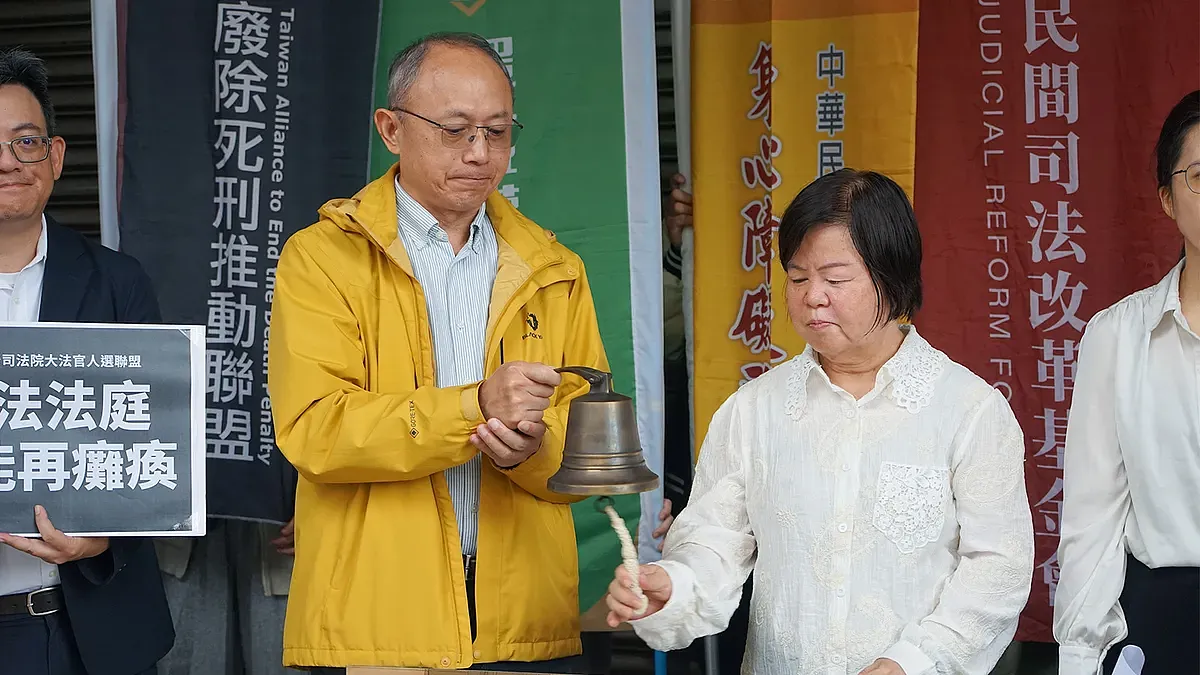
Press Conference | "270 Days of Constitutional Crisis! The Constitutional Court Cannot Remain Paralyzed Any Longer; Breaking Through on Our Own is Not Overreach" Press Release
Last edited: 2026-08-23
On October 8th, three Grand Justices—Tsai, Tsung-Jen, Chu, Fu-Mei, and Yang, Hui-Chin—issued a joint statement indicating that "Grand Justices must comply with the provisions of the currently effective Constitutional Court Procedure Act," and that "when the number of Grand Justices falls below 10, a lawful Constitutional Court cannot be formed in principle, and therefore deliberations on accepted cases cannot proceed. With an unlawful composition of the Constitutional Court, any deliberations conducted are naturally illegal. Based on the obligation to safeguard the Constitution, Grand Justices should not participate in illegal case deliberations and judgments." In this regard, given the divided opinions within the Constitutional Court, it will be difficult in the short term to restore the Constitutional Court's function of checking the executive and legislative branches through constitutional judgments.
Our Alliance already pointed out in our September 17th statement that as long as the Constitutional Court cannot perform its duty to monitor and check other powers in accordance with the Constitution of the Republic of China (Taiwan), the most effective way for the opposition coalition to evade oversight is to block all Grand Justice nominees across the board. In short, the fact that the Constitutional Court has stalled actually gives the opposition coalition an incentive to keep blocking appointments. On the other hand, to avoid the side effects of having a small number of nominees approved, the ruling party has also chosen to engage in strategic vetoes. Under this environment, no matter how qualified a nominee is, they cannot pass the Legislative Yuan.
Using the tolling of a bell to symbolize "a warning bell at dusk and dawn," our Alliance wishes to remind the President, legislators, and the general public—at a time when the Constitutional Court is paralyzed—not to forget the importance of constitutional order and the rights of the people who are still suffering while awaiting constitutional litigation remedies, and once again calls on the President and the Legislative Yuan to swiftly pass qualified candidates for Grand Justices; at the same time, our Alliance also emphasizes that when facing the dilemma of its own paralysis, the Constitutional Court should not merely passively accept the "laws" passed by the Legislative Yuan, but rather bears the primary obligation to safeguard the Constitution.
The Constitutional Court's Procedural Autonomy Is Neither Unconstitutional Nor Judicial Overreach
For this press conference, we have specially invited scholars including former Judicial Yuan Grand Justice Hung-Hsia Huang, Distinguished Professor Chia-Yin Chang of Soochow University's Department of Law, Research Fellow Yen-Tu Su of the Institutum Jurisprudentiae, Academia Sinica, and Associate Professor Hsiu-Yu Fan of National Taiwan University's Graduate Institute of National Development, to elucidate this dilemma from a constitutional perspective. In addition, drawing from the numerous scholarly opinions below, our Alliance will explain why the Grand Justices can and should independently break free from their current plight.
Based on the legal principle that the Constitution prevails over "laws," the power of judicial review of the Constitutional Court and its operation must never be arbitrarily hollowed out by the legislature through legislation. Otherwise, not only does this infringe upon the principle of separation of powers and conflict with constitutional supremacy, but the legislature will also be left unrestrained, and checks and balances and the separation of powers will cease to exist. Furthermore, scholar Yen-Tu Su believes that from the perspective of human rights protection, the inability of the Constitutional Court to function, leaving the people without remedies, also constitutes an infringement upon human rights.
Based on the legal principle of constitutional supremacy, the manner in which the power of judicial review is exercised cannot be entirely subjected to other branches of power. The concept of this "procedural autonomy" was revealed as early as "Interpretation No. 371" and was reaffirmed in "Interpretation No. 585." Its significance extends beyond merely filling gaps when the law is silent; it is an essential weapon enabling the Constitutional Court to monitor legislative and executive abuses of power. This is why "ordinary courts' compliance with procedural laws" cannot be analogized to the current impasse. The absence of past precedents does not prove that Grand Justices must simply bow to the Legislative Yuan; rather, it proves that prior to this, Taiwan had not experienced such attacks and contempt directed at the Constitutional Court. Scholar Chia-Ho Lin has also pointed out that under German law, whenever the legislature touches upon regulations concerning the adjudicative jurisdiction of the constitutional court—as long as the constitutional court itself perceives problems, doubts, ambiguities, or even contradictions—the legislature's rules and directives are frequently "bypassed by the Federal Constitutional Court of Germany."
Facing the current predicament, scholar Tung-Ying Li believes that in urgent situations where candidates for Grand Justices have long failed to be appointed, the Grand Justices may, pursuant to the aforementioned legal principles, declare Paragraph 2, Article 30 of the new Constitutional Court Procedure Act unconstitutional under "specific circumstances" because it renders the Grand Justices unable to fulfill the tasks assigned by the Constitution, and through a judgment of "retroactive nullification," exempt the Constitutional Court from being bound by the minimum quorum for deliberations in that specific case. Additionally, scholar Sheng-Yi Huang argues that based on the "need to avoid contradictory problems regarding the validity of applying the 'judgment declaring the new law unconstitutional' after declaring the new law unconstitutional" and the "purpose of judicial review," the old law should be applied to review the new law until the new law is confirmed to be constitutional.
Conversely, although dissenting opinions are not entirely without basis, they are powerless in the face of the present dilemma. In particular, the assertion that "Grand Justices are bound by the new Constitutional Court Procedure Act no matter what" clearly lacks persuasiveness under the legal principle of constitutional supremacy. The Constitutional Court's "procedural autonomy" does not mean it can act arbitrarily and without restraint; rather, it forms a dynamic balance with the legislature's legislative discretion regarding the system of judicial review. However, it is obvious that as the Constitutional Court steps into its 270th day of paralysis, this balance has long been shattered by the legislature. Starting from the opinions of the aforementioned scholars, and looking further at the opinions of four Grand Justices led by Ming-Yan Shieh, it is clear that the Constitutional Court has sufficient theoretical foundations to break through the current predicament. This is obviously not "unconstitutionality" or "judicial overreach," but rather a necessary measure to "uphold constitutional supremacy and prevent legislative dominance."
We call once again: for this deadlock of paralyzed constitutional organs, there is no other choice but for the Constitutional Court to take responsibility and respond if there is any chance to re-engage the functions of monitoring and checks and balances under the principle of the separation of powers. Otherwise, the Constitutional Court is very likely to remain endlessly paralyzed for the next three years.

Our Alliance already called on the President on September 17 to "enhance the transparency and participation of the screening and recommendation process to garner broader social support"; and called on the Legislative Yuan to "conduct rational reviews and avoid using the Grand Justices as sacrifices for partisan confrontation." We sincerely appeal that during the screening and recommendation process, the Office of the President should expand the membership of the screening and recommendation committee to include more diverse representatives, and should more actively and thoroughly explain the reasons for nomination to secure greater social support. Meanwhile, all party caucuses in the Legislative Yuan should allow legislators to vote freely, thoroughly examine nominees' moral integrity, constitutional human rights ideals, and academic expertise, and by no means repeat past mistakes by allowing the people's constitutional rights to continue being hijacked by party politics.
Press Conference Time
Wednesday, October 22, 2025, 10:00 AM
Press Conference Location
In front of Qunxian Building, No. 3, Sec. 1, Jinan Rd., Zhongzheng Dist., Taipei City
Scholars and Experts
Huang, Hung-Hsia|Former Grand Justice of the Judicial Yuan
Chang, Chia-Yin|Distinguished Professor, Department of Law, Soochow University
Su, Yen-Tu|Research Fellow, Institutum Jurisprudentiae, Academia Sinica
Fan, Hsiu-Yu|Associate Professor, Graduate Institute of National Development, National Taiwan University
Attendees and Allied Organizations
Huang, Sung-Li|Convener, Alliance to Monitor Judicial Yuan Grand Justice Nominees; Director, Human Rights Policy Center, Covenants Watch
Lee, Ming-Ju|Deputy Convener, Alliance to Monitor Judicial Yuan Grand Justice Nominees; Deputy Executive Director, Judicial Reform Foundation
Huang, Yi-Bih|Executive Director, Covenants Watch
Kan, Chih-Yi|Secretary-General, Taiwan Association of Youth Lawyers
Wang, Hsi|Deputy Secretary-General, Taiwan Association for Human Rights
Chien, Chih-Chieh|Secretary-General, Taiwan Alliance to Promote Civil Partnership Rights
Shen, Ya-Hui|Office Director, Taiwan Alliance to Promote Civil Partnership Rights
Chen, Li-Yi|Director of Policy Department, Citizen Congress Watch
Yang, Yan|Legal Affairs Director, Taiwan Alliance to End the Death Penalty
Huang, Hui-Yu|Deputy Director, Taiwan Association for Truth and Reconciliation
Lo, Fang-Chen|Full-time Attorney, Environmental Jurists Association
Kuo, Hsueh-Yun|Executive Secretary, Taiwan Criminal Defense Lawyers Association
Chang, Che-Cheng|Policy Research Specialist, National Union of the Physically and Mentally Impaired of the Republic of China
Association for Women's Rights Promotion
Taiwan Labor Front
Taipei Bar Association
Press Contacts
Attorney Lu, Elvin, Director of Legal Policy Department, Judicial Reform Foundation
Phone: 02-2523-1178#37
Email: elvin@jrf.org.tw
This article is an AI-generated translation of the original Chinese text. In the event of any discrepancy, the Chinese version shall prevail.