
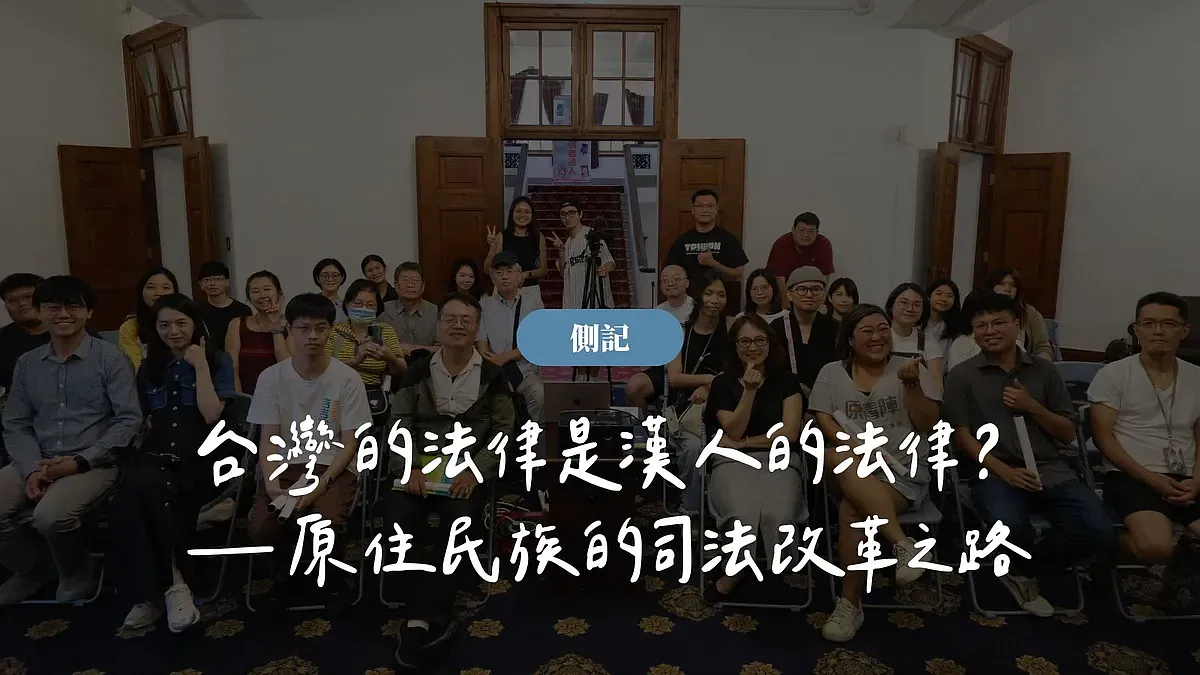
Sidelights | Are Taiwan's Laws Han Chinese Laws?——The Path of Indigenous Peoples' Judicial Reform
Last edited: 2026-08-23
Moderator | Lin Cheng-ching (Bill Research Assistant, Judicial Reform Foundation)
Speaker | Cheng Chuan-ju (Board Member, Judicial Reform Foundation; Associate Professor, Graduate Institute of Culture and Educational Law, National Taipei University of Education)
Speaker | Savungaz Valincinan (Chairperson, Taiwan Indigenous Youth Public Participation Association)
During the exhibition "Becoming an Ordinary Person," the lecture series selected key themes from the 30-year development of Taiwan's judicial reform for deeper sharing and discussion. For the final session, we invited Professor Cheng Chuan-ju and Chairperson Savungaz Valincinan to discuss the path of judicial reform for Indigenous peoples.
In 2005, the Indigenous Peoples Basic Law was hailed as a cross-era piece of legislation, legally recognizing for the first time Indigenous peoples and their rights to autonomy, land, and culture. Twenty years later, villages have wide asphalt roads, language revitalization programs have blossomed, and traditional intellectual creations have received exclusive rights protection; however, core land and resource rights remain trapped within the letter of the law.
From the Shuiyuan tribe in Hualien to Smangus in Hsinchu, and from the democratic legitimacy of the Constitution to cultural defenses in administrative litigation, the two speakers reviewed the achievements and setbacks of this journey while pointing directly to the gap in Taiwanese society's understanding of Indigenous peoples. With land not yet returned and autonomy difficult to exercise, the path forward still unfolds between dialogue and action.
"Are Taiwan's Laws Han Chinese Laws?"
In discussions on Taiwan's judicial reform, Indigenous rights have long been treated as a marginalized issue. When most people think of judicial reform, they think of amendments to criminal and civil procedural laws, the appointment of judicial personnel, and the improvement of trial environments; Indigenous peoples, on the other hand, are often associated with seemingly "alternative" issues such as hunting, gathering, and animal protection.
However, these two domains are not entirely unrelated. Moderated by JRF Bill Research Assistant Lin Cheng-ching, this lecture raised a core question: "Are Taiwan's laws Han Chinese laws?" He reviewed the drafting of the Constitution of the Republic of China, noting that Taiwan had only 18 representatives and Indigenous peoples had only one participant, highlighting a lack of constitutional legitimacy.
Furthermore, around the lifting of martial law in the 1980s, the Indigenous movement took shape within the context of the tangwai (outside the party) movement. After martial law was lifted in 1987, constitutional amendments and the drafting of a new constitution became two parallel paths: constitutional amendments gave birth to the "Indigenous Peoples Provisions" in Article 10 of the Additional Articles of the Constitution, while drafting a new constitution held the hope of reconstructing the national foundation of a multi-ethnic society. However, the constitutional recognition of Indigenous peoples remains controversial: are these "fundamental rights" or "fundamental national policies"? If they are fundamental national policies, they lack directly actionable claims.
Professor Cheng Chuan-ju: Twenty Years of Progress, Dilemmas, and the Future
Economic Progress
According to statistics, in 2005 the average annual income of Indigenous households was only about NT$510,000, less than half of Taiwan's overall average, with household sizes reaching five to six people, leaving a per capita monthly living expense of only NT$6,000 to NT$7,000. Twenty years later, the average annual income has risen to NT$750,000, and household sizes have decreased, improving living conditions.
Educational Progress
In 2005, there were no Indigenous experimental schools in Taiwan; by 2025, this has grown to 36 experimental elementary schools, 4 experimental junior high schools, and 1 experimental high school, repeatedly winning the Ministry of Education's Teaching Excellence Award. These schools not only teach general curricula but also shoulder the mission of cultural and linguistic transmission. In addition, 33 universities have established dedicated Indigenous classes and 6 professional master's programs covering fields such as tourism, design, and nursing.
Language Revitalization Progress
The Development of National Languages Act gave birth to the Indigenous Languages Development Foundation, promoting tribal language preservation and the digital learning platform "Indigenous Language e-Paradise," which has accumulated over 34 million views.
Cultural Protection Progress
Passed in 2007, the Indigenous Traditional Intellectual Creation Protection Act safeguards cultural achievements such as music, dance, and clothing co-created by ethnic groups. Currently, 95 items have secured exclusive rights confirmation, preventing unauthorized commercial use by outsiders.
Tribal Autonomy Case Study: The Co-management Model of Smangus
Located deep in the mountains of Hsinchu, the Atayal tribe's Smangus community had only about 9 households left in the late 1990s. Starting in 2001, relying on giant tree tourism, they implemented a co-management system where accommodation, guided tours, and dining are centrally coordinated by the tribe. Today, it attracts about 100,000 tourists annually, generates over NT$40 million in revenue, and provides welfare for weddings, childbirth, medical care, and retirement, becoming a case where autonomy is realized without legislation.
Current Dilemmas: Land Dispossession and Insufficient Social Understanding
The total area of Indigenous peoples' traditional territories (Indigenous reservations) across Taiwan is about 260,000 hectares, but nearly half (49%) are registered in the state's name, with only 51% owned by Indigenous peoples. Although the 1960s privatization policy was based on the principle of "user registration," its fairness was inadequate: those who went out to work, were unable to pay taxes, or were unaware of the boundaries of Indigenous reservations did not receive adequate opportunities to apply.
Using her hometown, the Shuiyuan tribe in Hualien, as an example, Professor Cheng noted that land that should have been registered by members of her ethnic group in the 1960s was, by 2023, only about 40% held by tribal members, with the rest flowing to the state or outsiders. The loss of land means the disintegration of a cultural way of life. Just as the history of the Pingpu groups demonstrates, once the living context connected to the land is lost, the ethnic group itself may vanish.
Future Directions: Land Restitution and the Promotion of Autonomy
Whether it is restoring fairness to Indigenous reservations, enacting legislation related to traditional territories, or promoting systems of autonomy, the land issue has always been core. Losing land signifies a break in the way of life and cultural transmission. If legislation and policies stagnate, Indigenous peoples may face an even more severe risk of cultural extinction.
Savungaz Valincinan: The Trajectory of Action from Electoral Demarcation and Exclusive Rights Disputes to the Hunter Constitutional Interpretation Case
Structural Limitations of Political Participation
Serving concurrently as the Chairperson of the Taiwan Indigenous Youth Public Participation Association and an activist in multiple social movements, Savungaz pointed out that barriers to political participation are often determined at the very moment of birth. Taiwan's current system divides Indigenous peoples into "mountain indigenous" and "plain indigenous" categories, with status determined by birthplace and household registration rather than personal choice. This division directly impacts the electoral system, with mountain and plain indigenous having different constituencies and legislative seats, creating differences in representation and further affecting resource allocation.
In Savungaz's view, such institutional design superficially guarantees the political representation of Indigenous peoples, but in reality, it may create barriers between ethnic groups, causing them to compete against each other for resources rather than cooperate. Furthermore, the current education system fails to design curricula tailored to the cultural backgrounds and needs of different ethnic groups, resulting in a generational disconnect among youth between political participation and cultural identity.
Conflicts Between Exclusive Rights and Cultural Use: The Case of the Cilangasan "Warrior Dance"
Savungaz shared the legal dispute surrounding the Cilangasan tribe's "Warrior Dance." The warrior dance is a highly symbolic cultural performance of the tribe. Tribal members applied for exclusive rights under the Indigenous Traditional Intellectual Creation Protection Act, believing that the tribe should independently manage and consent to its use by outsiders. However, in the administrative litigation, the court ultimately ruled against the tribal members on the grounds that the competent authority deemed external use of the cultural symbol lawful under "fair use."
This case highlights the limitations of the current system: although "exclusive rights to traditional intellectual creation" already exist in law, during concrete implementation, the interpretations of competent authorities and courts may lean toward public interest or commercial demands, failing to fully consider cultural ownership and spiritual significance. Savungaz believes this interpretation equates culture to a freely accessible public resource, weakening Indigenous peoples' independent control over their own culture.
Hunter Constitutional Interpretation and Traditional Name Actions
Beyond cultural rights, Savungaz has also actively participated in legal actions concerning hunters' rights. For years, Indigenous peoples hunting in traditional ways have frequently been prosecuted under the Wildlife Conservation Act and the Controlling Guns, Ammunition and Knives Enforcement Act. Savungaz supports and promotes the "hunter constitutional interpretation," advocating that hunting must be recognized as a cultural and livelihood necessity and regarded as a constitutionally protected cultural right.
At the same time, she calls on tribal members to restore their traditional names, viewing this as a vital part of cultural revitalization. For Savungaz, traditional names are not merely markers of identity, but embody the historical memories of families and tribes. Through the name-restoration movement, she hopes tribal members can reconnect with their cultural roots in daily life and normalize the use of traditional names in legal documents, educational systems, and social interactions.
Starting from Understanding to Rebuild Equality and Trust
Looking back over the past twenty years, the Indigenous Peoples Basic Law laid the foundation for the legal recognition of Indigenous rights and achieved remarkable results in economic, educational, linguistic, cultural, and tribal autonomy domains. However, core land and resource rights remain unresolved gaps. Stagnation in land surveys and restitution legislation leaves many traditional territories confined to legal texts and official documents, making it difficult to truly implement them on the ground.
As the speakers pointed out, the realization of rights is not merely a matter of legal text, but depends on society's understanding and support. When surveys show that nearly half of the public has never interacted with Indigenous peoples and 80% have insufficient understanding of their culture, this is not just an information gap, but the root cause of why political will is difficult to gather. A lack of understanding means that in policymaking and resource allocation, the voices of Indigenous peoples are easily marginalized.
The key to the future lies in establishing continuous and sincere exchange. Only when mainstream society views the rights and interests of Indigenous peoples as part of the common good rather than "special treatment" for a minority group can true consensus be forged at the legal and policy levels. Equality and trust cannot be accomplished in a single meeting or a single piece of legislation; they require time, patience, and continuous dialogue. When understanding becomes the foundation, policies can become solid, land has a chance to return to the hands of tribes, and culture and ways of life can be sustained. This is not only the future of Indigenous peoples, but the shared responsibility and challenge of Taiwanese society as a whole.
This article is an AI-generated translation of the original Chinese text. In the event of any discrepancy, the Chinese version shall prevail.