
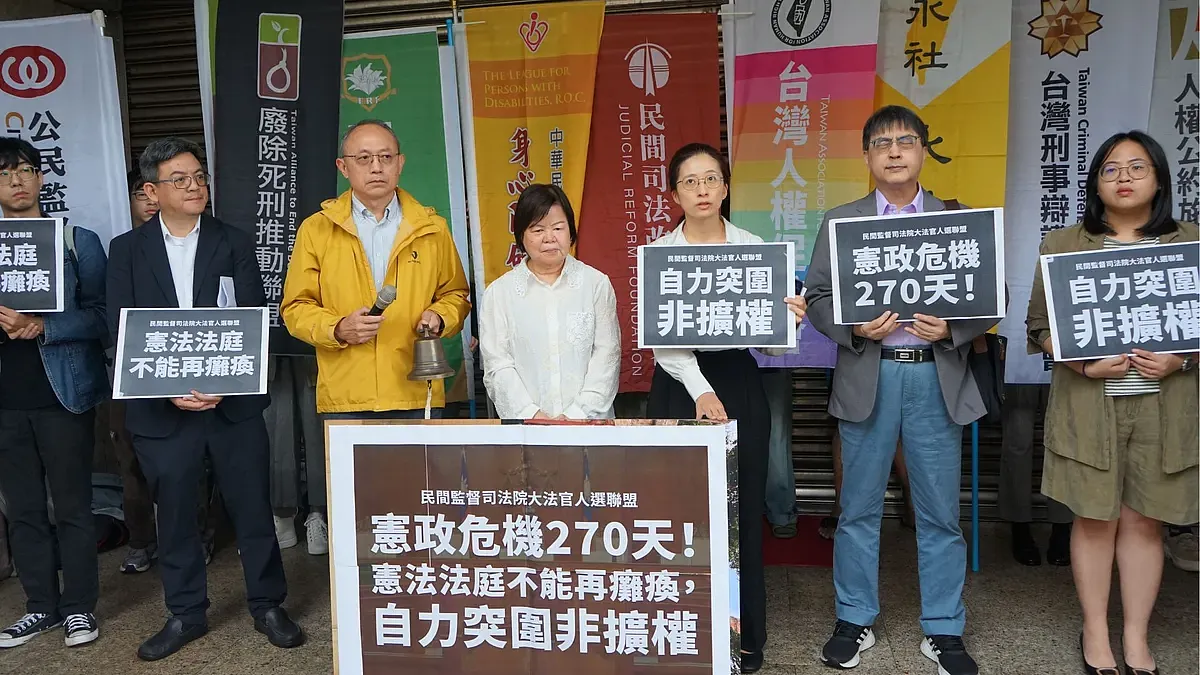
Speech | Press Conference on "270 Days of Constitutional Crisis! The Constitutional Court Cannot Be Paralyzed Anymore; Self-Breakthrough Is Not Overreach"
Last edited: 2026-08-23
Huang Sung-li | Convener, Alliance for Citizens' Monitoring of Judicial Yuan Grand Justice Nominees
The Constitutional Court has not functioned for 270 days. We believe this is not only a crisis for the protection of human rights, but also hinders the maintenance of Taiwan's constitutional democratic system. Today, we make a solemn appeal to our government—including the Legislative Yuan, the Executive Yuan, and the Judicial Yuan—to take action immediately, because if the current constitutional deadlock is not addressed, it will sooner or later become a constitutional crisis. Our time is limited; we are seeing a growing accumulation of petitions filed by citizens that are currently going unaddressed.
The confrontation between branches of government, in the absence of the Constitutional Court to render a final judgment, is a very dangerous matter for political and institutional operations. At the same time, we know that three Grand Justices hold different opinions regarding the handling of this crisis. However, we believe that their personal opinions still do not constitute the deliberation result of the Constitutional Court, and therefore we hope there is still room for turnaround on this matter.
Huang Hung-hsia | Former Grand Justice of the Judicial Yuan
Good morning, everyone. My mood today is truly very heavy. As a former Grand Justice, regarding the 270-day paralysis of the Constitutional Court, I feel truly apologetic to the people—truly sorry.
I have already stepped down as a Grand Justice, so I am also a citizen. Standing from the perspective of the people, I must also make an appeal. I believe this paralysis is unjustified; the Constitutional Court should not be paralyzed for a single day, nor should there be any method that can paralyze the Constitutional Court.
This result, I believe, stems from a failure of duty on the part of the current Grand Justices of the Constitutional Court. Therefore, I call upon the Grand Justices of the Constitutional Court here: please faithfully uphold your duties, safeguard the Constitutional Court, and protect the fundamental rights of the people. This is your unshirkable responsibility.
Regarding the current paralyzed situation, I believe there are several possible directions to resolve it.
First, these three Grand Justices used the method of "issuing a statement" to express their differing opinions. Of course, in a democratic society, everyone should mutually respect differing opinions on a given matter, but that does not mean you can use improper and inappropriate methods to paralyze the Constitutional Court. Over the past seventy-odd years, never has any Grand Justice used a method other than an opinion to express views on a case under deliberation—using the method of "issuing one's own statement." This is impermissible. Their public statement today is wrong; such behavior has violated self-disciplinary mechanisms, and the Constitutional Court has the authority to refer the violating Grand Justices for self-discipline.
The second method: the people can certainly save themselves, rather than letting the Grand Justices have the final say. Therefore, when Grand Justices display opinions through improper methods, the people should be able to seek self-help and file motions for the recusal of the Grand Justices.
The third method: under circumstances where the Grand Justices have a self-disciplinary mechanism, since some Grand Justices have already indicated their unwillingness to attend, such behavior is impermissible. Consideration should be given, through the provisions within the Constitutional Court Procedure Act itself, not to count them toward the attendance quorum. I believe this is a resolvable and acceptable approach. Especially under the current circumstances, since Grand Justices inherently possess procedural autonomy over their own proceedings, this should be acceptable.
During deliberations, I also hope that the honorable Grand Justices will reconsider and abide by the rules of the game. There is no right to refuse attendance at "deliberations." If you hold a dissenting opinion, please attend and communicate thoroughly during the meeting. If you believe your minority opinion is correct, you should strive to persuade the majority opinion and turn your minority opinion into the majority opinion. If you still remain in the minority, please use a dissenting opinion to express it. Expressing legal opinions by way of "statements" entirely forfeits the duties of a judge.
Chang Chia-yin | Distinguished Professor, Department of Law, Soochow University
As a scholar, I must say that standing here today, my mood is truly, very heavy.
First, I must condemn these three Grand Justices. Because the situation over the past year and a half has actually been very clear: what is the Legislative Yuan doing? The Legislative Yuan is murdering the Constitutional Court. When the Legislative Yuan is murdering the Constitutional Court, the Grand Justices, as members of the Constitutional Court, actually fail to think about resisting and instead act as accomplices—this is very hard to imagine. Just as former Grand Justice Huang Hung-hsia said, this matter has never happened in the history of constitutional interpretation by Grand Justices in our country. No matter how difficult things were in the past, the Grand Justices would still barely meet the attendance quorum, or resolve the issue based on the existing total number of members.
The phenomenon of "seeing the trees but not the forest" may be a flaw that legal professionals sometimes commit. Please take a look at the constitutional design governing the Justices of the Judicial Yuan: it is fundamentally grounded in the Constitution of the Republic of China, rather than created by legislation enacted by the Legislative Yuan. Some scholarly discourse claims that "the Constitutional Court is created by law"; this is entirely an erroneous view.
Scholars have discussed extensively what judicial procedural autonomy is. Of course, judicial procedural autonomy is not absolute either. The Constitution of the Republic of China embodies constitutionalism, and a fundamental principle of constitutionalism is the separation of powers. Therefore, while the Legislative Yuan certainly has the power to enact the Constitutional Court Procedure Act, it has a constitutional boundary. If it crosses this constitutional boundary, it is fundamentally a law with a very high suspicion of unconstitutionality. Moreover, let us look at what the result has been: over the past year, through the amendment of the Constitutional Court Procedure Act and through the complete vetoing of new Grand Justice nominees, the Legislative Yuan has created an unprecedented state of paralyzed judicial review. Even without necessarily studying constitutional law, from the perspective of an ordinary citizen, how can one endure such a situation?
The separation of powers is an indispensable part of constitutionalism. In the face of the severe confrontation and conflict between the executive and legislative branches, the Grand Justices can serve as the arbiters to mediate constitutional disputes. Since the Constitution assigns the Grand Justices the mission of being constitutional guardians, Grand Justices must themselves understand this role. Safeguarding the Constitution does not mean acquiescing to the murder of the Constitutional Court by the Legislative Yuan, nor does it mean complying with laws that cause the paralysis of the Constitutional Court.
Generally speaking, past Grand Justices have also had the courage to break through unreasonable restrictions imposed by legislators; therefore, when facing unconstitutional legal provisions, Grand Justices have no reason to obediently submit. Here, I still hope these three Grand Justices can have a change of heart. If they can recognize their responsibility to safeguard the Constitution, they should actively assume the role of constitutional guardians and awaken the Constitutional Court from its current "comatose" state.
Our constitutional order is disintegrating. If the Grand Justices can realize this, they should wake up and have the courage to withstand the pressure, truly stepping onto the path of safeguarding the Constitution. I believe history will surely record this critical moment.
Yen-Tu Su | Research Fellow, Institute of Law, Academia Sinica
Starting last year, many of my friends here and I stood right here, stood on the streets, calling on the Legislative Yuan not to pass the malignant amendments to the Constitutional Court Procedure Act. Very unfortunately, this year we are still standing here. I want to share four things with everyone. First: Why are we standing here? Second, I want to say some words to the Constitutional Court; third, I want to appeal to the political departments, including the Legislative Yuan and the President; and finally, I want to convey a message to our civil society.
Courts being attacked in Taiwan is not an isolated case. Over the past decade or so, for scholars discussing and researching comparative constitutional law globally, one of the most frequently used keywords is "democratic backsliding." The first step of democratic backsliding is often to attack the courts. Therefore, constitutional courts in many liberal democracies around the world have been attacked—such as through modifying institutional rules to make the constitutional courts difficult to operate, or allowing individuals aligned with those in power to control the constitutional courts.
Regrettably, we have followed in the footsteps of these countries undergoing democratic backsliding. Therefore, being paralyzed today is not just a matter concerning the Constitutional Court. The fact that the Constitutional Court is being paralyzed means Taiwan's democracy is sliding backward; this is everyone's business.
This issue has been relatively well-discussed in academia, so many scholars already have discourses on it—for example, I have a paper here from 2024: "Democratic Self-Defence of Constitutional Courts." If we hope the Constitutional Court can protect people's rights and safeguard the constitutional order of freedom and democracy, the Constitutional Court must first engage in self-defense. The theories and methods are laid out right in there. This self-defense is no longer even the constitutional court's instinct for self-preservation; it has already become its constitutional obligation.
Therefore, next, I want to say some words to the three Grand Justices who issued the public statement. I imagine they are also experiencing a great deal of struggle. These three Grand Justices feel they are facing a conflict of obligations, believing that based on their conviction, they must obey the law; yet following this conviction requires these three Grand Justices to even violate their obligation to participate in deliberations. These three Grand Justices might also worry that if the Constitutional Court renders an unconstitutional judgment on this matter, since there are currently only eight Grand Justices, many opposing individuals will not accept it.
These three Grand Justices might expect that it would be better to wait until the quorum for deliberations is replenished before discussing the case. Perhaps even if new Grand Justices agree that this new Constitutional Court Procedure Act is unconstitutional, such a judgment might more easily gain public trust.
What I want to explain to the three Grand Justices is that we can all understand your good intentions, but one probable inference is this: such a decision gives those who hope the Constitutional Court will be paralyzed zero incentive or motivation to keep the Constitutional Court functioning. If you want to destroy an institution, you must first paralyze the people operating that institution. If the Constitutional Court can only choose to passively wait for the headcount to be replenished, the Legislative Yuan will instead have zero motivation to consent to new Grand Justice personnel.
We can all understand various concerns, but when we already have 14 exceptional legal minds who have fallen in the line of duty, I believe it is truly time to ask the incumbent Grand Justices to re-examine: what is our current realistic state? And to rethink how we must act to truly live up to the public.
The third thing is to communicate with the government departments. Many people now mention that we only need to change our nomination mechanism to nominate candidates whom the opposition parties can accept, and they believe the current predicament is actually caused by the President's unwillingness to share power.
I want to report to you all that this is actually not the case. Because our Grand Justice nomination mechanism, aside from "presidential nomination" and "parliamentary consent," actually sets very strict qualifications for Grand Justices in the Judicial Yuan Organization Act. What was initially expected was not a highly politicized nomination mechanism, but rather nominating senior lawyers like Grand Justice Huang, legal professionals with rich experience and without heavy political coloration. Once we use a politicized approach where the President shares nomination power to "wheel and deal" candidates, can the overall composition of the Grand Justices truly better win the public's conviction?
The current state is somewhat like kidnapping for ransom: holding the Constitutional Court hostage and saying that if conditions are not accepted, I will continue to let the Constitutional Court remain paralyzed. I think this is wrong. When we encounter hostage-takers bullying the Grand Justices, we should not easily yield.
Finally, I want to tell our civil society that this is not just a matter for the legal academia or legal professionals; nor is it solely the business of the Constitutional Court; it is a matter for the entire Taiwanese society. We beg everyone to continue paying attention, to step up the intensity of our concern, and to amplify our strength. Because if society remains silent, and everyone feels that the current paralysis does not matter, politicians can do whatever they please without bearing any responsibility, thereby weakening our democratic system. What we need is for civil society to regroup and properly safeguard this democracy, so please everyone join together to continue stepping up supervisory efforts.
Hsiu-Yu Fan | Associate Professor, Graduate Institute of National Development, National Taiwan University
The Constitutional Court has been unable to hear cases for nearly a year. Taiwan's judicial review has never been suspended due to insufficient headcount from 1952 until now. This is an abnormality of democratic constitutionalism, and absolutely should not be a scenario that arises under partisan vicious struggle.
From the statement of the three Grand Justices, we know that your choice not to attend meetings is based on respect for the rule of law. You believe that since the Legislative Yuan has amended the provisions on the quorum for meetings, as Grand Justices, you ought to comply. This rigorous attitude toward the law is precisely what we expect of Grand Justices, and it is also the foundation of judicial prestige. Yet during this time, how many people's fundamental rights are waiting for protection? How many potentially unconstitutional laws continue to operate? We can also sense from the statement that the three Grand Justices are equally worried about this.
Please allow us to present another perspective for consideration. We earnestly implore you to reconsider three things:
1. The Constitutional Court is a collegial body operating by majority rule, not a single-judge system, and no single Grand Justice enjoys a veto power
The essence of a collegial system requires the participation of all members in deliberations.
As a collegial institution, all judgments concerning constitutionality or legality—even if conflicting views exist—must be determined through discussion and voting in the deliberation panel. No Grand Justice has the right to independently make a legally binding determination of legality outside the deliberation panel.
The three Grand Justices' refusal to attend on the grounds of the new statutory quorum provisions is substantially tantamount to pre-judging the procedural or organizational legality issues outside the deliberation panel. This practice amounts to "deciding without deliberating," or even raising the voting threshold for judicial review or challenging the status quo to unanimity, which fundamentally violates the core spirit of the collegial system. If you believe the deliberation panel formed under the new law is unlawful, the correct approach is to enter the deliberation panel, thoroughly express this legal view during discussions with other Grand Justices, and record the dissenting opinion in the minutes, rather than simply being absent.
2. All judges, regardless of seniority, may refuse to apply laws suspected of unconstitutionality.
Judicial reviewers should not be held hostage by laws suspected of unconstitutionality.
We understand the good intentions of the three Grand Justices in strictly performing their duties and abiding by the new law. However, it must be recognized that the Constitutional Court is the only institution in our country authorized to conduct judicial review. If legislators can paralyze the judicial review mechanism by amending procedural laws, this is equivalent to substantively hollowing out the supremacy of the Constitution.
More importantly, even ordinary court judges who lack judicial review power can choose to suspend judicial proceedings and petition the Constitutional Court for judicial review when encountering laws suspected of unconstitutionality during trials, rather than blindly applying them. If so, how can Grand Justices, whose primary duty is judicial review, be bound without choice when facing a new law that is clearly suspected of unconstitutionality and directly targets the operation of the Constitutional Court?
When the constitutionality of procedural provisions themselves is questioned, the Constitutional Court must have the capacity to review those provisions; otherwise, legislators will be able to arbitrarily paralyze the judicial review mechanism.
3. When the legislative and executive powers lose control, the people suffer greatly.
Judicial independence brooks no arbitrary infringement by political departments.
The Constitutional Court is not an institution subordinate to any political department, but an independent constitutional guardian whose purpose is to check and balance the two political branches: the legislative and executive powers.
When the judicial review mechanism is hollowed out, the beneficiaries are not only the legislative power but also the executive power; the real victims are the people who rely on the Constitutional Court to resist illegal government actions and protect their fundamental rights. Without a functioning Constitutional Court, laws will lose the oversight of judicial review, executive power will escape constitutional control, the President cannot be impeached, and partisan politics and vicious struggle will continue to erode democratic dialogue and civic contemplation. This is a comprehensive defeat of constitutional democracy. The Constitution once again becomes a plaque that can only be looked at from afar but not used close up.
The dignity of judges and legal professionals should not and cannot rely on handouts from political departments. Have the three Grand Justices fought for the law, for the judiciary, and for the Constitution throughout their entire lives and careers, only to concede in front of political departments at this moment?
4. Earnestly put the overall situation first.
Dear three Grand Justices, the critical moment of history has arrived. Your decision affects not only the survival of the Constitutional Court, but furthermore the future of Taiwan's constitutional democracy.
We earnestly implore you to:
Recognize that attending deliberations is not equivalent to violating the law or self-overreaching.
Understand that absence itself constitutes a substantive negation of the Constitutional Court's functions.
Realize that the people continue to suffer because of the paralysis of judicial review.
Please attend meetings together with other Grand Justices, and fully express your legal views within the deliberation panel. Even if the final voting result is not as expected, your participation itself is a defense of the constitutional order, and your dissenting opinions will become important constitutional literature.
Time is pressing, and a constitutional crisis is imminent. We look forward to you displaying the wisdom and courage of constitutional guardians and holding the last line of defense for Taiwan's rule of law and democracy.
This article is an AI-generated translation of the original Chinese text. In the event of any discrepancy, the Chinese version shall prevail.