
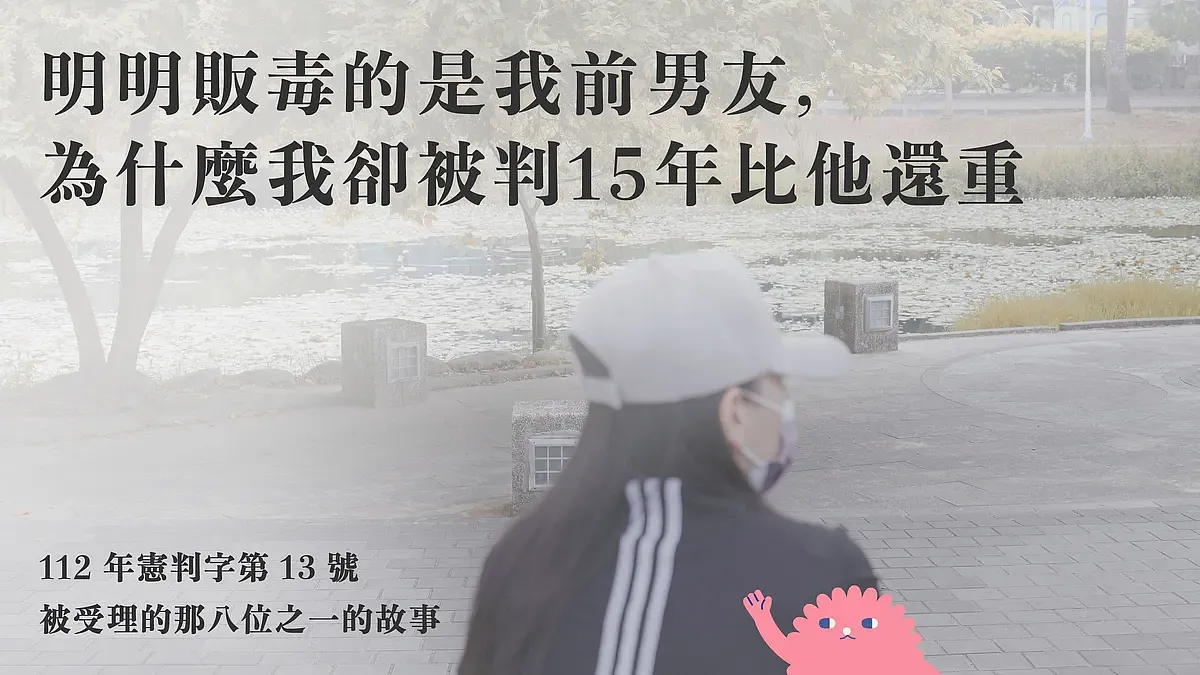
Why Was I Sentenced to 15 Years, Even Heavier Than My Ex-Boyfriend Who Actually Sold the Drugs? The Story of One of the Eight Petitioners Accepted under Constitutional Court Judgment No. 13 of 2023
Last edited: 2026-08-23
"Such a bizarre outcome can be described as a rare massacre of petitions in the history of constitutional interpretation in our country."—This was the comment left by Grand Justice Huang Chao-yuan in his dissenting opinion to TCC Judgment 112-Hsien-Pan-13 (2023), "Case on the Penalty for Selling Category One Narcotics". This criticism was no exaggeration: over 2,500 parties petitioned for constitutional interpretation, arguing that the statutory penalty of only the death penalty or life imprisonment for manufacturing, selling, or transporting category 1 drugs under Article 4, Paragraph 1 of the Narcotics Hazard Prevention Act violated the principle of proportionality. Facing such a massive number of petitioners, the Constitutional Court accepted only 8 of them, while over 99% of the remaining petition cases were dismissed, practically sealing off the avenue for people to seek relief through constitutional litigation.
Being "picked" by the Constitutional Court as one of the few 8 accepted petitioners made the story of Lin Shu-hui (a pseudonym) appear exceptionally ironic. At only 19 years old, she was sentenced to 15 years and 3 months of imprisonment because the court determined she had "jointly sold drugs" with her boyfriend on 3 occasions.
On those three occasions, she merely followed her boyfriend's instructions to pick up the phone and hand the package to whoever came to collect it. The payment she received for these three occasions was a mere NT$1,000 for the first time, and NT$2,000 for each of the subsequent two times. She stated that she only helped pass along items, did not know the contents, and was not the mastermind of the transaction. In this case, Lin Shu-hui's role was clearly minor and her gains limited. Yet, in the end, she was sentenced more heavily than the primary drug dealer—her ex-boyfriend's 11-year prison term.
"I just never expected that the one who would end up with the heaviest sentence was me."
Looking back at the day the incident occurred, her ex-boyfriend was taking a shower when the phone rang, and she casually answered it. The person on the other end of the line said, "I've arrived, bring the stuff down." Lin Shu-hui complied without asking a single extra question. Until one day in 2008, when she and her boyfriend returned from Taipei to Pingtung, police officers from the Kaohsiung City Police Department came knocking to make arrests. Although she was released without bail that day, her life felt as though it had been pressed on pause ever since.
Six years after the incident, in 2014, she finally received the written indictment. By that time, her life was completely different—she had long since broken up with her ex-boyfriend, remarried, and given birth to a child who was just over a year old. When the indictment from the Pingtung District Prosecutors Office arrived in her hands, she was completely stunned. "I was truly shocked. I thought to myself, the child has already been born, why is this charge still hanging over me? Why not indict earlier instead of waiting so many years?"
Recalling that past, she had asked her then-boyfriend multiple times, "How come you have so much money?" Her boyfriend would always casually brush it off, saying, "Don't ask too much, this is to protect you. If something happens one day, you won't know anything." She smiled bitterly, saying, "Indeed, I didn't know anything. I just never expected that the one who would end up with the heaviest sentence was me."

Photo / Visiting Lin Shu-hui at her hometown on the day of the interview
"The days waiting for the lawsuit to end were long and agonizing, living in constant panic every day."
Lin Shu-hui felt that she could not escape judicial punishment, and she worried that since her child was still so young, if she went in to serve a sentence, it might cause her child to be bullied or harassed by classmates in the future, or become the subject of gossip among friends and relatives. She also considered her parents, deeply afraid of bringing a heavy burden upon her family. Throughout the 3 years from the start to the end of her lawsuit, her family understood the situation of the case. Although the sentence was severe, her family understood and supported the fact that she had neither touched nor sold drugs.
Later, she gave birth to another child. Believing that her children had the right to know, she began preparing them like a "vaccination" from the very start of her lawsuit, telling her two children that one day Mommy might have to go away to work for a long time. Her daughter would ask, "Where are you going to work?" and she would honestly reply, "Mommy did something wrong and made bad friends, don't be like me in the future." She believed that rather than deceiving her children, it was better to let them understand the truth of the matter early on.
After the lawsuit concluded in 2017 with a confirmed sentence of 15 years and 3 months, Lin Shu-hui arranged a brief two-day, one-night family trip to Kenting with her father and aunt, bringing the children along the week before entering prison. Once the trip ended, she packed her bags and reported to the Pingtung District Prosecutors Office. Her mood was sorrowful and heavy; she first returned to her maternal home to have a meal with her grandparents and asked them to take care of their health. Afterward, her family rode their scooters, following her all the way to the Prosecutors Office. She declined her friends' offers to accompany her and temporarily deactivated her social media, unwilling to let outsiders know her whereabouts.
"The JRF's official document reached like a rope into the prison, bringing a glimmer of hope for constitutional interpretation."
"I have no prior criminal record, did not finish high school, and this criminal case is the only one in my life. The year I was involved I was only 19 years old, solely because my cohabiting boyfriend was a major drug dealer and I failed to exercise caution, answering his phone... sentenced to 15 years and 3 months in the first instance, isolated from society, with an infant child still in swaddling clothes..."—written in Lin Shu-hui's petition for statutory and constitutional review of judgments.
On her very first day in prison, her roommates asked about Lin Shu-hui's sentence, to which she replied, "15 years and 3 months." Back then, she spent almost all day spacing out. In the prison, about 6 or 7 people were crammed into a space of roughly two pings. Later, she was assigned to work in the workshop, doing simple processing such as packaging erasers and paper bags. Within just two months, she was appointed as a minor squad leader.
Lin Shu-hui recalled that in May 2022, an official document issued by the Judicial Reform Foundation (JRF) was received in the prison (Note: For details on the JRF's actions, please refer to the second article of the e-paper The Long Decade of Judicial Reform for "Light Offense, Heavy Punishment" under Drug Legislation). The document stated that qualified inmates could submit petitions for constitutional interpretation, with the deadline being July 15—less than two months away from the issuance of the document. This announcement caused quite a sensation in the prison: at that time, about 80% of the inmates were drug offenders, and drug cases typically carried very long sentences. To everyone, this document felt like a rope thrown out from inside a cage, offering a glimmer of hope to grasp onto.
"I immediately took the template and showed it to my roommate, who was a music teacher with a higher education level, and asked her to help me look at how this should be written." After reading it, the roommate told me, "Hey 0353 (Lin Shu-hui's inmate number), is your case file still here? I'll help you petition." After reviewing Shu-hui's case materials, she quickly understood her case situation and assisted her in drafting the petition for constitutional interpretation.
Although this roommate's own case did not qualify for this constitutional interpretation, she still enthusiastically helped Shu-hui write and check the contents of the legal brief. Furthermore, since the official document sent by the JRF included templates attached at the end, everyone began writing their own, triggering a butterfly effect—the petition forms sold out completely, and even craft paper sold out.
On August 11, 2023, this music teacher roommate saw in the newspaper that parts of the Narcotics Hazard Prevention Act had been ruled unconstitutional, and excitedly told Lin Shu-hui, "We succeeded! Even if your case is not directly affected, it will indirectly prompt an amendment of the law. According to regulations, unconstitutional statutory provisions must be amended within two years." The newspaper stated that only 8 petitioners nationwide obtained relief, 3 of whom were proposed by courts, while the other 5 were petitioned by inmates themselves. Lin Shu-hui reflected, "Seeing that there were only 5 people at that time, I felt in my heart that there shouldn't be any hope left."
"There were about 12 people in our workshop, 10 of whom were drug offenders with sentences mostly ranging from 20 to 30 years. Although everyone was very happy when they heard the news of unconstitutionality, as one notice of non-acceptance arrived after another, feelings of disappointment followed one after another." Lin Shu-hui was the first person in the workshop to complete her legal brief. While others who had also submitted constitutional petitions gradually received news, hers was delayed in coming. Her music teacher roommate could only comfort her, saying, "No news is good news."
When the Constitutional Court's judgment came out, Shu-hui saw her own name among the petitioners. After obtaining the judgment, she sat in her seat and read through it three whole times, yet still could not understand it. It wasn't until her music teacher roommate returned to the workshop that she nervously handed the case file to her, asking her to help explain the meaning of the judgment.
After reading it, the music teacher shed tears of joy. She said, "This constitutional interpretation succeeded, from scratch, and I helped you complete it step by step. To me, it feels like raising a child." This good news quickly spread within the workshop, and everyone was extremely happy about this hard-won judgment. Fortunately, with the help of her music teacher roommate, Lin Shu-hui came to know JRF specialist Lin Wei-ting.
"Whenever inmates in prison wrote letters with questions, she would reply and help provide answers. No other organization is as diligent as you guys," she said. If a petition is not submitted using the formal format of a legal brief, public officials usually ignore it. However, the threshold for this is very high for people in prison, and not everyone knows how to draft a legal brief." Therefore, the phrase "If anything comes up, just look for the JRF" began to spread widely within the prison.
"First sentencing me heavily, and now offering relief—is there truly any fairness in this?"
Looking back at the whole affair, Shu-hui said, "You guys judged wrongly in the first place, you need to return justice to me." But she also knew that none of this was that easy. On the day of the interview, she indignantly expressed, "But how do you return it? I've already been locked up for 6 years and 5 months. I was a young girl, locked up at 27, and now I come back at 34." She continued, "Fortunately, the aspect of family affection wasn't lost, but after all, it's still lagging behind others. When others are already taking off, what was I doing?"
She bleakly stated, "First sentencing me heavily, and now offering relief, is there truly any fairness in that? That is completely asymmetrical."
Following the constitutional judgment, Shu-hui's sentence was commuted to 9 years and 6 months of imprisonment by a branch of the Kaohsiung District Court, and she was released from prison this January after applying for parole. Today, she runs a papaya orchard in Pingtung with friends, rebuilding her own life. Despite regaining her freedom, Shu-hui still frequently returns to the Kaohsiung Women's Prison to visit her old friends and care about their recent conditions. She discovered that many friends who are released from prison repeatedly hit walls when looking for jobs, making the road back to social reintegration exceptionally difficult. This made her realize that the path of reintegration for rehabilitated persons is not easy, "but as long as there is something you want to do in your heart, you must bravely do it, no matter how long it takes." This is something Shu-hui often says to herself after enduring years of protracted trial.
This article is an AI-generated translation of the original Chinese text. In the event of any discrepancy, the Chinese version shall prevail.