
The Long and Winding Road of Judicial Reform on the Disproportionality of Drug Laws: Beyond the Eight Individuals Accepted in Constitutional Interpretation No. 13 of 2023
Last edited: 2026-08-23
Last July, in response to TCC Judgment 112-Hsien-Pan-13 (2023), the Ministry of Justice proposed a new draft amendment to the Narcotics Hazard Prevention Act. This October, the Judicial Reform Foundation (JRF) put forward a civil-society version of the draft, hoping to address the problem of “minor offenses, disproportionately severe punishment” caused by an extremely punitive drug-control policy. Shortly after the press conference announcing the civil-society draft, the Ministry of Justice immediately issued a statement in response.
What may look like an intense recent debate is in fact a longstanding issue of judicial reform. Looking back at past discussions and advocacy for legislative amendments, nearly a decade has passed in the blink of an eye. This article traces the JRF’s ten-year advocacy for amendments to the Narcotics Hazard Prevention Act, allowing us to look back together at the bumpy road of drug-law reform.
The First Attempt at Constitutional Review: The Chou Tsang-chi Case
“When discussing the JRF’s advocacy on drug policy, the Chou Tsang-chi case cannot be skipped.”
In 2006, prosecutors alleged that Chou Tsang-chi had sold heroin, a Category 1 narcotic, on three occasions. In two of those transactions, he allegedly sold 0.28 grams for NT$800 and 0.26 grams for NT$1,000, while the third involved NT$500 worth of heroin of an unknown weight. At first instance, the Kaohsiung District Court acquitted him for lack of sufficient evidence, but prosecutors appealed. At second instance, the High Court found that he had sold heroin twice. After taking into account an enhanced sentence for recidivism and statutory grounds for mitigation, the court sentenced him to 15 years and 2 months for each offense and fixed the combined sentence at 18 years.
JRF Deputy Executive Director and attorney Lee Ming-ju recalled that, in 2016, the Foundation’s drug-policy project team began focusing on the fact that the Narcotics Hazard Prevention Act imposed the same statutory punishment without distinguishing between different quantities sold, raising concerns under the principle of proportionality. The group therefore planned to petition the Grand Justices for constitutional review. In the Chou Tsang-chi case, the quantities sold and payments received were extremely small, yet the overall sentence was extraordinarily severe. Among numerous cases, the group selected this one as a representative case.
In 2018, with assistance from attorney Chang Ching-kai of the constitutional-litigation team, the JRF filed petitions for constitutional review concerning the circumstances of drug sales and the corresponding punishment in the cases of Chou Tsang-chi and Hsu Hung-chang. Hsu had been sentenced to 18 years for a single heroin sale involving three small packets with net weights of 0.038, 0.035, and 0.143 grams.
Unfortunately, on June 19, 2020, the Grand Justices issued a resolution declining to accept Case No. 107-Hsien-Er-343. They reasoned that although the relevant provisions treated the manufacture, transportation, and sale of Category 1 narcotics as serious crimes, courts could reduce or waive punishment when statutory requirements were met. They therefore concluded that the petitions had not sufficiently explained why the relevant provisions violated the principle of proportionality between crime and punishment or the principle of equality.
| Petitioner | Circumstances of Sale | Sentence in the Final Judgment |
|---|---|---|
| Chou Tsang-chi | Two completed heroin sales, with net weights of 0.073 grams and 0.023 grams | 15 years and 2 months for each offense |
| Hsu Hung-chang | One completed sale involving three small packets of heroin, with net weights of 0.038, 0.035, and 0.143 grams | 18 years |
Table / Circumstances and sentences of the petitioners in the Chou Tsang-chi constitutional review case. Source: former Grand Justice Huang Horng-shya’s dissenting opinion regarding the resolutions declining to accept Case No. 107-Hsien-Er-343 and Case No. 108-Hsien-Er-458.
Although Grand Justice Huang Horng-shya filed a dissenting opinion against the decision not to accept the petitions, she agreed that the JRF had specifically explained why it could be unconstitutional for the challenged provision to set life imprisonment as the minimum statutory punishment in every case without distinguishing between different levels of criminal seriousness. Many criminal-law scholars had also raised similar concerns. In her view, these disputes plainly had constitutional significance and should have been accepted for review. Nevertheless, this round of efforts came to an end with the non-acceptance decision.
A Frantic Summer: 2,500 Petitions for Constitutional Review
After the first constitutional petition failed, the JRF’s constitutional-litigation team again discussed the possibility of filing a second petition on August 17, 2020. The team decided to wait until a new group of Grand Justices took office, revise the subject matter and reasoning of the petition, and then try again.
Interestingly, while JRF attorneys were preparing the second petition, the Constitutional Court agreed on December 23, 2021, to hear a constitutional challenge concerning Article 4, Paragraph 1 of the Narcotics Hazard Prevention Act. At the same time, the new constitutional-litigation system under the Constitutional Court Procedure Act formally took effect in 2022, creating an opportunity to seek review of individual final judgments. Under the new system, relevant constitutional-review petitions had to be filed by July 4, 2022.
Under these circumstances, to help as many people as possible in drug cases involving “minor offenses, disproportionately severe punishment” seek relief, the JRF proactively prepared a “Guide to Constitutional Litigation and Sample Pleadings” and sent an official letter asking the Agency of Corrections to notify incarcerated individuals
Subject: Regarding the Taiwan Constitutional Court’s acceptance of a constitutional challenge to Article 4, Paragraph 1 of the Narcotics Hazard Prevention Act, we respectfully request that your Agency notify the correctional institutions under its authority of the relevant information so that incarcerated persons may safeguard their constitutional rights.
Explanation:
- According to publicly available information on the Taiwan Constitutional Court website, the Court accepted Case No. 107-Hsien-Er-331 on December 23, 2021, concerning the constitutionality of the death penalty and life imprisonment prescribed under Article 4, Paragraph 1 of the Narcotics Hazard Prevention Act. To date, 36 related cases have been consolidated and accepted for review (see attachment).
- Under Article 92, Paragraph 2 of the Constitutional Court Procedure Act, where a final judgment had already been served before the new constitutional-litigation system took effect, the petition had to be filed by July 4, 2022. This differed substantially from the previous system, which imposed no filing deadline. In addition, pursuant to Article 63, which applies Article 53, Paragraph 3 mutatis mutandis, a person convicted under the same legal norm who does not file a petition for constitutional review of that norm will have no possibility of obtaining subsequent relief.
- Accordingly, if the outcome of the above constitutional litigation is favorable to the petitioners, individuals who did not file petitions may have no opportunity for relief, potentially affecting the rights of relevant incarcerated persons. Considering that a substantial number of people convicted under Article 4, Paragraph 1 of the Narcotics Hazard Prevention Act remain incarcerated, it is necessary to make this remedial opportunity widely known so that they have an opportunity to assert their rights within the statutory period.
- We therefore respectfully request that your Agency instruct correctional institutions under its authority to make this information known throughout their housing units, so as to assist people in safeguarding their constitutional rights
As the Agency of Corrections helped distribute the information to prisons across Taiwan, the JRF began receiving a large volume of petitions. JRF staff and interns formed a response team for cases involving the Narcotics Hazard Prevention Act, classifying cases according to the circumstances involved—Article 4, Paragraph 1; Article 4, Paragraph 2; and Article 5, Paragraph 1—and preparing case summaries based on the petitioners’ Supreme Court criminal judgments. For example:
Article 4, Paragraph 1 of the Narcotics Hazard Prevention Act: The petitioner was found by the Taiwan High Court Taichung Branch Court in Criminal Judgment No. 108-Shang-Su-2743 to have sold Category 1 narcotics, heroin, on nine occasions, earning NT$11,500 in profit. The combined sentence was fixed at eight years’ imprisonment. The Supreme Court dismissed the appeal, rendering the judgment final. The petitioner is currently incarcerated at a Penghu correctional institution.
Article 4, Paragraph 2 of the Narcotics Hazard Prevention Act: The petitioner was found by the Taiwan High Court in Judgment No. 109-Shang-Keng-I-91 to have jointly sold Category 2 narcotics, methamphetamine, on two occasions, earning NT$24,000 in profit. The combined sentence was fixed at 11 years and 6 months’ imprisonment. The Supreme Court dismissed the appeal, rendering the judgment final. The petitioner is currently incarcerated at a Taoyuan correctional institution.
The JRF would then return to the petitioners the completed sample petition for constitutional review of legal norms, together with a written explanation of the constitutional concerns.
Photo / Before the constitutional judgment was announced, JRF interns helped process replies to petitioners.
Between June and July 2022, the JRF estimates that it mailed out approximately 550 sample pleadings and again assisted Chou Tsang-chi in filing a petition. Ultimately, the Constitutional Court is estimated to have received approximately 2,500 petitions.
On June 8, 2023, the JRF went one step further and, under the amicus curiae mechanism introduced by the new Constitutional Court Procedure Act, submitted an opinion addressing the constitutionality of Article 4, Paragraph 1 of the Narcotics Hazard Prevention Act. However, when the Constitutional Court issued its judgment on August 11, 2023, it denied the JRF’s application to participate as amicus curiae.
In TCC Judgment 112-Hsien-Pan-13 (2023), “Case on the Penalty for Selling Category One Narcotics,” the Constitutional Court ultimately accepted the cases of eight petitioners. Chou Tsang-chi, however, was once again turned away by the Grand Justices. Looking at the cases accepted by the Court, JRF Deputy Executive Director Lee Ming-ju noted that all eight petitioners had no prior criminal records and simply presented situations involving “minor offenses, disproportionately severe punishment.” Chou Tsang-chi, by contrast, may have been excluded because of a prior record for drug use.
Only a small number of petitioners succeeded in this collective constitutional challenge. This also prompted the JRF to reconsider why, when confronted with a flood of petitions, the Constitutional Court had not opened its doors as widely as expected. One possible reason was the practical difficulty of processing such a massive caseload, together with concern that sweeping changes in drug cases could unsettle the existing judicial framework, pushing the Court toward a more conservative approach.
Photo / On the day the constitutional judgment was announced, members of the Legal Policy Department and JRF interns watched the Constitutional Court’s live pronouncement of judgment together.
The JRF Restarts Its Narcotics Hazard Prevention Act Amendment Working Group, Seeking Legal Reform on the Foundation of the Constitutional Judgment
TCC Judgment 112-Hsien-Pan-13 (2023), “Case on the Penalty for Selling Category One Narcotics,” held that Article 4, Paragraph 1 of the Narcotics Hazard Prevention Act could still produce situations of “minor offenses, disproportionately severe punishment” even after mitigation under Article 59 of the Criminal Code of the Republic of China, and required the Ministry of Justice to amend the law.
In response to the Constitutional Court’s requirement, however, the Ministry of Justice’s draft amendment merely proposed adding Article 17-1. It provided that where the circumstances of selling Category 1 narcotics were minor and the sentence remained excessively severe even after mitigation, the court could further reduce the punishment—but not if the defendant had a prior criminal record. In doing so, the Ministry of Justice went beyond the constitutional judgment by unilaterally imposing a “no prior criminal record” threshold for additional sentence mitigation. Moreover, the current Narcotics Hazard Prevention Act determines statutory punishment primarily according to narcotics classification: selling Category 1 narcotics is punishable by “death or life imprisonment,” while selling Category 4 narcotics is punishable by “fixed-term imprisonment of five to twelve years.” Yet the law does not take the quantity sold into account, creating obvious concerns of unfairness.
In response to the slow and misguided official amendment process, the JRF established the “Narcotics Hazard Prevention Act Amendment Working Group” in 2024 to provide continuing oversight and momentum for reform. From 2016 to 2024, the JRF had already been following amendments to the Narcotics Hazard Prevention Act for nearly a decade. In addition to the attorneys who had participated in the earlier years, the working group began bringing in volunteer lawyers from a younger generation.
To better understand the JRF’s long-term commitment and continued efforts on amendments to the Narcotics Hazard Prevention Act, we interviewed working-group member attorney Chang Tsun-hsiang to explore what motivates younger lawyers to engage with drug-policy issues and what challenges they face.
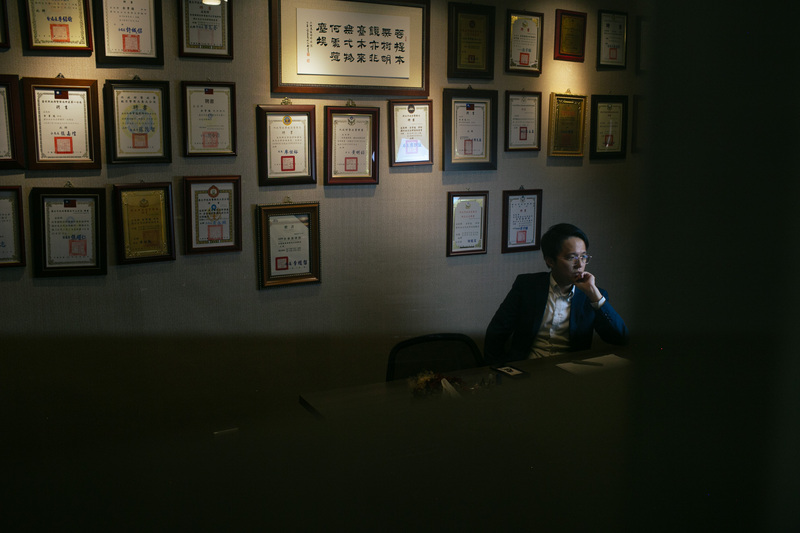
Photo / Volunteer attorney Chang Tsun-hsiang of the Narcotics Hazard Prevention Act Amendment Working Group attends a JRF meeting after finishing his regular legal work.
Attorney Chang’s involvement in drug-policy issues began with guidance from a teacher while he was still a student. At the time, Professor Wan-Shan Lin served as an expert witness before the High Court in one of the petitioners’ cases and invited Chang to help organize and analyze the case materials. Chang thus plunged into piles of Supreme Court judgments and began compiling statistics on cases involving Article 4, Paragraph 1. As his understanding deepened, the statistical patterns convinced him that this was a legal issue that could not be ignored
“Take, for example, the ranges from 7 years and 6 months to 9 years, or from 7 years and 6 months to 8 years, and then from 15 to 17 years, or from 15 to 18 years. Those two ranges account for almost all defendants’ sentences. The result is an extremely distorted curve with only two peaks. That is very strange, because a normal sentencing range should have some gradation. If a case is more serious, the sentence should be heavier; if it is less serious, the sentence should of course be lighter. How could there be only two points?
“The reason is simply the difference between mitigating the sentence once and mitigating it twice. If life imprisonment is reduced once, it becomes 15 years. If 15 years is reduced again, it becomes 7 years and 6 months.
“The reason there is still some range is that, for example, suppose someone is convicted of three counts of selling narcotics and receives 7 years and 6 months, 7 years and 6 months, and 7 years and 6 months, with a combined sentence of 8 years and 1 month. For the 15-to-17-year or 15-to-18-year range, it might be five counts of selling narcotics, with sentences of 15 years, 15 years, 15 years and 1 month, and so on, ultimately combined into 16 years. There is no smooth gradation at all—just two points. Almost all the sentences cluster around 7 years and 6, 7, or 8 months, or 15 years and 1 or 2 months. I find that quite absurd.
“So what standard are courts using? It is whether the circumstances are ‘manifestly deserving of sympathy.’ But there is essentially no standard at all for what counts as ‘manifestly deserving of sympathy.’ Almost every case invokes it. Statistically speaking, it appears in more than 80 percent of Supreme Court cases.”
With these reflections on drug-case judgments in mind, after entering legal practice Chang continued to devote his after-work hours to the JRF’s drug-law working group, hoping that sustained oversight would help more people recognize the problem.
Faced with the difficult course of amending the Narcotics Hazard Prevention Act, Chang endorsed TCC Judgment 112-Hsien-Pan-13 (2023), “Case on the Penalty for Selling Category One Narcotics.” However, he believes that how the relevant authorities can translate that judgment into more progressive policies and legislation that better protect people’s rights remains a matter requiring continued research and advocacy.
Along the long road toward reforming the Narcotics Hazard Prevention Act, the JRF continues striving to bring about legal change that provides greater fairness and stronger human rights protections for society.
This article is an AI-generated translation of the original Chinese text. In the event of any discrepancy, the Chinese version shall prevail.