
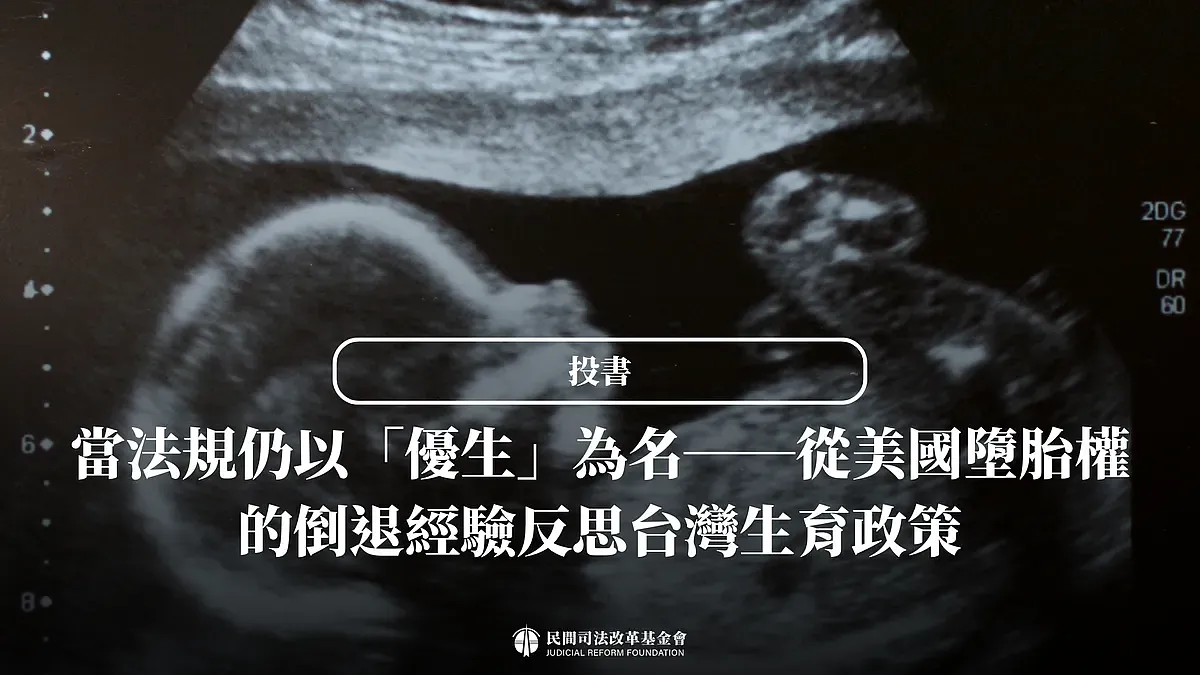
Opinion | When Regulations Still Bear the Name of "Eugenics": Reflecting on Taiwan's Reproductive Policy Through the Retrogression of Abortion Rights in the United States
Last edited: 2026-08-23
In August 2025, a citizen initiated a proposal on the Public Policy Network Participation Platform to "delete the spousal consent requirement for induced abortion." Achieving the threshold of endorsements in just two weeks, this prompted the Health Promotion Administration of the Ministry of Health and Welfare (HPA) to respond, stating that the draft amendments to the Genetic Health Act had completed public notice. This action demonstrates society's high level of attention toward women's reproductive autonomy, while once again reopening the long-standing debate over "who gets to decide on a woman's body."
In fact, long before this petition, the HPA had already proposed a draft amendment in 2022, planning to rename the Genetic Health Act as the Reproductive Health Act, delete the "spousal consent requirement," and amend provisions relating to induced abortions for minors. The draft was originally designed such that if a minor and their statutory agent held conflicting views, a court would adjudicate whether to permit the procedure.
However, due to the controversy surrounding the "consent requirement for minors undergoing induced abortions," a social consensus could not be reached, leaving the legislative amendments stalled.
On September 28 of this year, International Safe Abortion Day, the National Human Rights Commission once again spoke out, pointing out that the Criminal Code of the Republic of China still treats abortion as a crime, and the Genetic Health Act further requires married women to obtain spousal consent for an abortion. It called upon the government to consider the decriminalization of abortion and to remove consent requirements from spouses, parents, or guardians, in order to comply with international human rights standards.
Looking back at history, the new feminist movement of the 1970s centered on "privacy/choice," advocating for women's bodily autonomy. Inspired by the U.S. women's movement, Annette Lu argued that a woman's uterus should not be controlled by the state or patriarchal families. The enactment of the Genetic Health Act in 1984 allowed women to lawfully terminate pregnancies under specific conditions. Although it did not fully decriminalize abortion, it was nevertheless an important step forward for women's reproductive rights.
Yet 40 years later, the offense of abortion in the Criminal Code of the Republic of China remains, and the Ministry of Justice even announced a draft amendment in 2024 proposing to raise the maximum fine from NT$3,000 to NT$80,000, withdrawing the proposal only after it triggered fierce backlash. However, fewer people have noticed that the title and content of the Genetic Health Act still retain a flavor of "eugenics," with some provisions even imposing restrictions on the reproductive rights of persons with physical and mental disabilities, reflecting that Taiwan's reproductive policy still harbors implicit discrimination regarding "who is suited or unsuited to reproduce."
A Comparison of International Trends: The Retrospective Experience of Abortion Rights in the United States
In contrast to international developments, the protection of reproductive rights exhibits divergent paths across different countries. The Constitutional Court of South Korea declared the crime of abortion unconstitutional in 2019; the Supreme Court of Mexico further struck down the crime of abortion from the federal penal code in 2023, requiring the government to provide safe medical services. The United States, however, has gone in the opposite direction—in the 2022 case of Dobbs v. Jackson Women's Health Organization, the U.S. Supreme Court overturned the 1973 ruling of Roe v. Wade, denying abortion as a fundamental right protected by the Constitution. This resulted in strict abortion bans in numerous states, causing a precipitous regression in women's reproductive autonomy.
This turning point reminds us that the advancement of reproductive rights does not follow the linear progression from ignorance to enlightenment seen in Whig history; the promotion of rights is capable of retreating and facing setbacks.
The American experience reveals that the shift in constitutional jurisprudence is not merely a matter of judicial structure, but also reflects the fragility of rights discourse. When abortion is framed narrowly under "personal liberty" rather than "gender equality" or "reproductive justice," it becomes far more susceptible to being overturned amid a tide of political conservatism.
The Dilemma of Privacy and the Rethinking of Equality: From Reproductive Freedom to Reproductive Justice
As seen from the three major U.S. constitutional decisions, while abortion rights grounded in the "right to privacy" once expanded women's bodily autonomy, that framework also has limitations. The Dobbs decision rejected the privacy-based approach by relying on constitutional text and historical tradition, revealing the inadequacies of relying solely on liberty rights. Furthermore, while conservative Supreme Court Justices denied the asserted privacy right, they also declined to address the relationship between gender equality and abortion rights on the ground that the earlier precedents, Roe v. Wade and Planned Parenthood of Southeastern Pennsylvania v. Casey, had not been argued under the Equal Protection Clause. This allows us to reflect further: can the right to privacy or choice serve as an adequate foundation for fully guaranteeing women's reproductive autonomy?
As early as the litigation of Roe v. Wade, attorney Nancy Stearns attempted in an amicus curiae brief to argue for abortion rights through the lens of women of color, highlighting the intersectional discrimination of race, class, and gender. Former U.S. Supreme Court Justice Ruth Bader Ginsburg also commented that Roe v. Wade placed excessive reliance on the legal reasoning of privacy while overlooking the vital function of equality rights. Moreover, criticisms of liberal feminism likewise remind us that if abortion is treated solely as an issue of personal choice, it ignores the deep-seated impacts of patriarchal structures, economic inequality, and social systems on women's reproductive decisions. Reproduction is not merely a matter of choosing "whether or not to have children"; it is a question of power shaped by political, economic, and social conditions.
The concept of "reproductive justice" proposed by critical race feminism asserts that reproductive-related rights should encompass three dimensions:
- The right not to have a child: freedom from criminal penalties and interference from others, allowing a person to autonomously terminate a pregnancy.
- The right to have a child: freedom from state or societal restrictions on reproduction based on eugenics, poverty, or disability.
- The right to parent children in safe and healthy environments: ensuring social support and equal protection.
This concept reminds us that reproductive rights are not only issues of liberty, but also concern equality, social rights, and cultural rights. For vulnerable groups, the state must not only guarantee the freedom "not to reproduce," but must also secure the social conditions required to "safely bear and raise children with dignity."
Therefore, in reviewing the Genetic Health Act, Taiwan should not focus merely on deleting spousal or statutory-agent consent requirements; it must also examine the discriminatory designs implicitly embedded within the statutory provisions. For instance, the current law still includes disability-related conditions among the grounds permitting termination of pregnancy, reflecting assumptions about the reproductive capacity of persons with disabilities that may conflict with the principle of equality.
In conclusion, if Taiwan is to genuinely implement women's reproductive autonomy, it must transcend the liberty-rights framework centered on "privacy/choice" and incorporate the concepts of equality rights and reproductive justice. Only by doing so can we further reflect upon whether, when political parties utilize the Assisted Reproduction Act to address sub-replacement fertility in an effort to raise Taiwan's birth rate, they truly recognize the costs and limits of reproductive freedom.
Perhaps Taiwan's reproductive policy reform should begin with the Genetic Health Act.
This article was published on November 6, 2025, in The Reporter.
This article is an AI-generated translation of the original Chinese text. In the event of any discrepancy, the Chinese version shall prevail.