
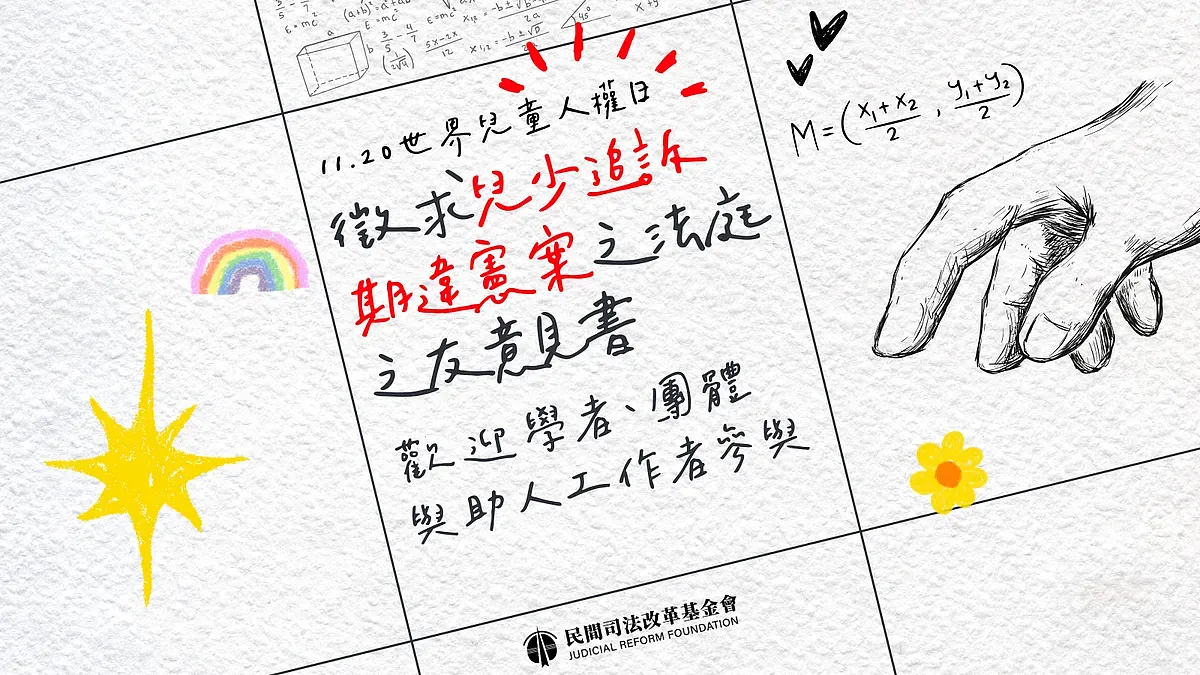
Call for Amicus Curiae Briefs on the Unconstitutionality of the Statute of Limitations for Child Sexual Abuse: Scholars, Organizations, and Helping Professionals Invited to Participate!
Last edited: 2026-08-24
Updated Application Deadline: July 7, 2026
Today is World Children's Day, and we invite you to speak up for children and adolescents!
In March 2024, the Constitutional Court accepted Case No. 112-Hsien-Min-384, concerning the constitutionality of the statute of limitations for sexual offenses against child and adolescent victims. Due to the consolidation of additional cases, the deadline to apply to participate as amicus curiae was extended to July 7, 2026. Following approval of the application, applicants would have additional time to prepare and submit their briefs.
JRF submitted an amicus curiae brief in May 2024, arguing that the current system violates the right to judicial remedy guaranteed by Article 16 of the Constitution of the Republic of China. However, the statute of limitations for sexual offenses against children and adolescents is not merely a matter of legal regulation; it also involves systemic issues across social, cultural, and gender dimensions. Major international investigations have shown that survivors of child sexual abuse often take decades to disclose their experiences.
➤ Australian Royal Commission into Institutional Responses to Child Sexual Abuse: Survivors took an average of 24 years to disclose the abuse, and 57% disclosed only after reaching adulthood.
➤ UK Independent Inquiry into Child Sexual Abuse (IICSA): Survivors likewise took an average of approximately 24 years to disclose, with roughly two-thirds speaking about their experiences only after reaching adulthood.
➤ New Zealand Royal Commission of Inquiry into Abuse in Care: From the perspective of historical justice for vulnerable groups, including Māori, Pacific peoples, and persons with disabilities, the inquiry found that many survivors required decades before they were able to recount their experiences of victimization.
Taiwan still lacks official research on disclosure time. However, according to service statistics from the Garden of Hope Foundation's Dandelion Center, people who experienced sexual abuse during childhood took an average of 22 years before making their first call for help.
Meanwhile, statistics from the Department of Protective Services of the Ministry of Health and Welfare for 2024 also show that:
Among 9,230 sexual assault victims, children and adolescents under the age of 18 accounted for nearly 52%.
Among child and adolescent survivors, approximately three-quarters were female.
In addition, a 2021 investigation report by the Control Yuan pointed out that:
The proportion of child and adolescent sexual assault victims was highest in welfare institutions for persons with physical or mental disabilities.
The proportion of child and adolescent victims in Indigenous townships was higher than that among the non-Indigenous population.
Furthermore, a survey by the Modern Women's Foundation indicated that as many as 90% of victims did not dare report to the police, while 40% never sought help at all, suggesting that the dark figure of unreported sexual violence may far exceed the statistics compiled by the Ministry of Health and Welfare.
Taken together, even these limited data remind us of at least two important points:
Child and adolescent survivors face multiple and intersecting vulnerabilities.
A trauma-informed perspective is essential to understanding the difficulties survivors face in disclosing experiences of sexual violence.
To help the Constitutional Court more comprehensively understand the real-life circumstances faced by survivors of child sexual abuse, JRF openly invites professionals and organizations in the following fields to submit amicus curiae briefs:
❯ Scholars who have long focused on child sexual abuse and trauma research
❯ Civil society organizations that assist child and adolescent survivors
❯ Frontline helping professionals in social work, counseling, psychology, education, and related fields
Pursuant to the Constitutional Court Procedure Act, a person, agency, or organization permitted to submit an amicus curiae brief must be represented by qualified counsel when submitting professional opinions or materials to the Constitutional Court. JRF has therefore established a panel of volunteer attorneys who will provide pro bono representation to assist with the application process.
If you are willing to join this effort, please submit an application or contact us at:
Email: contact@jrf.org.tw
Let the lived experiences of child and adolescent survivors be truly seen by the Constitutional Court.
This article is an AI-generated translation of the original Chinese text. In the event of any discrepancy, the Chinese version shall prevail.