
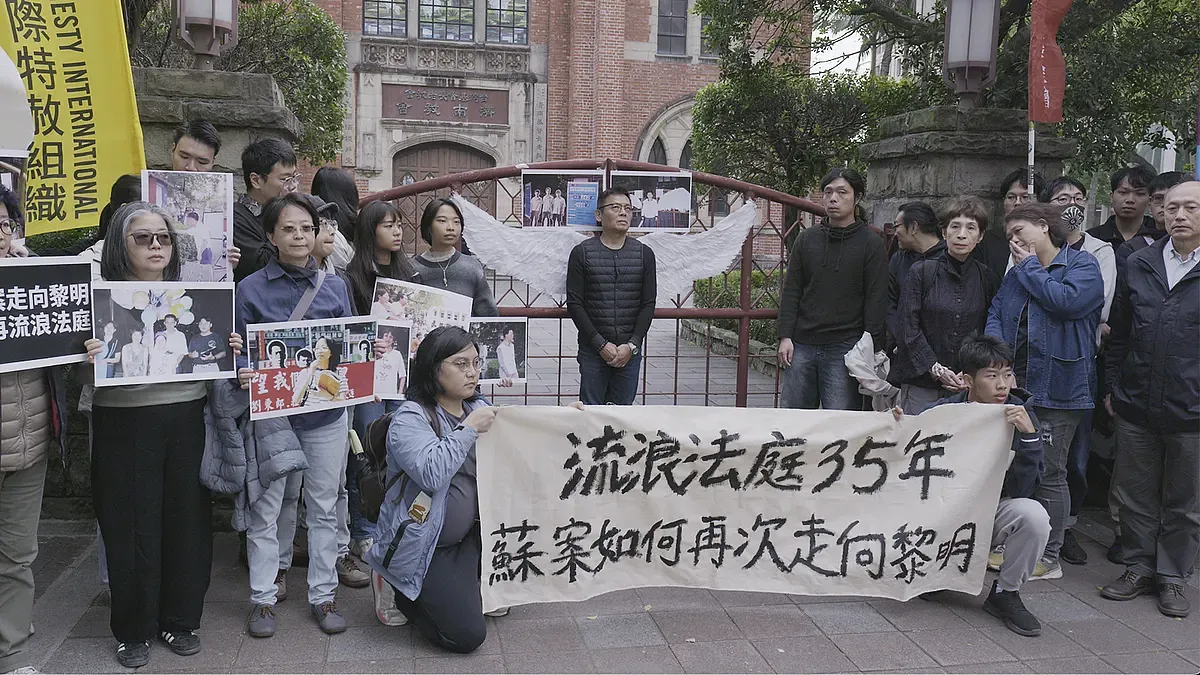
Press Release | 35 Years of Wandering the Courts: How the Su Chien-ho Case is Walking Toward the Dawn Once Again
Last edited: 2026-08-24
Sign up for the Su Case "Walking Toward the Dawn" Volunteer Recruitment Sign up for Su Case Civil Remand Second Instance Court Observation
Regarding the claim for damages filed against Su Chien-ho, Liu Bin-lang, Chuang Lin-xun, and their families, the Supreme Court on August 21, 2025, vacated the civil judgment in the first remand proceeding and remanded the case to the Taiwan High Court. This marked the second time the Supreme Court had vacated and remanded the case. The judiciary has failed to promptly stop the damage to the lives of the wrongful conviction victims—Su Chien-ho, Liu Bin-lang, Chuang Lin-xun, and their families—whose lives have been profoundly disrupted by this miscarriage of justice, bringing their ordeal of wandering through the courts into its 35th year.
In response, the "Su Chien-ho Case Rescue Team"—jointly formed by the Judicial Reform Foundation, Taiwan Association for Human Rights, Humanistic Education Foundation, Covenants Watch, Taiwan Alliance to End the Death Penalty, Amnesty International Taiwan, and Taiwan Innocence Project—is officially restarting its volunteer team and issuing the following statement:
1. The "Su Chien-ho Case" Promoted Criminal Justice System Reform, Yet 35 Years Later, They Are Still Wandering the Courts
The "Su Chien-ho Case" is one of Taiwan's most well-known wrongful capital convictions. In 1991, Su Chien-ho, Liu Bin-lang, and Chuang Lin-xun were implicated in the murder of the Wu couple in Xizhi Township, Taipei County. In the absence of objective evidence proving their involvement and relying on confessions obtained through torture, the court wrongly convicted the three in 1995, sentencing each to two death sentences and deprivation of civil rights for life. Fortunately, on May 18, 2000, through the unremitting efforts of the pro bono defense team, the High Court ruled to initiate a retrial. Following three remands by the Supreme Court during the retrial proceedings, the Taiwan High Court finally held in its third retrial judgment on August 31, 2012, that Su Chien-ho and the other two had not participated in the crime, and their acquittals became final.
The rescue campaign back then was best known for the 100-day silent march "Walking Toward the Dawn," where people from all walks of life took turns demonstrating rationality and determination without noise or agitation. In the lagging criminal procedure framework of the 1990s, the Su Chien-ho case brought about severe and crucial reflections, driving the progress of Taiwan's criminal justice procedures. For example, Article 100-1 of the Code of Criminal Procedure was amended in 1997 to mandate continuous audio recording throughout the interrogation of a defendant, and continuous video recording when necessary. The 2001 amendments to the Code of Criminal Procedure further advanced protections by: explicitly codifying the presumption of innocence and the exclusionary rule for illegal evidence; prohibiting confessions obtained through prolonged or fatigue-inducing interrogation from being used as evidence; and requiring that "where a confession is submitted by the prosecutor, the court shall order the prosecutor to indicate the means of proof showing that the confession was made voluntarily." This improved upon trial practices that frequently reversed the burden, demanding that defendants prove they had suffered torture.
Today, younger generations of students officially practice critical thinking in civics textbooks under the chapter on the "presumption of innocence" through the Su Chien-ho case—examining whether police torture and confessions obtained without legal counsel comply with due process and whether they constitute evidence that a lawful trial should adopt, thereby learning civic legal literacy and knowledge from the case. It can be said that from the moment Su Chien-ho and the other two were accused of the crime, from age 18 to 39, they spent 21 long years proving their innocence. Following their exoneration, they have continued to play crucial roles in civil society promoting legal education and making ongoing contributions to Taiwanese society. We even frequently hear young and mid-generation lawyers, judges, and prosecutors mention that they were inspired to enter the legal profession by the Su Chien-ho case.
However, nearly 35 years later today—almost 13 years after their criminal acquittal became final—the Supreme Court has remanded the lawsuit for a second time (Supreme Court Civil Judgment 114-Tai-Shang-488 (2025)), leaving Su Chien-ho and the other two still facing civil damages proceedings ancillary to the criminal case brought by the victim's family. They are still wandering the courts, struggling to bid farewell to their identities as victims of wrongful convictions and torture, and unable to return to an ordinary life free from the stigma of wrongful conviction.
2. Taiwan Lacks Torture Prevention and Accountability Mechanisms; Can Torture Evidence Really Be Used in Civil Litigation?
35 years later, what most astonished the Rescue Team is that in this remand reasoning, the Supreme Court still spent a significant length questioning whether the confessions in this case are admissible and argued that the reasoning in the retrial's first-instance judgment was insufficiently explained.
Regarding the confessions, both in the final criminal judgment acquitting Su Chien-ho and others and in the judgment in the first remand proceeding, it has already been established that the confessions made by Su Chien-ho and the others, as well as by co-defendants Wang Wen-hsiao and Wang Wen-chung, drastically contradicted each other regarding critical crime details—such as the types, sources, and individual possession of weapons, the stolen goods obtained and their distribution, and how the weapons were subsequently disposed of—and conflicted with objective facts. Consequently, the alleged tortious conduct cannot be established.
In particular, given the fact that these confessions stemmed from torture—which the Control Yuan had previously issued corrective measures against the Ministry of Justice and the National Police Agency, and the courts in the criminal acquittal judgment comprehensively combined "witness testimonies from detention center cellmates," "physical examination results upon entry," and "painkiller prescription records" to determine that Su Chien-ho and others had indeed suffered torture and that acts of torture existed—it is established that Su Chien-ho and others were victims of torture under the typical high-pressure authoritarian interrogation model of Taiwan in the 1990s.
Yet such confession evidence is actually still being deliberated in civil courts—and even repeatedly scrutinized by the Supreme Court, which demands that the High Court investigate and review it once again!?
Su Chien-ho and the other two have already traded their lives in exchange for the reform of Taiwan's criminal justice system. Now, the civil justice system must also conduct a rigorous self-examination. Through this case, the Rescue Team hopes to raise awareness of how civil litigation evidence law should exclude illegal evidence and allocate the burden of proof. We also wish to remind the public once again that Taiwan's mechanisms for torture prevention and accountability remain incomplete; parties cannot invoke the still-unenacted draft Enforcement Act of the Convention against Torture and Other Cruel, Inhuman or Degrading Treatment or Punishment and its Optional Protocol to urge courts to exclude unlawfully obtained evidence more actively, and the state as a whole has yet to take responsibility for preventing torture and repairing the damages arising from it.
3. Support the Innocent, Pay Attention to the Aftermath of Wrongful Convictions, and Work Together to Let the Su Chien-ho case Walk Toward the Dawn Once Again!
As this case enters its 35th year, the remand intent of the Supreme Court's Civil Division continues to wander in the labyrinth of confessions, adopting an extremely lenient and perfunctory standard and testing method for the production of scientific evidence. The Rescue Team will continue to monitor and support this cause. This verdict concerns not only the reputation and dignity of Su Chien-ho and others, but also the fairness and credibility of Taiwan's judiciary. We sincerely invite everyone to enter the courtroom with us to witness this long road to exoneration.
The first preparatory proceeding after the remand will be held at 9:30 AM on December 22 at the Taiwan High Court.
We invite the seniors who once carried the criminal case of the Su Chien-ho case "Walking Toward the Dawn" and the young people living in a rule-of-law society already transformed by the Su Chien-ho case to step into the courtroom together for observation and to witness this long road to exoneration.
We need seniors who have previously participated in Su Chien-ho case advocacy and solidarity campaigns to return and gather at Chinan Church. We are also officially restarting a new generation of volunteer teams, and we earnestly invite volunteers who are willing to care about individual cases and participate in reform to join us, working together to bring the Su Chien-ho case walking toward the dawn once again.
Press Conference Information
Time
10:00 AM, November 28, 2025
Location
Courtyard of Chinan Presbyterian Church (No. 3, Zhongshan S. Rd., Zhongzheng Dist., Taipei City)
Press Conference Program
Following remarks by supporting organizations, participants will silently walk around Chinan Church
Moderators
Shih I-hsiang | Senior Researcher, Taiwan Association for Human Rights
Tsai Shang-heng | Social Worker, Judicial Reform Foundation
Speakers
Hsu Tzu-chiang | Spokesperson Representative, Judicial Reform Foundation; Wrongful Conviction Exoneritee
Feng Hsien-hsien | Director of the Documentary *Spring Rain 424*
Tsai Tsung-lung | Director of the Documentary *Island Etude*
Chang Chuan-fen | Chairperson, Taiwan Alliance to End the Death Penalty
Feng Chiao-lan | Executive Director, Association for Humanistic Education
Yu Yi-chia | Secretary-General, Taiwan Association for Human Rights
Huang Sung-li | Director of Policy Center, Taiwan Association for International Human Rights
Chang Chih | Deputy Secretary-General, Amnesty International Taiwan
Wei Yu-an | Advocacy Specialist, Taiwan Innocence Project
Su Chien-ho Case Rescue Team
Judicial Reform Foundation
Amnesty International Taiwan
Taiwan Association for International Human Rights
Association for Humanistic Education
Taiwan Association for Human Rights
Taiwan Innocence Project
Taiwan Alliance to End the Death Penalty
This article is an AI-generated translation of the original Chinese text. In the event of any discrepancy, the Chinese version shall prevail.