
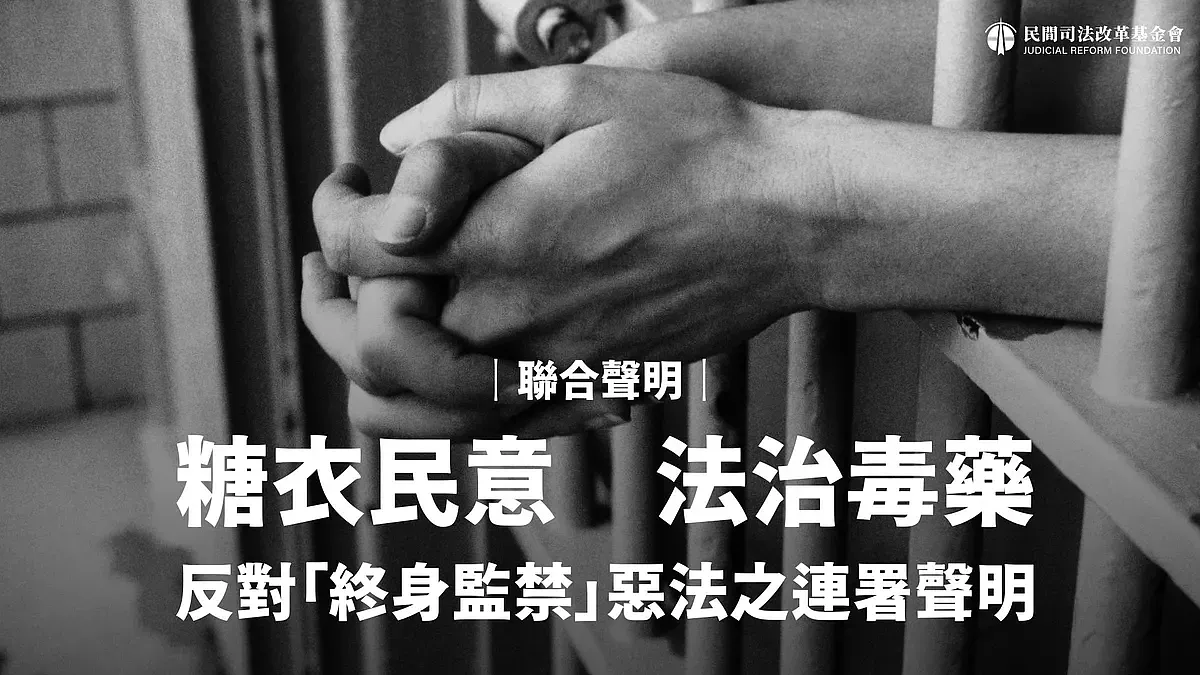
Joint Statement | Sugar-coated Public Opinion, Rule-of-Law Poison: Joint Statement Opposing the Malicious "Life Without Parole" Bill
Last edited: 2026-08-24
- Seventeen lead signatories, together with Covenants Watch, the Judicial Reform Foundation, the Taiwan Association for Human Rights, the Taiwan Association for Innocence, and the Taiwan Alliance to End the Death Penalty, invite people from all sectors of society to join the statement opposing the harmful "life imprisonment without parole" bill.
- For the complete list of signatories, please see the link.
In late October 2025, the Executive Yuan approved draft amendments to the Criminal Code of the Republic of China, the Enforcement Law of the Criminal Code of the Republic of China, and the Prison Act, broadly introducing a system of life imprisonment without parole (LWOP). Under the proposal, persons convicted of specified offenses and sentenced to life imprisonment or fixed-term imprisonment exceeding 10 years would be ineligible for parole. Before this, the Taiwan People's Party and the Kuomintang had already proposed their own versions of LWOP and a three-tiered life-imprisonment system. On November 24, the Judicial Yuan submitted supplementary comments on the Executive Yuan's draft, stating that it was necessary to clarify whether the proposal would violate the prohibition of torture under international human rights law and to assess the difficulties it could create for prison administration.
The Executive Yuan's proposal was formulated without prior public notice, lacked rigorous empirical research and a human rights impact assessment, and raised serious concerns under international human rights law, the Constitution of the Republic of China, and fundamental principles of criminal law. Moreover, it does not advance the penal objective of protecting public safety. We therefore call on all sectors of society to join this statement and collectively oppose the Executive Yuan's inappropriate legislative proposal.
[Joint Demands]
- The Executive Yuan should withdraw the legislative proposals relating to the life imprisonment without parole (LWOP) system.
- All party caucuses in the Legislative Yuan should halt legislative proceedings on proposals relating to the LWOP system.
- Major criminal policies with significant human rights implications must be supported by rigorous empirical research and human rights impact assessments, and opinions from all sectors should be sought in advance through a public, transparent, and comprehensive process.
I. Flawed Legislation Lacking Evaluation and Proper Procedure
Before the Executive Yuan announced the amendments on October 30, the draft had not undergone prior notice or public consultation by the competent authority, the Ministry of Justice. Under Point 3, Subparagraph 4 of the Directions Governing the Submission of Draft Bills by Agencies under the Executive Yuan for Executive Yuan Review (descriptive English translation), government agencies are required to comprehensively assess the impact and scope of proposed legislation, including its effects on human rights. Moreover, the Executive Yuan had only recently revised its mechanisms for controlling ministerial draft bills and conducting human rights impact assessments, with the new procedures taking effect on July 1, 2025. Yet based on the information publicly available, no such assessment appears to have been conducted for this draft, and the Executive Yuan's review process did not broadly consult scholars, experts, or civil society organizations. The legislative process was hasty, rough, and incomplete.
"Meeting the eligibility threshold to apply for parole" is not the same as "being granted parole." Nevertheless, misinformation often causes the public to conflate the two, creating the false impression that parole is easy to obtain in Taiwan and thereby fueling public anxiety. A 2005 amendment to Article 77 of the Criminal Code of the Republic of China, which took effect on July 1, 2006, raised the parole-eligibility threshold for life imprisonment from 15 years to 25 years. To date, no prisoner has been released on parole under this new regime; those who have been paroled were subject to the former law. The reason is straightforward: the first group of prisoners subject to the current 25-year threshold will not become eligible to apply for parole until 2031 at the earliest. Nevertheless, the Executive Yuan has neither clarified this point to the public nor specifically explained in the legislative reasons what problems exist in the current sentencing and parole systems or what effective penal objective the introduction of LWOP is expected to achieve.
II. Life Imprisonment Without Parole Is a Cruel Punishment that Violates Human Dignity
In its supplementary comments issued on November 24, the Judicial Yuan asked the Executive Yuan to explain whether the proposed amendments would violate the prohibition of torture, demonstrating substantial concern about the draft and a reserved position toward it.
In Vinter and Others v. the United Kingdom (2013), the European Court of Human Rights held that, under Article 3 of the Convention for the Protection of Human Rights and Fundamental Freedoms (European Convention on Human Rights), a life sentence must be reducible both in law and in practice. A person serving a life sentence must have both a prospect of release and a mechanism for review capable of assessing whether continued detention remains justified by legitimate penological grounds, including punishment, deterrence, public protection, and rehabilitation.
Life imprisonment without parole also raises serious concerns regarding the human dignity protected by the Constitution of the Republic of China. In its 1977 Life Imprisonment judgment (BVerfGE 45, 187), the German Federal Constitutional Court held that the guarantee of human dignity under Article 1(1) of the Basic Law for the Federal Republic of Germany requires that a person serving a life sentence retain a concrete and realistically attainable prospect of regaining freedom at some point in the future.
Similarly, in R. v. Bissonnette, 2022 SCC 23, the Supreme Court of Canada held that a sentence that deprives a person of any realistic possibility of parole is incompatible with human dignity and violates section 12 of the Canadian Charter of Rights and Freedoms, which protects against cruel and unusual treatment or punishment.
The Executive Yuan's proposal draws on the legal system of the United States. However, in its 2023 concluding observations on the United States, the United Nations Human Rights Committee called for the prohibition of mandatory life imprisonment without parole, access to parole review for all prisoners including those serving life sentences, and consideration of a moratorium on LWOP sentences.
Taken together, the positions of the United Nations Human Rights Committee, the German Federal Constitutional Court, the Supreme Court of Canada, and the European Court of Human Rights show that imprisoning a person for life while denying any meaningful expectation of release is a cruel and inhuman practice that conflicts with the rehabilitative purposes of punishment and threatens human dignity. Inappropriate conditions of detention and treatment may further intensify the risk of such punishment becoming torture or other cruel, inhuman, or degrading treatment.
Although Taiwan has not yet enacted an enforcement act for the Convention against Torture and Other Cruel, Inhuman or Degrading Treatment or Punishment (CAT), the International Covenant on Civil and Political Rights (ICCPR) has been incorporated into domestic law through the Act to Implement the International Covenant on Civil and Political Rights and the International Covenant on Economic, Social and Cultural Rights. Article 7 of the ICCPR expressly prohibits torture and cruel, inhuman, or degrading treatment or punishment. Accordingly, the state—including the executive, legislative, and judicial branches—already bears a legal obligation to prohibit and prevent such treatment. Article 10(3) of the ICCPR further provides that the penitentiary system should have as its essential aim the reformation and social rehabilitation of prisoners. In other words, a correctional system should not be purely punitive; it must also pursue rehabilitation and social reintegration.
The Executive Yuan's proposed rules categorically excluding persons serving life sentences from parole therefore raise serious concerns under Articles 7 and 10 of the International Covenant on Civil and Political Rights (ICCPR) and under the principle of human dignity required by the Constitution of the Republic of China, as recognized in Taiwan's constitutional jurisprudence.
III. Blanket Denial of Parole Will Exacerbate the Burdens and Risks of Prison Administration
The fundamental function of correctional institutions is to protect public safety and reduce recidivism through meaningful measures of rehabilitation and social reintegration. Blindly resorting to life imprisonment, raising parole thresholds, or lengthening sentences will only increase the incarcerated population and create a vicious cycle. International calls for reform have long emphasized that strengthening the social-reintegration function of correctional institutions is the more fundamental solution. If we refuse to confront this root problem and instead continue placing more people in prison and keeping them there for longer periods, the problems created by the prison system may ultimately exceed those it claims to solve.
The Judicial Yuan's supplementary comments also expressed serious concern about whether the amendments would create "difficulties in prison administration or corrections" and recommended that their effects be evaluated. This demonstrates that the Executive Yuan did not conduct an adequate empirical assessment of the impact of the proposed amendments on correctional institutions. In an October statement, the Republic of China Correction Association warned that parole is not leniency but a "safety valve" for prison order and a source of hope for inmates; that absolute despair can fuel confrontation and conflict; and that abolishing parole may create serious risks within correctional institutions.
These warnings reflect the anxieties of frontline correctional personnel regarding the proposed amendments. Yet the competent authority, the Ministry of Justice, has largely ignored these concerns, shifting the risks generated by flawed legislation onto the workload and personal safety of frontline prison staff. At a time when correctional institutions are already strained by overcrowding and other systemic pressures, such policies would further worsen prison-management risks. Taiwan should not repeat the disorder and social fragmentation associated with the era of mass incarceration in the United States.
IV. Retroactive Application of Parole Ineligibility to Past Cases Is Unconstitutional
Article 7-3, Paragraph 2 of the Ministry of Justice's draft amendments to the Enforcement Law of the Criminal Code of the Republic of China would apply the new parole-ineligibility rules to certain finalized homicide cases in which a death sentence is later vacated and replaced with another sentence. This raises serious concerns under the principle of legality required by the Constitution of the Republic of China and codified in Article 1 of the Criminal Code of the Republic of China.
The Ministry of Justice's proposed amendments to the Criminal Code of the Republic of China would transform sentences that were parole-eligible under the law in force at the time of the offense—including life imprisonment and fixed-term imprisonment exceeding 10 years—into harsher sentences for which parole is categorically unavailable. This changes and aggravates the penal consequences after the conduct has occurred. Although the Ministry of Justice argues in the legislative reasons for the draft Enforcement Law of the Criminal Code of the Republic of China that parole is not itself a punishment, but rather a criminal-policy measure that temporarily suspends the execution of a custodial sentence and therefore does not fall within Article 2, Paragraph 1 of the Criminal Code of the Republic of China, the practical purpose of the proposed reform is precisely to impose a more severe deprivation of liberty. Characterizing parole as "not a punishment" does not resolve the constitutional problem created by retroactively aggravating the legal consequences of an offense.
Taiwan has previously amended its parole rules twice. Articles 7-1 and 7-2 of the Enforcement Law of the Criminal Code of the Republic of China, which governed the temporal application of those amendments, did not adopt a general rule requiring retroactive application of the more lenient law. Nevertheless, they still respected the principle that the applicable legal consequences should be determined by reference to the law in force at the time of the offense. Taiwan has not previously retroactively applied harsher parole thresholds to conduct committed before the amendments took effect. Creating such a rule now would therefore raise serious concerns under the principle of legality and the prohibition against retroactive aggravation of penal consequences.
V. Excluding Post-Final-Judgment Confinement Pending Execution from Sentence Credit Is Unconstitutional
Finally, Article 148, Paragraph 2 of the Ministry of Justice's draft amendments to the Prison Act would provide that, where a finalized death sentence is later vacated and replaced with another sentence, the period of confinement pending execution may neither be credited against the prison term nor counted toward the period of sentence execution required for parole eligibility. This raises serious concerns under the constitutional principles of proportionality and equality.
The Ministry of Justice's legislative reasons state that confinement after a death sentence becomes final is merely a transitional stage preceding execution and that the resulting restriction on personal liberty is only incidental. However, this reasoning overlooks the reality that a person sentenced to death is subject to state-imposed confinement and actual restrictions on liberty no less real than those experienced by prisoners serving custodial sentences or defendants held in pretrial detention. Crediting periods of detention against a sentence is not an act of grace; it reflects the constitutional principle of proportionality by preventing the state from imposing confinement beyond the scope of the sentence ultimately imposed. Even if post-final-judgment confinement pending execution formally serves a different purpose from pretrial detention, the actual restriction on liberty is comparable. Categorically excluding such confinement from sentence credit would therefore permit excessive state interference with personal liberty and would also treat persons formerly sentenced to death differently without sufficient justification, raising concerns under the constitutional principle of equality.
We call on the Executive Yuan to return to professional standards, refrain from treating legislative reform as political performance, and engage in dialogue with all sectors of society on the basis of facts and legal principles. For the reasons set out above, civil society organizations urge the Executive Yuan to withdraw these inappropriate and hasty proposals and call on the Legislative Yuan to suspend review of the related bills. We also invite people from all walks of life to join the statement and collectively oppose this improper legislative reform.
*To join the joint statement, please complete the form at the following link.
Lead Signatories and Organizations
- Wu Chih-kuang (Distinguished Professor, Department of Law, Fu Jen Catholic University)
- Wu Hao-jen (Professor, Department of Law, Fu Jen Catholic University)
- Chia-Wen Lee (Professor, Department of Law, National Cheng Kung University)
- Mau-Sheng Lee (Professor Emeritus, College of Law, National Taiwan University)
- Lin Yu-hsiung (Professor, College of Law, National Taiwan University)
- Mong-hwa Chin (Professor, School of Law, National Yang Ming Chiao Tung University)
- Hsu Wei-chun (Associate Professor, Department of Financial and Economic Law, Chung Yuan Christian University)
- Chen Chun-hung (Professor, Department of Political Science, Soochow University)
- Huang Sung-li (Adjunct Professor, Institute of Public Health, National Yang Ming Chiao Tung University)
- Huang Jung-chien (Professor Emeritus, College of Law, National Taiwan University)
- Mab Huang (Professor, Department of Political Science, Soochow University)
- Fort Fu-Te Liao (Research Professor, Institutum Iurisprudentiae, Academia Sinica)
- Yen-Sen Teng (Chair Professor, School of Law, Soochow University)
- Yu-Wei Hsieh (Professor, College of Law, National Taiwan University)
- Chien Chien-Jung (Adjunct Lecturer, Department of Law, Soochow University / Managing Attorney, Happy Feet Law Firm)
- Chih-Jen Hsueh (Professor, College of Law, National Taiwan University)
- Lo Ping-cheng (Adjunct Professor of Practice, College of Law, National Taiwan University / Managing Attorney, Dolo Law Firm)
Covenants Watch
Judicial Reform Foundation
Taiwan Association for Human Rights
Taiwan Association for Innocence
Taiwan Alliance to End the Death Penalty
This article is an AI-generated translation of the original Chinese text. In the event of any discrepancy, the Chinese version shall prevail.