
Post-Event Press Release | The Legacy of *Free China* and the Trials of Contemporary Democracy
Last edited: 2026-08-24
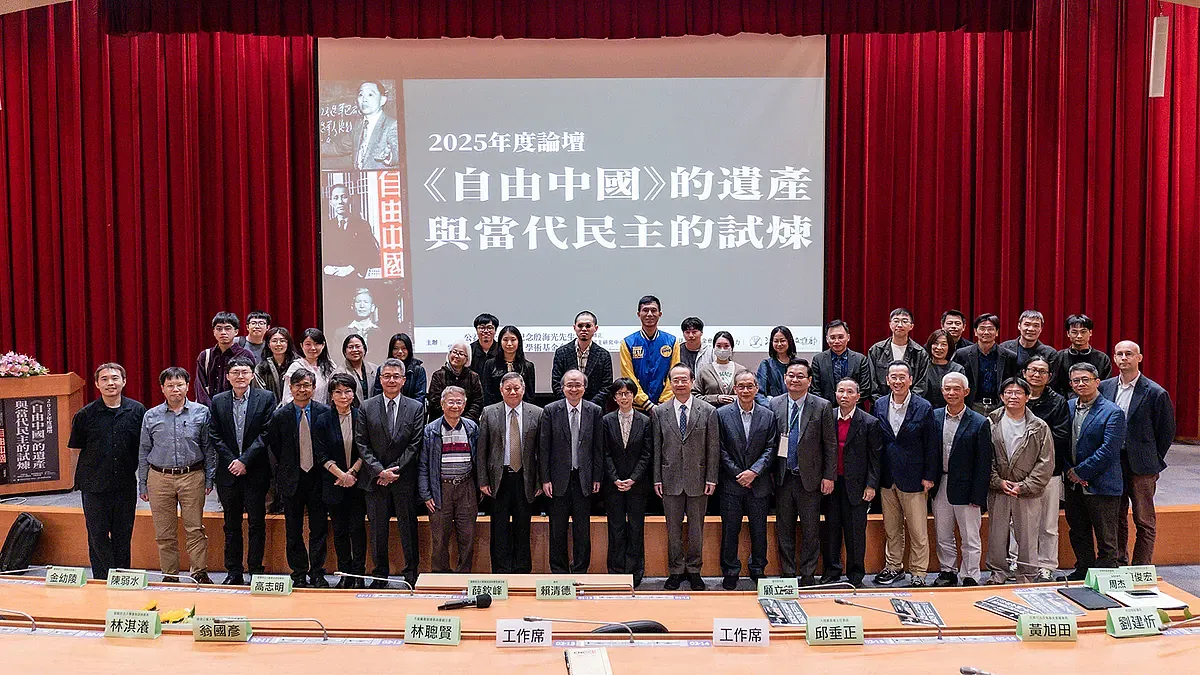
The Lei Chen Democracy and Human Rights Memorial Lecture held its 2025 annual forum today (December 6) at the International Conference Hall in National Taiwan University College of Law's Tsai Lecture Hall. The forum, titled "The Legacy of Free China and the Trials of Contemporary Democracy," drew more than 200 registrants from across generations, reflecting broad public interest in these pressing questions.
In the politically repressive climate of the 1950s, three prominent advocates of freedom and democracy—Lei Chen, Yin Hai-kuang, and Fu Cheng—strongly criticized communist totalitarianism and argued that genuine anti-communism must be grounded in freedom and the rule of law, thereby planting important intellectual seeds for Taiwan's democratization. Seventy years later, as China continues to exert pressure on Taiwan, the discourse of "anti-communism" has once again come to the fore. President Lai Ching-te personally opened the forum. His remarks underscored its significance: at a moment when Taiwan is seeking to defend its democracy, society must understand the profound influence that earlier generations' anti-communist thought and strategies had on Taiwan's democratic development. Lai emphasized "democracy, anti-communism, and national interests" as three key pillars for safeguarding Taiwan and called on people across party lines to unite in confronting external challenges.
Session I | Reflections on Anti-Communism: The Nature of Communist China and the Problem of Anti-Communism
The first session, "Reflections on Anti-Communism: The Nature of Communist China and the Problem of Anti-Communism," was moderated by attorney Chin-Feng Hsueh, Convener of the Advisory Committee of the Lei Chen Democracy and Human Rights Charitable Trust. The keynote address was delivered by Chen Jo-shui, Chairperson of the Yin Hai-kuang Academic Cultural Foundation. Paul Lin, a member of the Trust's Advisory Committee, and Chao-Nien Huang, Associate Professor and Director of the Graduate Institute of National Development at National Chengchi University, served as discussants.
In his keynote address, Chairperson Chen Jo-shui argued that Taiwan currently faces a serious threat from the Chinese Communist Party (CCP) regime and therefore urgently needs to reconsider the meaning and foundations of "anti-communism." He emphasized that China is not merely an ordinary authoritarian state, but a totalitarian system characterized by extensive control and domination over thought, whose objectives and conduct go far beyond conventional competition between states and may produce devastating consequences. According to Chen, the CCP has evolved from revolution, violence, and social transformation into a technologically enabled form of digital totalitarianism, while continuing to glorify power, manipulate nationalism, and employ highly flexible and unscrupulous tactics. Chinese nationalism, as promoted by the CCP, has now become central to the regime's legitimacy, expansion, and rule.
Professor Chen stressed that anti-communism cannot be reduced to slogans. It must instead rest on an accurate understanding of the nature of totalitarianism so that Taiwan can respond to aggression and build a common democratic will. He called on Taiwanese society to remain clear-eyed, continually reassess its strategies, and treat this awareness as an essential foundation for defending the country and protecting freedom.
In his remarks, Paul Lin emphasized that the CCP is fundamentally a totalitarian system that uses pragmatism as a method while placing power and violence at its core. Historically, he argued, the CCP has expanded its influence through deception and exchanges of benefits, abandoning policies once they have served their purpose. Lin warned the audience to recognize this unscrupulous mode of governance. He further argued that both the CCP's domestic control and its external expansion depend on exploiting human vulnerabilities.
Addressing Taiwan's recent blocking of Xiaohongshu (RED) as an anti-fraud measure, Lin said that thorough communication with younger generations is necessary to build awareness. He urged Taiwanese society to recognize the nature of the CCP, prevent human weaknesses from being exploited, and preserve internal tolerance and solidarity in order to resist united-front tactics and external threats.
Chao-Nien Huang analyzed the CCP across different historical periods from a political-science perspective. Although maintaining the legitimacy of its rule has remained the regime's ultimate objective, he explained, its leadership structure, party-state relations, and methods of social control have changed over time. The Mao era was characterized by totalitarianism, personal dictatorship, party-state integration, and ideological legitimacy grounded in communism. The post-Mao period shifted toward authoritarianism, collective leadership, greater differentiation between party and state, and legitimacy based increasingly on economic growth and nationalism. Under Xi Jinping, Huang argued, China has moved back toward totalitarianism and personalistic rule, with more extensive control over state-society relations and renewed emphasis on ideology.
Huang also discussed how the Chinese regime employs both soft power—through culture and ideology—and hard power, including coercion and economic leverage, creating spillover effects and facilitating the expansion of authoritarian influence. He argued that Taiwan still faces internal contradictions and unfinished transitional justice, while its democratic culture requires further consolidation. Taiwan therefore needs to strengthen its society-wide consensus on the values underlying democratic institutions.
Session II | Freedom of Speech for the Enemies of Freedom
The second session, "Freedom of Speech for the Enemies of Freedom," was moderated by Professor Chen Chun-hung, Director of the Fu Cheng Democracy Research Center and Professor in the Department of Political Science at Soochow University. The panel featured Hui-Chieh Su, Associate Professor at National Taiwan University College of Law; Lin Tzu-yi, former Justice of the Constitutional Court and Adjunct Professor at National Taiwan University College of Law; and Hsu Tzong-li, former President of the Judicial Yuan and Professor Emeritus at National Taiwan University College of Law.
At the beginning of the session, Professor Hui-Chieh Su focused on the tension between constitutional protection of speech and democratic self-defense when dealing with speech by "enemies of free democracy." Reviewing U.S. constitutional practice and existing judicial decisions in Taiwan, Su also introduced Germany's model of "defensive democracy," developed in response to its authoritarian past. This framework employs mechanisms such as political-party bans and the forfeiture of certain fundamental rights to prevent democratic institutions from being legally exploited for their own destruction.
Su further discussed developments in European law and European human rights jurisprudence following Russia's invasion of Ukraine, explaining how advocacy of war, threats to national security, and propaganda endangering public order may be treated as threats to democratic institutions and therefore subject to restriction. Drawing on comparative experience, she argued that Taiwan should consider the degree to which speech endangers national security and public order when determining whether restrictions are justified, while maintaining carefully defined thresholds. In light of Cross-Strait tensions, social polarization, and regulatory gaps affecting online platforms, Su argued that Taiwan must find an appropriate balance between defending core democratic values and protecting freedom of speech. Civil society, she added, must continue putting constitutional values into practice.
Professor Hsu Tzong-li then elaborated on the basic concept of defensive democracy. In simple terms, he explained, a tolerant society must retain the ability to defend tolerance against forces that would exploit democratic freedoms in order to destroy democracy itself. Hsu identified four broad features of defensive democracy: first, a commitment to binding constitutional values; second, a focus on threats arising from internal political forces; third, the use of defensive measures, often through political and legal institutions; and fourth, a preventive orientation.
Hsu also explained why the United States did not develop a defensive-democracy model comparable to those found in Europe. By contrast, he described Taiwan's system as "half-developed." J.Y. Interpretation No. 499 affirmed the priority of the free and democratic constitutional order, while J.Y. Interpretation No. 445 applied the American "clear and present danger" standard in the context of freedom of assembly and expression. From the perspective of defensive democracy, Hsu regarded this tension as regrettable. Given Taiwan's geopolitical circumstances, which differ substantially from those of the United States, he argued that Taiwan should actively fill the legislative gaps in its defensive-democracy framework. This includes reconsidering the applicable danger threshold and examining how anti-democratic speech outside the scope of the Assembly and Parade Act might be regulated consistently with the principle of proportionality.
In his discussion, Professor Lin Tzu-yi began with a more fundamental question: should Taiwan's present difficulties lead society to re-examine the framework of liberalism itself? Describing himself as a believer in liberalism, Lin recalled a seminar held by the Comparative Law Society of Taiwan more than 30 years ago on the "clear and present danger" standard. At the time, he warned that a legal framework being used to protect speech advocating Taiwan independence might one day operate in reverse and protect speech advocating unification. The design of defensive democracy, he therefore stressed, must be approached with exceptional caution.
Drawing on U.S. cases, Lin emphasized that assessments of "clear and present danger" are highly context-dependent and must take into account both the nature and severity of the threatened harm. He particularly endorsed Su's discussion of the dramatic changes in contemporary social-media environments and methods of communication, noting that these developments may affect how harmfulness should be evaluated. Lin concluded by asking how deeply society values freedom of speech. He maintained that freedom of speech remains a precious fundamental value, while agreeing that Taiwan must continue reflecting on how best to practice and protect that freedom under contemporary conditions.
Both sessions also expressed appreciation to Lei Chen's maternal grandson, Jin Youling, and his wife, Cao Lezhi, who presented flowers to the keynote speakers and discussants on behalf of the organizers.
The forum took place against a critical backdrop in which history and contemporary reality intersect. By carrying forward the intellectual legacy of Lei Chen, Yin Hai-kuang, and Fu Cheng, participants reflected on the challenges currently facing Taiwan. The discussions revealed shared concerns as well as serious intellectual debate, while collectively exploring possible future directions and institutional paths for protecting liberal democracy.
Organizers
Lei Chen Democracy and Human Rights Charitable Trust
Yin Hai-kuang Academic Cultural Foundation
Fu Cheng Democracy Research Center
Co-Organizer
Judicial Reform Foundation
Media Collaborator
Plain Law Movement
This article is an AI-generated translation of the original Chinese text. In the event of any discrepancy, the Chinese version shall prevail.