
Sidelights | "Freedom of Speech for the Enemies of Freedom": How Can Democracy Self-Defend Amidst Information Warfare and Totalitarian Infiltration?
Last edited: 2026-08-24
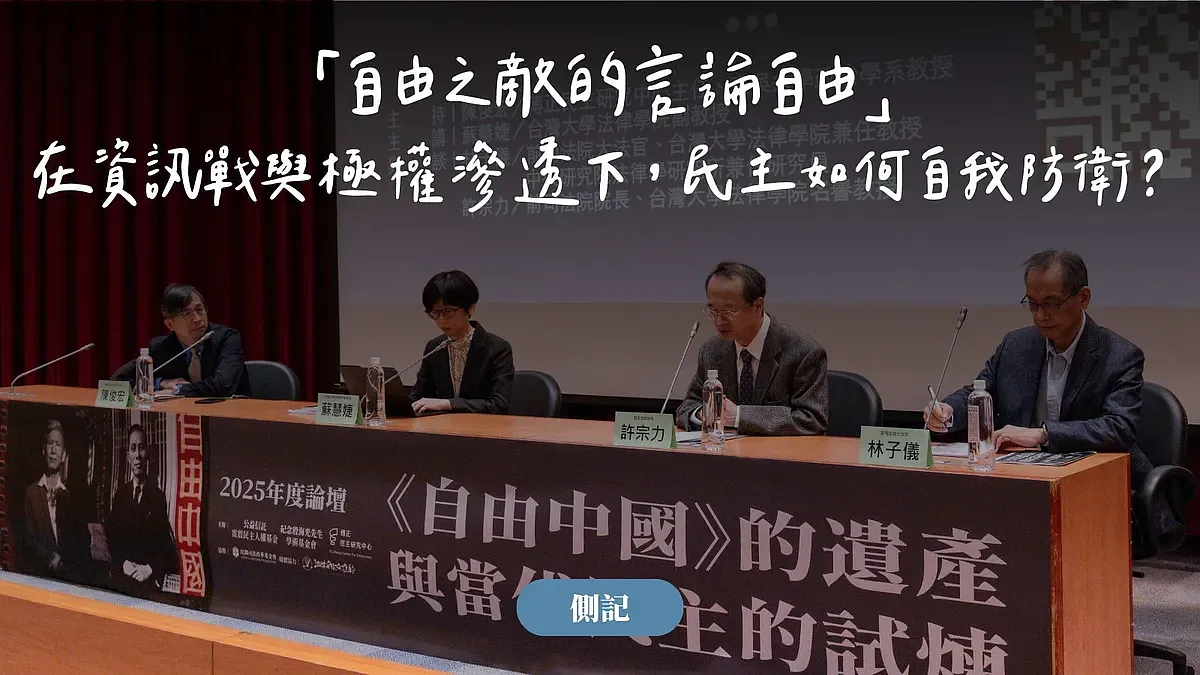
Moderator Professor Chen Chun-hung, Director of the Fu Cheng Democracy Research Center, pointed out that the challenges Taiwan currently faces have long transcended traditional military threats. Instead, they arise from multilayered forms of aggression involving Chinese military coercion, economic infiltration, diplomatic isolation, and large-scale cognitive warfare. External forces seek to divide Taiwanese society through media influence, disinformation, and manipulation of social media, while structural vulnerabilities within Taiwan's political system interact with and reinforce these external threats, pushing Taiwan toward what Chen described as an "existential crisis."
Against this backdrop, Chen Chun-hung raised a central question: when authoritarian regimes exploit the openness and freedom of speech of democratic societies to disseminate information capable of eroding the democratic system itself, must democracy continue to tolerate such speech unconditionally? Faced with "boiling-frog-style" infiltration and information warfare, whether classical liberalism's belief that "truth will prevail through debate" remains sufficient to defend democracy is precisely the constitutional question this session sought to confront.
Associate Professor Hui-Chieh Su: Addressing the Dilemmas of Defensive Democracy Through European Experience and the "Clear and Present Danger" Standard
Associate Professor Hui-Chieh Su first clarified the concept of the "enemy of freedom/democracy." She explained that the term does not refer to people whom the Constitution itself designates as enemies, but rather to actors who actively attack the constitutional order. Such actors may arise from within the state—including the executive, legislature, or public administration—or from within society, including individuals, organizations, or political parties. The session focused particularly on speech directed against the state or constitutional system, such as support for armed aggression against Taiwan, incitement of military personnel to violate their duties, or advocacy of destroying the free and democratic constitutional order through unlawful means.
Su reviewed how, over more than three decades of democratization in Taiwan, social movements and constitutional jurisprudence have jointly shaped a freedom-of-speech framework strongly influenced by the "clear and present danger" standard. Political speech criticizing state power receives the highest level of protection, and state restrictions require a sufficiently serious danger to national security, social order, or the life, bodily integrity, or freedom of others. This approach reflects significant influence from U.S. constitutional law and a high degree of confidence in the "marketplace of ideas" and rational public deliberation.
Su cautioned, however, that not every democracy shares such an optimistic view of rational deliberation. Countries with histories of authoritarianism have in particular developed the concept of "defensive democracy" to prevent anti-democratic forces from using legal institutions and democratic procedures to gradually dismantle democracy from within. The intellectual origins of this idea can be traced to German constitutional scholar Karl Loewenstein in the 1930s: democracy should not be required to permit its own destruction, and the state may therefore adopt preventive measures to defend the constitutional order.
Using Germany as an example, Su explained that the Basic Law for the Federal Republic of Germany contains mechanisms including the eternity clause, the prohibition of unconstitutional political parties, and the forfeiture of certain fundamental rights in order to protect the constitutional order against forces seeking its destruction and to prevent a recurrence of the Nazis' "legal seizure of power." At the same time, defensive democracy creates difficult questions in both constitutional theory and practice.
Su noted that early fascist and communist authoritarian movements were more readily identifiable as fundamentally hostile to democracy. Contemporary populist movements, by contrast, often employ democratic rhetoric and claim to "truly represent the people" while gradually eroding constitutional institutions from within, making the boundary far more difficult to draw. This also gives rise to the "paradox of democracy": if the state restricts fundamental rights too aggressively in the name of protecting democracy, does it risk defending freedom and democracy through methods that are themselves illiberal or undemocratic? Determining when defensive mechanisms should be activated and how far restrictions may legitimately extend therefore presents exceptionally difficult constitutional questions.
Su specifically discussed Article 20(1) of the International Covenant on Civil and Political Rights (ICCPR), which requires the prohibition by law of propaganda for war, as well as decisions of the General Court of the European Union and the European Court of Human Rights following Russia's invasion of Ukraine. She explained that international and European human rights practice recognizes that preventive restrictions may be imposed on speech whose principal purpose is to promote or strengthen support for aggressive war, without requiring authorities to wait until war actually breaks out. This approach narrowly defines the intent and content necessary to constitute "propaganda for war," while allowing restrictions before a direct causal connection to actual acts of war can be established.
Taiwan has given domestic legal effect to the two Covenants through the Act to Implement the International Covenant on Civil and Political Rights and the International Covenant on Economic, Social and Cultural Rights. Nevertheless, Taiwan still lacks specific legislation addressing "propaganda for war." Su argued that, if such legislation is enacted in the future, restrictions should continue to depend on the substantial harm posed by the speech to national security and public order rather than on an abstract invocation of "national security."
Returning to Taiwan's current circumstances, Su emphasized that determining the danger posed by speech that incites unlawful conduct, intensifies social division, or reinforces hostile narratives requires close attention to context. Chinese military aircraft and warships operating around Taiwan and large-scale military exercises have become recurring features of the security environment, while internal political and social antagonisms continue to accumulate. Determining whether speech creates a "clear and present danger" must therefore take account not only of Taiwan's concrete domestic and international political circumstances but also of the contemporary information environment dominated by digital platforms.
Regarding the responsibilities of media organizations and platforms, Su observed that contemporary speech distribution is highly concentrated in mass media and digital platforms. External forces may create "systemic risks" to the public sphere by controlling media outlets or manipulating platform algorithms, generating effects such as echo chambers, political polarization, and information asymmetry. European practice has, in certain circumstances, treated state-controlled foreign media as instruments of information warfare rather than as equivalent to independent news organizations. At the same time, large online platforms may be required to assume minimum risk-management obligations arising from their own content-curation and recommendation systems even when they are not directly responsible for third-party content.
Yet generative artificial intelligence has dramatically reduced the cost of producing disinformation, and large volumes of AI-generated content are foreseeable during elections. Taiwan still lacks a comprehensive legal framework governing digital platforms and systemic risks. Su acknowledged that the current legal system does not yet provide sufficiently robust defensive mechanisms for democracy in this information environment, leaving substantial room for future reform. The central difficulty is how to strengthen the Constitution's "normative resilience" without abandoning constitutional values—ensuring that the Constitution is not merely a "fair-weather constitution," but remains binding and effective during periods of crisis.
Su concluded by emphasizing that, regardless of how legal institutions are designed, the ultimate line of defense for democracy and civil society remains citizens who believe in constitutional values and are willing to put them into practice.
Former Judicial Yuan President Hsu Tzong-li: Is Taiwan a "Half-Baked Defensive Democracy"?
Former Judicial Yuan President Hsu Tzong-li began with the intellectual foundations of defensive democracy. In addition to Karl Loewenstein, whom Su had discussed, Hsu referred to Karl Popper's "paradox of tolerance" in The Open Society and Its Enemies: unlimited tolerance toward intolerant forces may ultimately destroy tolerance itself. A democratic society may therefore, under appropriate conditions, refuse to tolerate actors who would exploit tolerance to eliminate democracy. This captures a central intuition of defensive democracy—democracy need not permit itself to be destroyed "in the name of democracy."
Hsu summarized defensive democracy through four characteristics. First, democracy is not value-neutral but is anchored in the free and democratic constitutional order as a fundamental constitutional value. Second, defensive mechanisms are directed primarily at anti-democratic extremist forces operating within the political system. Third, democracy may adopt exclusionary institutional mechanisms for self-defense, such as dissolving unconstitutional political parties, restricting speech that incites the destruction of the democratic order, or, in Germany, forfeiting certain fundamental rights when those rights are abused to attack the constitutional order. Fourth, defensive democracy is preventive: it may intervene before a danger becomes fully imminent.
Hsu therefore identified a structural tension between defensive democracy and the "clear and present danger" standard traditionally associated with U.S. constitutional law. Defensive democracy emphasizes early prevention, whereas the latter generally demands a much more immediate threat before speech may be restricted. The United States' willingness to tolerate highly provocative expression, including neo-Nazi demonstrations, reflects its strong First Amendment tradition, individualism, and confidence in democratic resilience. It has therefore not developed the same comprehensive system of party prohibition and anti-extremism mechanisms found in some continental European states.
Turning to Taiwan, Hsu described the country as resembling a "half-baked defensive democracy." At the level of constitutional values, Article 5, Paragraph 5 of the Additional Articles of the Constitution of the Republic of China provides that a political party is unconstitutional if its goals or activities endanger the existence of the Republic of China or the nation's free and democratic constitutional order. J.Y. Interpretation No. 499 likewise recognized the free and democratic constitutional order as a foundational constitutional principle. From this perspective, Hsu argued, public institutions and channels of civic communication—including education, media, and the internet—should actively communicate the importance of the free and democratic constitutional order.
Hsu argued that opposition to communism, fascism, and extreme dictatorship should constitute a common minimum commitment among democratic political parties. Greater China nationalism may certainly exist as a political viewpoint, he said, but it should not be placed above the free and democratic constitutional order: discussion of unification or a Greater China is permissible, but commitment to freedom and democracy must take priority.
At the level of concrete defensive tools, however, Hsu argued that Taiwan still has major gaps compared with countries such as Germany. Germany criminalizes certain extremist symbols and forms of expression, while Taiwan has comparatively little substantive regulation. Article 4 of the Assembly and Parade Act states that assemblies and parades must not advocate communism or territorial separation, but J.Y. Interpretation No. 445 imposed demanding constitutional limits on restrictions of assemblies and parades. In practice, speech such as displaying the People's Republic of China flag or advocating acceptance of armed unification is therefore difficult to restrict solely on the basis of its political content. Hsu considered this highly speech-protective approach difficult to reconcile with the preventive logic of defensive democracy.
Hsu also referred to the view of an Israeli Supreme Court justice that democratic collapse often does not occur through a single dramatic event, but through gradual and cumulative erosion. For Taiwan, which stands on the geopolitical front line and faces persistent military intimidation and information warfare, he argued that it is necessary to reconsider whether the "clear and present danger" framework remains fully adequate, or whether a more responsive standard is needed for direct advocacy of aggressive war and speech inciting the destruction of the free and democratic constitutional order through media or online platforms.
At the same time, Hsu repeatedly stressed that strengthening defensive democracy must never come at the expense of fundamental rule-of-law requirements such as proportionality and legal clarity. Otherwise, the concept of "protecting democracy" could itself produce a dangerous slippery slope. He also referred to public-opinion findings that concerned him, particularly indications that firm support for democracy in Taiwan may be weaker than commonly assumed. Democracy, he emphasized, should never be taken for granted; it is a collective achievement that each generation must be willing to defend.
Former Justice Lin Tzu-yi: Re-Evaluating the "Clear and Present Danger" Standard in the Information Society
Former Justice Lin Tzu-yi recalled that during Taiwan's authoritarian era, advocacy of Taiwan independence was frequently treated as sedition or territorial separatism, leading to criminal prosecution of political dissidents. Lin invoked the "clear and present danger" standard to criticize the state's suppression of pro-independence speech in the name of national security and argued that such political advocacy should receive constitutional protection.
At the time, Lin also raised a warning: if advocacy of unification were one day to become a minority position, or even a form of speech that some people wished to prohibit, would those who had once defended "Taiwan independence speech" remain willing to apply the same liberal standard to political views with which they strongly disagreed?
Lin then offered two additional reflections.
First, he noted that the Constitution of the United States is not entirely devoid of mechanisms of democratic self-defense; its mechanisms simply differ from those found in Germany's Basic Law. Section 3 of the Fourteenth Amendment bars certain former officeholders who previously swore to support the U.S. Constitution and later engaged in insurrection or rebellion from holding specified public offices. In 2023, the Colorado Supreme Court relied on Section 3 to hold that Donald Trump was constitutionally disqualified from the presidency because of his conduct relating to the January 6, 2021 attack on the U.S. Capitol. In Trump v. Anderson, 601 U.S. 100 (2024), the U.S. Supreme Court reversed that judgment, holding that individual states lack authority to enforce Section 3 against candidates for federal office in the manner Colorado had attempted. The controversy nevertheless demonstrates that U.S. constitutional law also contains mechanisms concerned with defending the constitutional system against insurrectionary conduct.
Second, Lin returned to the "clear and present danger" standard itself. He explained that the standard focuses heavily on the temporal urgency of the harm that particular speech may cause. As long as there remains sufficient time for open discussion and rational deliberation to address the danger, the state should hesitate to suppress speech in advance. Behind this approach lies a belief in the marketplace of ideas and in the capacity of rational communication to correct error.
In the contemporary information environment, however, Lin argued that this premise may no longer be as secure. Societies differ in their confidence that rational discussion can resolve political conflict, and when the threatened harm concerns human life or the survival of the state itself, the acceptable degree of immediacy and urgency may differ from that applied to ordinary harms.
Lin stressed that today's information environment is neither that of the 1910s and 1920s nor the relatively centralized mass-media environment of the fascist era. Information technology has fundamentally transformed how people interact and communicate. He summarized this transformation through two concepts: speed and scale. Once information is placed on a social-media platform, it can spread through the public sphere almost instantaneously and at enormous scale. Under these conditions, freedom-of-speech theories developed around the assumption that society has ample time for calm discussion inevitably face new pressures.
Lin observed that U.S. scholars themselves have long criticized simplistic versions of the "marketplace of ideas." Algorithmic recommendation systems and echo chambers may prevent people from encountering competing perspectives at all, undermining the assumption that false claims will naturally be corrected through open debate. Whether society can simply rely on the proposition that "truth will prevail through debate" is therefore a question that constitutional theory must confront directly.
Nevertheless, Lin emphasized that discovering truth is not the only reason for protecting freedom of speech. The dignity, autonomy, and free development of every individual should remain central constitutional values. Freedom of speech serves multiple functions: self-fulfillment, exchange of opinions, pursuit of truth, satisfaction of the public's right to know, formation of public opinion, and maintenance of a pluralistic democratic society. Taiwan's constitutional jurisprudence has repeatedly affirmed that freedom of speech deserves the highest degree of protection, and the rise of the information society does not eliminate that fundamental commitment.
Finally, Lin returned to intergenerational experience and civic responsibility. Compared with generations that experienced war and the White Terror, many younger people were born into a relatively free society and may find it more difficult to appreciate how hard-won democracy and freedom have been. Yet under conditions of information warfare and authoritarian infiltration, no institutional design—however sophisticated—can substitute for citizens who are willing to participate in public life and practice constitutional values. The final defense of democracy, Lin argued, remains those who continue to believe in freedom and are willing to accept responsibility for protecting it.
Q&A Session: Special Platform Legislation, the Effectiveness of Defensive Democracy, and Standards for Speech Restrictions in the Name of National Security
During the Q&A session, participants focused on three issues.
The Draft Digital Intermediary Services Act Has Become Highly Politicized in Taiwan, Making Its Revival Difficult in the Short Term. Can the State Still Improve the Information Environment Through Existing Legal Mechanisms in the Absence of Special Platform Legislation?
Associate Professor Hui-Chieh Su responded that courts can currently address certain platform duties concerning unlawful content through civil tort law, while administrative agencies communicate with platforms through administrative guidance and nonbinding guidelines. However, these approaches raise concerns regarding the principle of statutory reservation and democratic legitimacy. In the long term, she argued, dedicated platform legislation remains necessary to bring both state authority and platform obligations within a clear constitutional and rule-of-law framework.
Germany Once Broadly Excluded Political Radicals from Public Employment, Yet Far-Right Parties Have Since Grown Significantly. Does This Cast Doubt on the Effectiveness of Defensive Democracy?
Hsu Tzong-li responded that Germany possesses one of the most developed sets of defensive-democracy mechanisms, yet those mechanisms have been invoked relatively sparingly. With the Alternative for Germany (AfD) having become a major political force, authorities remain cautious about initiating party-ban proceedings because of the potentially significant political consequences. This demonstrates that institutional design alone cannot resolve the problem: defensive mechanisms must be carefully calibrated against political realities, and their actual operation and unintended consequences must be continuously evaluated.
Does Invoking National Security Permit the State to Abandon the "Clear and Present Danger" Standard and Apply a More Deferential Constitutional Standard to Restrictions on Speech?
Associate Professor Hui-Chieh Su clarified that she was not advocating a lower standard of constitutional review. Rather, she emphasized that Article 20(1) of the International Covenant on Civil and Political Rights (ICCPR), concerning propaganda for war, has itself been the subject of substantial historical controversy. If Taiwan legislates in this field, restrictions should remain subject to the existing constitutional framework governing freedom of speech, with the substantial harm posed to national security and public order serving as the relevant threshold. Abstract invocations of "national security" should not by themselves justify relaxing constitutional safeguards for expression.
Beginning with the theoretical foundations of defensive democracy, the session combined Taiwan's high-risk geopolitical environment with its increasingly fragmented information ecosystem to reconsider where constitutional boundaries should be drawn. All three scholars emphasized that institutions are indispensable, but even the most comprehensive defensive mechanisms cannot preserve Taiwan's hard-won free and democratic constitutional order without citizens who genuinely believe in constitutional values and are willing to put them into practice.
This article is an AI-generated translation of the original Chinese text. In the event of any discrepancy, the Chinese version shall prevail.