
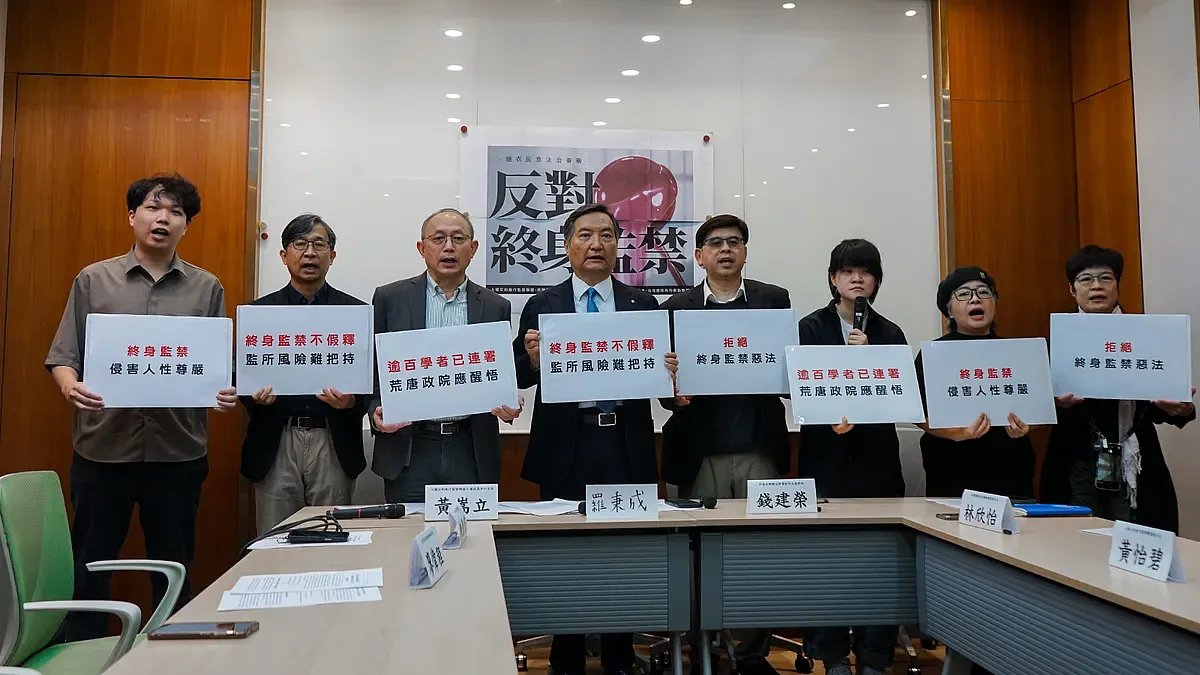
Press Conference | Is the Constitutional Court Sick, and is the Ministry of Justice Taking Advantage of the Chaos? — Civil Society Groups Oppose the "Life Without Parole" Bad Law Press Release
Last edited: 2026-08-24
In late October 2025, the Executive Yuan announced draft amendments to the Criminal Code of the Republic of China, the Enforcement Law of the Criminal Code of the Republic of China, and the Prison Act. The proposals would broadly introduce a life imprisonment without parole (LWOP) regime, under which persons convicted of specified offenses and sentenced to life imprisonment or fixed-term imprisonment exceeding 10 years would be ineligible for parole.
The proposed amendments have triggered strong opposition from both legal scholars and practitioners. The three major political parties have joined forces to advance far-reaching changes to the correctional system without adequately consulting relevant experts, understanding the difficulties faced by frontline correctional personnel, or conducting rigorous empirical research and human rights impact assessments. In response, civil society organizations—including Covenants Watch, the Judicial Reform Foundation, the Taiwan Association for Human Rights, the Taiwan Innocence Project, and the Taiwan Alliance to End the Death Penalty—issued a public statement this month and launched the petition "Sugar-Coated Public Opinion, Rule-of-Law Poison: Oppose the Harmful 'Life Imprisonment Without Parole' Bill", initiated by the organizations together with 17 lead scholars.
To date, more than 100 scholars, particularly from the fields of law and the social sciences, have joined the petition. Practitioners have also signed on, including attorneys, frontline correctional personnel, probation officers, juvenile investigation officers, social workers, psychologists, and court bailiffs. Their participation demonstrates the serious concern that these amendments have generated among those working on the front lines of the correctional and criminal justice systems. Civil society organizations therefore issue the following statement:
1. The Executive Yuan should withdraw the proposed amendments relating to the life imprisonment without parole system.
2. All party caucuses in the Legislative Yuan should halt legislative proceedings concerning the life imprisonment without parole system.
3. Major criminal justice policies must be supported by rigorous empirical research and human rights impact assessments.
1. The Executive Yuan Should Withdraw the Proposed Amendments Relating to the Life Imprisonment Without Parole System
In our previous petition statement, civil society organizations explained that irreducible life sentences have been found in European human rights jurisprudence, Germany, and Canada to raise serious concerns under prohibitions on cruel, inhuman, or degrading punishment and under guarantees of human dignity. We therefore contend that the Executive Yuan's proposal to categorically exclude certain life sentences from parole is incompatible with Articles 7 and 10 of the International Covenant on Civil and Political Rights (ICCPR).
The Republic of China Correction Association has also warned that parole is not leniency, but rather a "safety valve" for prison order and a "path of hope" for incarcerated people, and that abolishing parole would not produce greater public safety but could instead create serious risks within correctional institutions. These warnings underscore the prison-management concerns and operational dangers that flawed legislation may create.
Moreover, the proposed parole-ineligibility provisions would apply retroactively to certain cases in which judgments have already become final. The draft also provides that, where a finalized death sentence is later vacated and replaced with another sentence, the period of post-final-judgment confinement pending execution may neither be credited against the prison term nor counted toward the period of sentence execution required for parole eligibility. The former raises serious concerns under the prohibition against retroactive aggravation and the principle of legality, while the latter raises concerns under the constitutional principles of proportionality and equality. Civil society organizations consider both aspects constitutionally improper.
We therefore urge the Executive Yuan to withdraw the proposed amendments relating to the life imprisonment without parole system. Doing so would avoid adding another serious human rights controversy involving Taiwan's treaty obligations and would prevent the government from setting a troubling precedent by advancing legislation that raises substantial constitutional concerns, particularly at a time when the Constitutional Court has faced serious institutional difficulties in hearing cases.
2. All Party Caucuses in the Legislative Yuan Should Halt Legislative Proceedings Concerning the Life Imprisonment Without Parole System
In addition to the Executive Yuan's proposals, party caucuses in the Legislative Yuan have recently introduced other bills concerning life imprisonment, a three-tiered life-imprisonment system, or proposals similar to those advanced by the Executive Yuan.
Civil society organizations urge all party caucuses in the Legislative Yuan to halt legislative proceedings concerning life imprisonment without parole. Criminal justice policies that require professional deliberation and careful study should not be turned into political performances designed merely to cater to public opinion. The legislature should not advance proposals that raise serious concerns under Taiwan's international human rights obligations and the Constitution.
3. Major Criminal Justice Policies Must Be Supported by Rigorous Empirical Research and Human Rights Impact Assessments
More than 100 scholars have joined the civil society petition "Sugar-Coated Public Opinion, Rule-of-Law Poison: Oppose the Harmful 'Life Imprisonment Without Parole' Bill". Their participation highlights not only the substantive concerns surrounding the proposed amendments, but also the lack of adequate evaluation and the haste of the legislative process.
Before the Executive Yuan announced the amendments on October 30, 2025, the draft had not undergone prior public notice or public consultation by the competent authority, the Ministry of Justice. Moreover, the Executive Yuan had only recently revised its mechanisms for reviewing ministerial draft bills and conducting human rights impact assessments, with the new procedures taking effect on July 1, 2025. Yet based on the information publicly available, the present draft contains no corresponding empirical or human rights assessment, and the Executive Yuan's review process did not broadly consult scholars, experts, or civil society organizations. This reflects a rushed and inadequate legislative process.
Civil society organizations therefore urge the Executive Yuan not only to withdraw the present draft amendments, but also to comprehensively review how agencies such as the Ministry of Justice formulate legislation. When major criminal justice policies are proposed in the future, they must be supported by rigorous empirical research and human rights impact assessments, and the government should broadly consult scholars, practitioners, experts, and civil society organizations. Only through such procedures can Taiwan avoid repeating similarly flawed legislative processes.
Press Conference Time
December 16, 2025, 10:00 a.m.
Press Conference Location
Room 101, Legislative Yuan Research Building (Chung-Hsing Building), No. 3-1, Sec. 1, Jinan Rd., Zhongzheng Dist., Taipei City
Attendees
Moderator:
Wang Hsi|Deputy Secretary-General, Taiwan Association for Human Rights
Speakers:
Lo Ping-cheng|Chairperson, Taiwan Innocence Project; Adjunct Professor of Practice, College of Law, National Taiwan University
Chien Chien-Jung|Managing Attorney, Ida Happy Feet Law Office; Adjunct Lecturer, Department of Law, Soochow University
Huang Sung-li|Director, Human Rights Policy Center, Covenants Watch; Adjunct Professor, Institute of Public Health, National Yang Ming Chiao Tung University
Supporting Attendees:
Chen Chun-hung|Professor, Department of Political Science, Soochow University
Huang Yi-bee|Executive Director, Covenants Watch
Lin Hsin-yi|Executive Director, Taiwan Alliance to End the Death Penalty
Liao Weicheng|Associate Researcher, Judicial Reform Foundation
Press Contacts
Huang Yi-bee|Executive Director, Covenants Watch (yibee.huang@cwtaiwan.org.tw)
Wang Yuxiang|Legal Affairs Specialist, Taiwan Alliance to End the Death Penalty (ys@taedp.org.tw)
Wang Hsi|Deputy Secretary-General, Taiwan Association for Human Rights (info@tahr.org.tw)
Liao Weicheng|Associate Researcher, Judicial Reform Foundation (wayne@jrf.org.tw)
This article is an AI-generated translation of the original Chinese text. In the event of any discrepancy, the Chinese version shall prevail.