
Sidelights|The Two Covenants Review is Approaching: How Are Indigenous Youth Responding? Indigenous Human Rights Classroom
Last edited: 2026-08-24
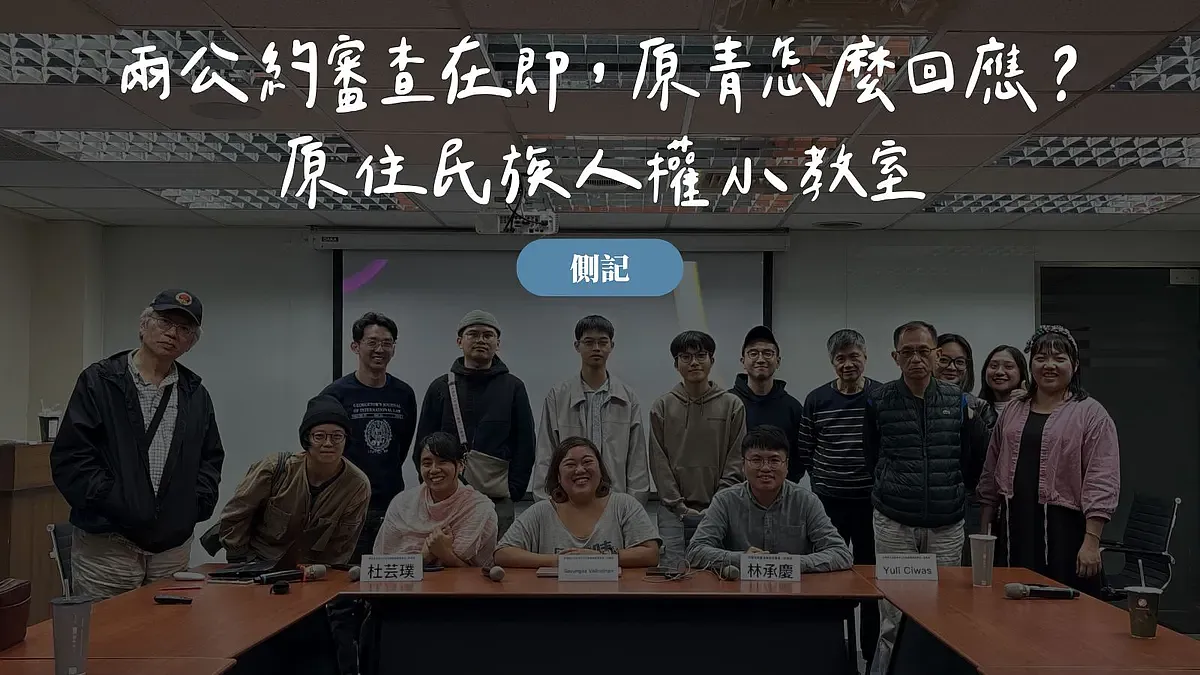
Hosted by the Taiwan Indigenous Youth Public Participation Association, the "Indigenous Human Rights Classroom" lecture, titled "The Two Covenants Review Is Approaching: How Are Indigenous Youth Responding?", brought together young practitioners who have long worked on Indigenous rights and international human rights mechanisms at the Koo Kwang-Ming Foundation office on December 12, 2025. The discussion focused on the upcoming fourth international review of Taiwan's national reports under the Two Covenants—the International Covenant on Civil and Political Rights (ICCPR) and the International Covenant on Economic, Social and Cultural Rights (ICESCR). Moderated by Yuli Ciwas, Secretary-General of the Association, the event featured Nikal Kabala'an (Margaret Yun-Pu Tu), Vice President of the Pacific Alliance For Autonomous Traditions, Indigenous Sovereignty (PAFATIS); Savungaz Valincinan, Chairperson of the Taiwan Indigenous Youth Public Participation Association; and Lin Cheng-Ching, Legislative Policy Researcher at the Judicial Reform Foundation. The speakers examined how Indigenous peoples use international law and human rights mechanisms for rights advocacy from the perspectives of international institutions, domestic participation, and legal and historical theory.
Moderator Yuli Ciwas opened the session with a vivid metaphor, comparing the Two Covenants review to Christmas decorations put up year after year: although the underlying structure may remain the same while the outer decorations change, the process remains an important occasion for examining progress in human rights. Nikal Kabala'an (Margaret Yun-Pu Tu) then opened the substantive discussion by introducing Indigenous rights mechanisms within the United Nations system from an international perspective.
Nikal Kabala'an (Margaret Yun-Pu Tu) explained that although the United Nations Declaration on the Rights of Indigenous Peoples (UNDRIP) is not itself a legally binding treaty, it provides a crucial international framework and foundation for Indigenous peoples around the world in asserting their rights. She introduced three major UN mechanisms: the United Nations Permanent Forum on Indigenous Issues (UNPFII), the Special Rapporteur on the rights of Indigenous Peoples, and the Expert Mechanism on the Rights of Indigenous Peoples (EMRIP). She also spoke candidly about the obstacles Taiwanese Indigenous participants may encounter because Taiwan is not a UN Member State, including difficulties when attempting to participate in international meetings using Taiwan-issued passports. Nevertheless, Taiwanese Indigenous advocates continue to build connections with the international community through overseas NGOs and side events, raising Indigenous rights issues and demonstrating the resilience of Taiwan's Indigenous peoples in international forums.
Savungaz Valincinan then brought the discussion back to Taiwan, sharing more than a decade of practical experience participating in reviews under the Two Covenants. She explained that Taiwan's unique international status led to the development of an unusual review model in which international experts are invited to Taiwan to examine the government's national reports. From the uncertainty surrounding her first participation in 2013 to the present, Indigenous organizations have become increasingly experienced in preparing parallel reports and using international human rights standards to identify gaps in the implementation of Indigenous rights.
Savungaz emphasized that government reports often diverge sharply from the realities experienced by Indigenous peoples. One example is the significant gap in the implementation of Free, Prior and Informed Consent (FPIC). By preparing precise and well-supported parallel reports, civil society organizations can bring these realities to the attention of international review experts and increase pressure on the government to respond. She also noted that, although the government has in recent years imposed tighter restrictions on civil society engagement with review committee members, the review process remains an important arena in the continuing negotiation and struggle between Indigenous peoples and the state.
Cheng-Ching Lin concluded the substantive presentations by examining the dual significance of international law for Indigenous peoples from historical and jurisprudential perspectives. He noted that international law historically functioned in part as an instrument of colonialism, but after World War II it increasingly became a tool through which Indigenous peoples could assert self-determination and sovereignty. Lin argued that, although Taiwan has incorporated several international human rights instruments into domestic law, including the Two Covenants, the inherent sovereignty of Indigenous peoples is often marginalized within a constitutional and legal system that continues to bear colonial characteristics.
For Lin, the strategic value of participating in international human rights reviews lies in measuring state practice against international standards and making visible the areas in which the government falls short. The review process also allows Indigenous advocates to build legal and political arguments over time, creating additional leverage for challenging existing institutions and advancing decolonization.
During the Q&A session, audience members asked whether the conclusions and recommendations produced through the review process have any meaningful binding effect on the government. The speakers acknowledged that the lack of direct coercive force can create a sense of frustration in a long-term struggle. At the same time, they stressed that the mechanism creates an opening that the government cannot easily ignore.
Although international human rights mechanisms do not operate through the same coercive enforcement structure as domestic law, international human rights standards have become important sources cited by legal practitioners in domestic legal arguments and documents. Taiwan's concern for its international reputation can also provide civil society organizations with leverage to press the government for accountability. The lecture concluded with an engaged discussion, and the speakers encouraged the public to continue following the fourth review of the Two Covenants and to participate in monitoring the implementation of Indigenous rights.
This article is an AI-generated translation of the original Chinese text. In the event of any discrepancy, the Chinese version shall prevail.