
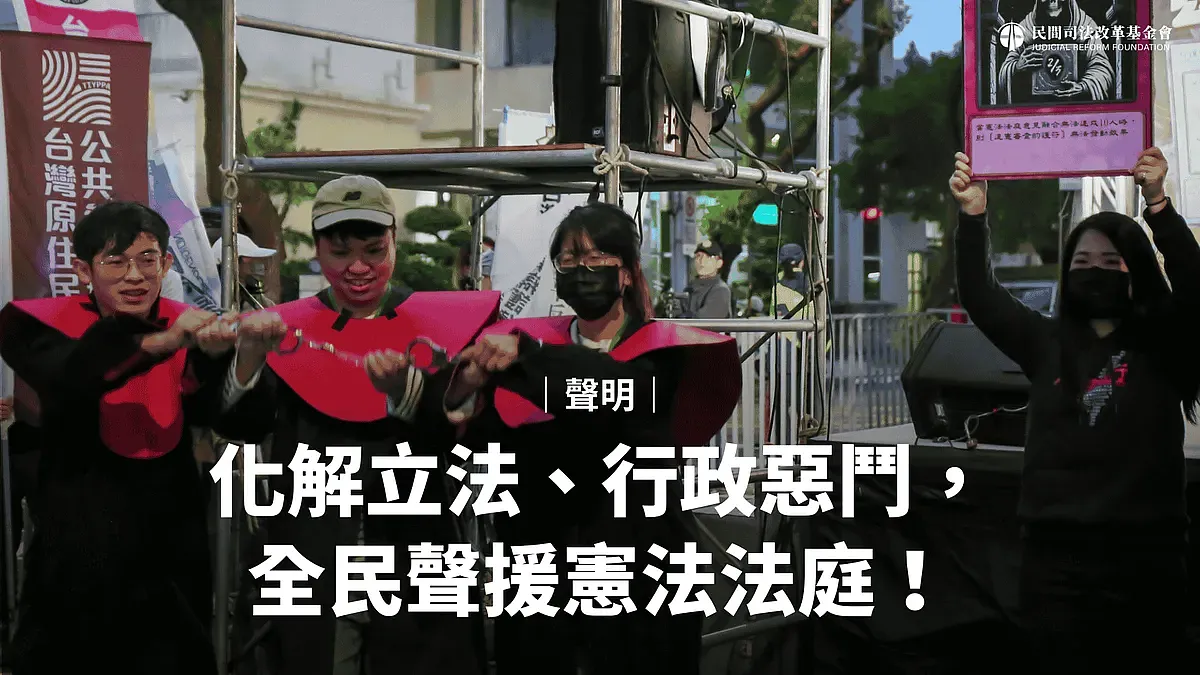
Statement|Resolving Legislative-Executive Confrontation, Public Solidarity with the Constitutional Court!
Last edited: 2026-08-24
On December 20, 2024, the Legislative Yuan passed amendments to the Constitutional Court Procedure Act (hereinafter the "CCPA") that raised the quorum and voting thresholds for Constitutional Court deliberations. Together with the repeated rejection of the President's nominees for Constitutional Court justices, the amendments left the Constitutional Court substantially unable to function for nearly a year, prompting repeated calls from academics and civil society organizations for the Court to resume its constitutional duties independently.
On December 19, 2025, the Constitutional Court rendered TCC Judgment 114-Hsien-Pan-1 (2025), "Case on the Amendment to the Constitutional Court Procedure Act" (hereinafter the "Judgment"), declaring the challenged amendments unconstitutional. Three Justices declined to participate in the Court's deliberation and instead separately published a legal opinion expressing disagreement with the Judgment.
The Judicial Reform Foundation (JRF) believes that the Judgment prevents the judicial branch from being hollowed out by the legislative branch, restores the judiciary's ability to check abuses of power by the legislative and executive branches, upholds the separation of powers, and accords with the constitutional purpose of protecting people's rights.
At a time of intensifying political polarization and confrontation, JRF calls on the public and legal professionals to support the Judgment and ensure that the Constitutional Court can perform its role in stabilizing the constitutional order.
Accordingly, JRF makes the following three statements:
1. JRF supports the reasoning and conclusion of the Judgment and affirms the significant positive role of the Constitutional Court's judicial self-preservation in defending the separation of powers and stabilizing the constitutional order.
2. As the ultimate interpreter of the Constitution, the Constitutional Court rendered the Judgment on the basis of judicial autonomy, its commitment to preserving the constitutional order, and rigorous constitutional interpretation. JRF considers the Judgment procedurally valid. Even where Justices disagree, JRF believes those disagreements should be expressed through participation in the Court's deliberations in faithful performance of the duties conferred by the Constitution.
3. Both the legislative and executive branches have a duty to faithfully observe the Constitution and preserve the constitutional order. Constitutional disputes that cannot be resolved through political negotiation should be addressed through the Constitutional Court; neither branch should unilaterally interpret the Constitution as a political weapon that intensifies constitutional conflict. The ruling and opposition parties should also engage in rational negotiations concerning the confirmation of Constitutional Court nominees and should not turn the Court into a casualty of partisan competition.
I. JRF Supports the Reasoning and Conclusion of the Judgment and Affirms the Constitutional Court's Role in Defending the Separation of Powers and Stabilizing the Constitutional Order
The Justices independently exercise constitutional review authority under the Constitution of the Republic of China. JRF argues that, in order to continuously and faithfully perform their constitutional duties, the Justices must ultimately be guided by the Constitution's superior legal authority rather than by an ordinary statute that itself prevents the exercise of constitutionally assigned judicial power.
For example, if the Legislative Yuan were to amend the Constitutional Court Procedure Act to require unanimous agreement by all 15 Justices before any constitutional judgment could be rendered, such a "technical amendment" could in practice paralyze the Constitutional Court. JRF argues that legislation of this kind could not constitutionally be permitted to eliminate the Court's ability to exercise the powers assigned to it by the Constitution.
JRF therefore believes that the Judgment thoroughly explains why the challenged amendments to the Constitutional Court Procedure Act were unconstitutional and looks forward to the Constitutional Court resuming normal operations and promptly adjudicating cases involving significant effects on people's rights.
II. JRF Considers the Judgment Procedurally Valid and Calls on All Justices to Participate in Deliberations Even When They Disagree
The Judgment was rendered by five Justices: Chief Justice Ming-Yan Shieh, Justice Tai-Lang Lu, Justice Tsai-Chen Tsai, Justice Chung-Wu Chen, and Justice Po-Hsiang Yu. Three other Justices—Justice Tzung-Jen Tsai, Justice Hui-Chin Yang, and Justice Fu-Meei Ju—declined to participate in the deliberation and instead published a separate legal opinion expressing disagreement with the Judgment.
The central issue behind this disagreement concerned whether the amended Constitutional Court Procedure Act, enacted by the opposition-controlled legislature, had absolute binding force on the Justices even when the constitutionality of those very procedural provisions was itself under review.
Relying on judicial autonomy and the constitutional judiciary's authority over its own adjudicatory procedures, the Judgment reasoned that provisions of the Constitutional Court Procedure Act whose constitutionality was being challenged could not simultaneously determine the procedure by which their own constitutionality would be reviewed. Otherwise, a circular problem would arise:
- If the Court ultimately declared the provisions unconstitutional, it would appear to have used an unconstitutional and invalid procedure to reach that conclusion.
- If the Court ultimately declared the provisions constitutional, doubts could arise as to whether the Court reached that result merely to avoid the foregoing contradiction—in effect, deciding the result before completing the review.
To avoid this circularity and the problem of allowing the challenged rule to determine the procedure for reviewing itself, the Constitutional Court concluded that the disputed procedural provisions could not govern the Court's review of their own constitutionality.
JRF further argues that the disagreement among the eight incumbent Justices should ordinarily have been resolved through deliberation and a 5–3 vote. Instead, the three dissenting Justices declined to participate. The Constitutional Court concluded that their refusal obstructed or impeded the other Justices' exercise of constitutional powers and therefore excluded them from the number of incumbent Justices used to calculate the quorum and decision threshold in this case.
The three nonparticipating Justices argued, in substance, that the organizational rules established by the Constitutional Court Procedure Act are prerequisites to the lawful constitution of the Constitutional Court and the existence of its adjudicatory authority, and therefore absolutely bind the Justices. JRF rejects that position as inconsistent with the institutional purpose of constitutional review and with Taiwan's historical practice of constitutional adjudication.
Paragraph 35 of the Judgment and Part IV of Justice Po-Hsiang Yu's concurring opinion emphasize that the Justices exercised constitutional powers before comprehensive statutory procedures existed. After the Constitution of the Republic of China took effect, the Justices issued J.Y. Interpretations Nos. 1 through 76 directly on the basis of constitutional authority. Only thereafter did the Legislative Yuan enact the Council of Grand Justices Act; before that Act entered into force, the Justices also issued J.Y. Interpretations Nos. 77 through 79. Their validity was not affected by the absence of a governing statute.
Even after legislation governing the exercise of the Justices' powers was enacted, the Justices declared statutory provisions unconstitutional and suspended their application, as in J.Y. Interpretation No. 371, and developed remedial mechanisms not expressly provided by statute, including delayed invalidation and provisional relief. JRF therefore argues that the manner in which the Justices exercise constitutionally conferred powers does not necessarily depend entirely on statutory authorization.
Accordingly, JRF maintains that the Constitutional Court is the ultimate interpreter of the Constitution and that the Judgment was rendered through judicial autonomy, a commitment to preserving the constitutional order, and rigorous constitutional interpretation. Although only five Justices signed the Judgment, JRF considers it procedurally valid, legally effective, and binding on state organs and the public.
JRF expects all Justices to participate in the deliberation of future Constitutional Court cases so that they may faithfully perform the duties entrusted to them by the Constitution.
III. The Legislative and Executive Branches Must Respect the Constitution, Resolve Constitutional Disputes Through the Constitutional Court, and Address the Vacancies on the Court
The Constitutional Court must not again be allowed to grind to a halt, and filling the vacancies remains urgent. On December 24, 2024, the Legislative Yuan rejected all seven Constitutional Court nominees in the first round. On July 25, 2025, it again rejected all seven nominees in the second round, for a total of 14 rejected nominations. JRF argues that many of these rejections were insufficiently explained and that the highly confrontational confirmation process has discouraged qualified legal professionals from accepting nomination in the first place.
Against this highly polarized political environment, even qualified candidates who agree to be nominated may face an exhausting and politicized confirmation process.
More recently, the constitutional controversy surrounding the "Premier's refusal to countersign" has further intensified confrontation between the ruling and opposition camps. JRF argues that this episode illustrates why neutral constitutional adjudication is necessary: without an operational Constitutional Court, severe disputes between political branches can become impossible to resolve, potentially paralyzing government functions and harming people's rights.
The restoration of the Constitutional Court's operations does not inherently favor the governing party. Opposition parties may likewise petition the Constitutional Court regarding constitutional disputes—including disputes concerning the Premier's refusal to countersign—and are equally entitled to access constitutional adjudication.
Both the legislative and executive branches must faithfully fulfill their constitutional obligations and should resolve disputes concerning the separation of powers through the Constitutional Court rather than relying on unilateral constitutional interpretations that intensify political conflict. JRF therefore calls on the ruling and opposition camps to prioritize dialogue, contain political confrontation, and promptly address both the vacancies on the Court and unresolved constitutional disputes.
At the same time, JRF calls on President Lai Ching-te to engage in substantive consultations with the Legislative Yuan, incorporate a more diverse range of participants into the nomination and recommendation process, and complete a third round of nominations as soon as possible.
The Judgment emphasizes that the protection of people's rights cannot be interrupted even momentarily and that constitutional institutions whose ultimate purpose is to safeguard those rights must likewise continue to function. It further stresses that the Justices' ability to exercise their constitutional powers must not be improperly restricted or influenced by other constitutional organs, because the uninterrupted operation of constitutional review is an important mechanism for ensuring that the Constitution is fully implemented.
JRF believes that the Judgment represents an effort by the Constitutional Court to defend the constitutional order, prevent continuing conflict between the legislative and executive branches from producing a constitutional deadlock, and restore a mechanism for resolving constitutional disputes. JRF sincerely hopes that society will support the Judgment and enable the Constitutional Court to perform its role in resolving institutional conflict and safeguarding Taiwan's hard-won constitutional democracy.
Press Contact
Lyu Jheng-yan, Attorney-at-Law|Director, Legal Policy Department, Judicial Reform Foundation
Phone: 02-2523-1178 #37
Email: elvin@jrf.org.tw
This article is an AI-generated translation of the original Chinese text. In the event of any discrepancy, the Chinese version shall prevail.