
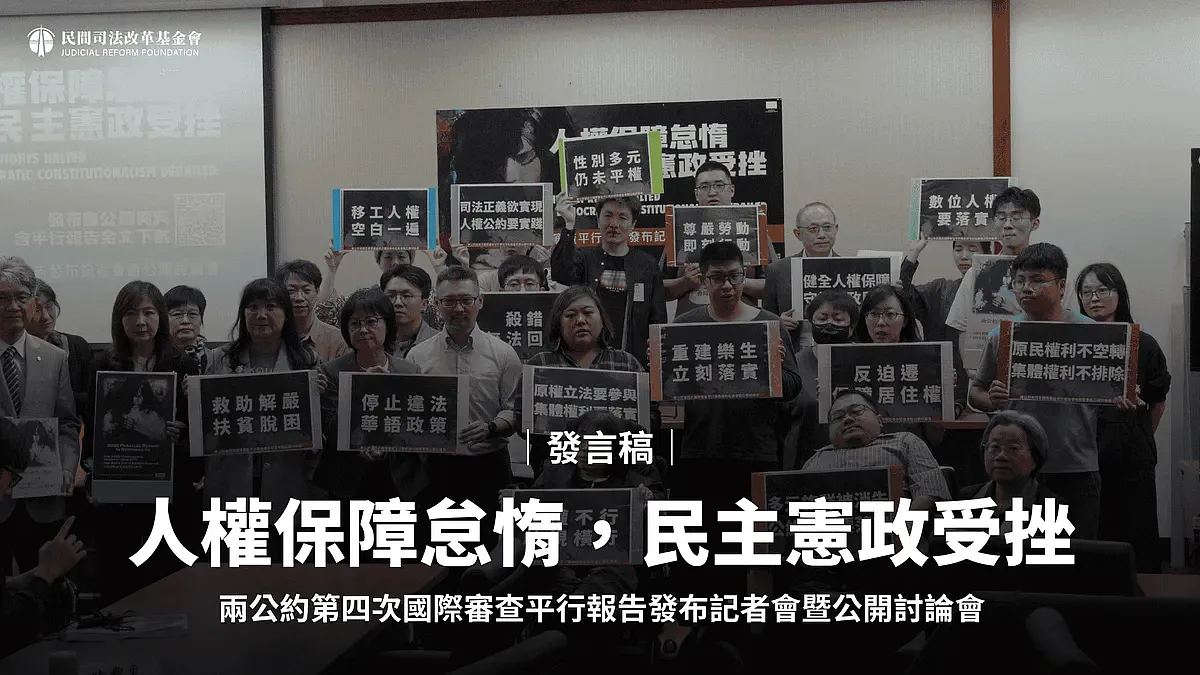
Statement | Sluggish Human Rights Protection, Frustrated Democratic Constitutionalism: Press Conference and Public Forum on the Parallel Report for the Fourth International Review of the Two Covenants
Last edited: 2026-08-24
Covenants Watch held the "Press Conference and Public Forum on the Parallel Report for the Fourth International Review of the Two Covenants" at 10:00 a.m. on Tuesday, December 23, 2025, in Room 101 of the Legislative Yuan's Red Building. At the event, Covenants Watch and 32 other civil society organizations officially released their joint parallel report for the fourth international review of Taiwan's national reports under the International Covenant on Civil and Political Rights (ICCPR) and the International Covenant on Economic, Social and Cultural Rights (ICESCR).
The report was jointly prepared by civil society organizations with long-standing experience in frontline human rights advocacy. It systematically examines structural problems in the government's protection of human rights and implementation of international human rights obligations, while offering concrete policy recommendations as an important reference for the international review scheduled for May 2026. The press conference presented the report's key findings and invited discussion with the media and other sectors on issues including human rights protection mechanisms, the rights of persons with disabilities, Indigenous rights, linguistic equality, poverty, migrant workers' rights, domestic labor rights, gender equality, the right to housing, judicial rights, and technology and digital human rights.
Good afternoon, distinguished guests and members of the media:
I am a representative of the Judicial Reform Foundation. Regarding the fourth international review of Taiwan's national reports under the Two Covenants, JRF offers the following five observations.
1. Escalating Penal Severity and Criminal Justice Policy
In recent years, the legislature has repeatedly increased statutory penalties through legislative amendments, including for fraud, drunk driving, and drug offenses, in an effort to respond to public anxiety about safety through "harsher punishment." This trend toward ever-increasing penal severity not only raises concerns under the principle of proportionality between crime and punishment and the ultima ratio principle of criminal law, but empirical research also indicates that harsher penalties alone do not necessarily deter crime.
We urge the government to stop pursuing populist punitive legislation. Criminal justice policy should return to an empirical foundation rather than simply criminalizing or more severely punishing social problems, which only increases pressure on correctional institutions and misallocates judicial resources.
2. Police Arrest Procedures and the Erosion of Personal Liberty (Article 9 of the ICCPR)
The first issue is the gap in identifying a "de facto arrest." According to Human Rights Committee General Comment No. 35, an arrest begins when a person's deprivation of liberty commences; it does not depend solely on whether domestic authorities formally label the situation an arrest. In Taiwan, however, investigators may effectively deprive individuals of their liberty—for example, by sealing off a scene and prohibiting them from leaving—without beginning to calculate the statutory custody period. This risks circumventing constitutional safeguards governing deprivation of liberty.
The second issue is excessive disclosure of investigative information and resulting harm to reputation. Law enforcement agencies have repeatedly violated the principle of non-disclosure of investigations. In the high-profile child-abuse case involving a babysitter in 2024, media photographed and broadcast footage of the social worker involved in the case while she was handcuffed, exposing the investigative process and seriously affecting her reputation.
This was not the first time that investigative information had been made public in connection with efforts to apprehend a suspect. Where a defendant is fleeing or concealing their whereabouts, authorities may issue a wanted notice, and Article 8 of the Regulations Governing the Non-Disclosure of Investigations permits limited public disclosure under specified circumstances. Yet in the 2022 Tainan police-killing case, photographs of a person believed to be the wanted suspect could not be found on the relevant police websites, while the same images were widely circulated by the media with labels such as "provided by a member of the public" and "released by police."
Fang Yang-ning, then Commissioner of the Tainan City Police Department, responded only that it was unclear how the photographs had been leaked. Whether the disclosure violated the Regulations Governing the Non-Disclosure of Investigations was never meaningfully reviewed. This illustrates how similar problems have continued to recur without being seriously examined or addressed.
3. Prisoners' Human Rights and Living and Medical Conditions (Article 10 of the ICCPR)
The problems in correctional institutions are not limited to overcrowding; they also reflect insufficient respect for human dignity.
- Overcrowding and involuntary transfers: Correctional institutions in northern Taiwan are severely overcrowded. One response has been to transfer prisoners to institutions hundreds of kilometers away, disrupting their connections with family members and creating instability within prisons.
- De facto solitary confinement: Although prolonged solitary confinement is subject to strict limits, prison authorities may use administrative arrangements such as assigning a prisoner to a single-occupancy cell in ways that effectively circumvent those restrictions. Prisoners may consequently experience extended periods without meaningful human contact, amounting in practice to potentially indefinite isolation without adequate professional physical and mental health assessment.
- Punitive use of instruments of restraint: The grounds for using handcuffs and shackles may be interpreted too broadly. Even without a specific act of violence, conduct described as "emotional instability" or "kicking a door" may be treated as disruption of order and used to justify prolonged restraint. Cases have included the use of shackles for as long as 47 hours. JRF argues that such practices may amount to torture or other cruel, inhuman, or degrading treatment and fail to satisfy the strict requirements of necessity and proportionality reflected in the United Nations Standard Minimum Rules for the Treatment of Prisoners (the Nelson Mandela Rules).
- The parole system requires reform: The Agency of Corrections may disregard recommendations of parole review committees and deny parole for abstract reasons such as "public perception." At the same time, average remuneration for prison labor is only NT$765 per month, making it extraordinarily difficult for prisoners to meet expectations concerning compensation and reconciliation and placing meaningful social reintegration even further out of reach.
4. Juvenile Corrections and the Right to Education (Articles 14 and 24 of the ICCPR)
Although Taiwan's former juvenile reform institutions have been reorganized as correctional schools, the underlying system still risks becoming "old wine in a new bottle." Correctional education continues to rely heavily on a custodial-management mindset and lacks sufficient special-education resources and professional psychological counseling personnel.
JRF has identified continuing concerns regarding improper discipline and corporal punishment in correctional schools, while transition and support mechanisms after release remain fragmented, making successful reintegration difficult for young people. We call for full implementation of the principles of the Convention on the Rights of the Child (CRC), including an education-first approach rather than one centered primarily on punishment, and for a comprehensive review of staffing structures and treatment models in correctional schools.
5. Fair Trial Rights and Equality of Arms (Articles 14 and 17 of the ICCPR)
The ability of defense counsel to perform their role remains insufficiently protected.
- The Code of Criminal Procedure does not currently grant defense counsel a general statutory right to be present during the execution of an investigative search. As a result, a defendant may be unable to receive effective legal assistance at a critical stage of the investigation.
- In TCC Judgment 112-Hsien-Pan-9 (2023), "Case on Search and Seizure of Law Firm's Offices," the Constitutional Court held existing provisions of the Code of Criminal Procedure unconstitutional insofar as they failed to exclude constitutionally protected attorney-client communications from search and seizure. Nevertheless, legislation still lacks a dedicated procedural framework specifically governing searches of law firms. Without effective protection of confidential attorney-client communications, the substantive right to defense is seriously undermined.
Regarding judicial accountability and evaluation:
Mechanisms for holding judges and prosecutors accountable remain inadequate. From the Shih Mu-chin case to more recent cases involving workplace bullying within the judiciary, evaluation committees have frequently concluded that requests are unfounded or have referred matters only for internal official supervision. JRF believes this demonstrates that internal accountability mechanisms continue to lack sufficient capacity for institutional self-examination.
In conclusion, the fourth international review should not become a purely ceremonial exercise. JRF calls on the government to establish concrete timelines for addressing these long-standing problems in Taiwan's criminal justice system and to fulfill its commitment to building a state grounded in human rights.
Thank you.
This article is an AI-generated translation of the original Chinese text. In the event of any discrepancy, the Chinese version shall prevail.