
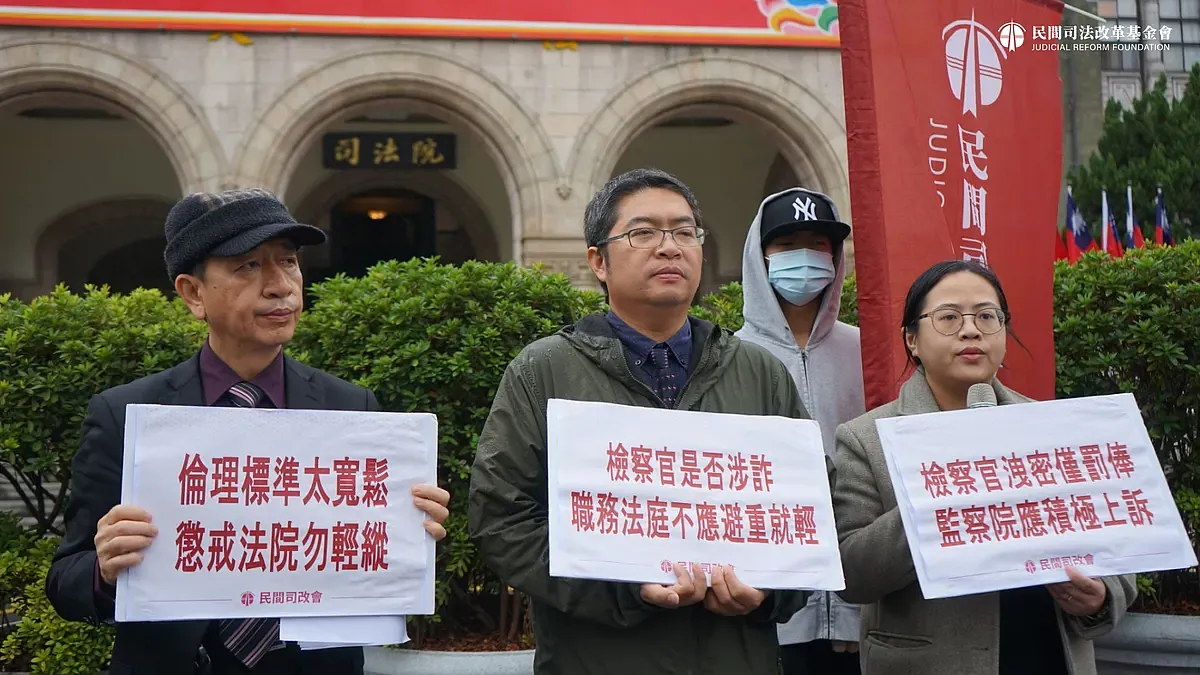
Press Conference | The Disciplinary Court Must Not Establish Lax Ethical Standards for Prosecutors: JRF Press Release on Disciplinary Cases Nos. 1 and 4, 2025, Concerning Prosecutor Wu Ya-chih's Leak of Confidential Information
Last edited: 2026-08-24
On December 26, 2025 (last Friday), the Disciplinary Court issued a press release announcing that its Court of the Judiciary had rendered its judgments at 2:30 p.m. that day in the disciplinary cases against Prosecutor Wu Ya-zhi (hereinafter referred to as Prosecutor Wu), Disciplinary Cases Nos. 1 and 4 of 2025, and explaining the gist of the judgments.
Among them, the judgments appear to explicitly determine that Prosecutor Wu committed two major acts of misconduct, including leaking information subject to the non-publicity of investigations and disclosing personal data, and that disciplinary action was necessary.
However, the Court imposed only a fine equivalent to ten months of her current total monthly remuneration. This has raised concerns from various sectors that, at a time when prosecutors are cracking down heavily on leaks by the defense, the judiciary is instead adopting lax standards and penalties for prosecutorial leaks. In response, the Judicial Reform Foundation (JRF) issues the following statement:
1. The Disciplinary Court's rationale for imposing only a fine for clear violations of the non-publicity of investigations and the disclosure of personal data is flimsy. We call upon the referring authorities to actively appeal and refrain from exercising undue leniency.
According to the disciplinary judgments, Prosecutor Wu, a candidate prosecutor at the Taiwan Taoyuan District Prosecutors Office, transmitted internal documents obtained through the document inquiry system—including non-prosecution dispositions, indictments, victim tables from cases she handled, and criminal preparatory pleadings—to her boyfriend, Mr. Chu, multiple times for purposes unrelated to official duties, including "at the entreaty of her boyfriend, Mr. Chu." Furthermore, she failed to redact personal information such as the names and addresses of the parties involved. This violated Point 4 of the Directions for the Use of Identification Codes and Passwords by Prosecutors Offices at All Levels under the Ministry of Justice to Search Ministry Intranet Data, Article 245, Paragraph 5 of the Code of Criminal Procedure regarding the non-publicity of investigations, and the official duties prescribed by Article 16 of the Personal Data Protection Act, severely damaging the reputation of prosecutors. The Disciplinary Court also determined that, "taking into consideration the frequency and degree of her lack of prudence, her conduct, according to general social consensus, seriously damaged the reputation of prosecutors and constituted a serious violation of ethical requirements—including that prosecutors exercise prudence in speech and conduct, refrain from disclosing non-public information concerning their duties, avoid unbecoming conduct, and refrain from activities inconsistent with the impartial image of a prosecutor." The Court therefore concluded that the circumstances were grave and that disciplinary action against Prosecutor Wu was necessary.
In the impeachment case, the Control Yuan did indeed request that the Disciplinary Court consider relieving Prosecutor Wu of her duties pursuant to the Judges Act and barring her from reappointment as a civil servant. However, the disciplinary judgments took an abrupt turn, mitigating the severity on the grounds that Prosecutor Wu "had served as a candidate prosecutor for only over two years," "had received favorable evaluations in her performance reviews," "acted merely out of a lack of circumspection," and, moreover, that "the leaked materials did not constitute the full text," thereby treating the circumstances as relatively minor and imposing only a fine equivalent to ten months of her current total monthly remuneration. Not only are these reasons contradictory to the determination that the circumstances were grave, but the reasoning also mentions that "what was leaked was merely indictment information that 'would become public in the future' (though it was not yet public)," thereby playing down the seriousness of violating the non-publicity of investigations under the Code of Criminal Procedure. One must ask: Can documents destined to become public in the future be arbitrarily leaked while an investigation is still subject to non-publicity requirements? Should the seriousness of a leak be determined not by the personal data involved—such as amounts implicated in a case or details of testimony contained in an indictment—but by whether the information will eventually become public? Can the principle of non-public investigations under Article 245, Paragraph 5 of the Code of Criminal Procedure and the interpretation of disclosure of confidential information by a public official under Article 132, Paragraph 1 of the Criminal Code of the Republic of China really be construed in this manner?
In contrast, Shih Yu-en, a judge at the Taiwan Ciaotou District Court involved in the same case, was suspended from duty by the Judicial Yuan effective May 18, 2024, and the Control Yuan also requested his removal from judicial office and a bar on his reappointment as a civil servant. The Court of the Judiciary at the Disciplinary Court has not yet rendered judgment in his case. Given that both cases involve alleged links to a fraud syndicate, the standards established by the Court of the Judiciary in Prosecutor Wu's case risk undermining public trust in the judiciary.
In response, the JRF calls upon the referring authorities to actively appeal, and we will continue to monitor the court's subsequent determinations.
2. The Disciplinary Court's judgments are ambiguous as to whether Prosecutor Wu knowingly made encouraging remarks in a chat group concerning a lawyer's involvement with a fraud syndicate, and therefore fail to inspire public confidence.
As for the facts referred by the Control Yuan concerning "the person subject to disciplinary action, despite being a prosecutor, monitoring Mr. Cheng's case-assignment messages for Mr. Chu in real time in the chat group at issue, actively encouraging Mr. Chu to break into the circle of the fraud syndicate, and suggesting a model of cooperation between Mr. Chu and Mr. Cheng," according to the summary in the Disciplinary Court's press release, the Court did indeed determine that: "Although the person subject to disciplinary action once told Mr. Chu that there was an opportunity to break into the fraud circle, the preceding and subsequent dialogue indicates that the person subject to disciplinary action was primarily expressing concern and support for Mr. Chu's business decisions." Nevertheless, the Court held that prosecutors still have ordinary social interactions and real-life needs, and that the chat group contained content other than "inquiring whether other lawyers were willing to take cases." It therefore found that the evidence did not fully establish the extent of Prosecutor Wu's knowledge.
However, following the logic of these judgments also means that statements such as "breaking into the fraud circle" were indeed made, and that inquiries concerning lawyers' willingness to take cases in the chat group also indeed occurred. Regardless of Prosecutor Wu's motives or the extent of her knowledge underlying her purported "concern and support," Prosecutor Wu, as a public official whose duty is to combat crime, should have remained vigilant about and distanced herself from the atmosphere and subjects discussed in the chat group, even if she did not immediately attempt to dissuade or admonish remarks concerning "breaking into the fraud circle." The Disciplinary Court's leniency and tolerance in characterizing Prosecutor Wu as "primarily expressing concern and support for Mr. Chu's business decisions" are difficult to understand.
In particular, a closer examination of the impeachment document referred by the Control Yuan reveals that the determination of these facts may bear directly on whether the disclosure of information was merely an expression of work-related frustration or was instead connected with the affairs of the fraud syndicate. The Court of the Judiciary held that "whether she should be held criminally or administratively liable is a separate matter from the disciplinary action in this case and falls outside the scope of this Court's review."
However, some of the facts described in the impeachment document may even implicate criminal liability as an accomplice. Would this not potentially fall within the grounds for disciplinary action under Article 42 of the Judges Act, namely where a person has received a final sentence of fixed-term imprisonment or a more severe punishment and has thereby damaged the dignity of prosecutors? The Court of the Judiciary's findings are vague and evasive and truly fail to inspire public confidence.
3. Strict with oneself, strict with others: The Court of the Judiciary must not establish lax ethical standards for prosecutors.
The legislative purpose underlying the Judges Act includes maintaining prosecutors' independent exercise of their powers in accordance with the law, safeguarding the status of prosecutors, and establishing a prosecutor evaluation mechanism to protect the people's right to a fair trial. The functions of prosecutor evaluation and discipline are inherently to remove unfit prosecutors or to issue warnings and impose accountability when prosecutors engage in improper conduct, thereby supervising the prosecutorial system—which bears responsibility for impartial criminal investigations—to maintain proper professional standards and enhance public confidence.
Fraud is among the most serious public safety problems in contemporary society, causing more than NT$100 billion in property losses each year and shattering countless families. The public expects prosecutors to stand on the front lines in combating fraud, yet Prosecutor Wu failed to observe the necessary professional boundaries and committed serious misconduct. While the Court of the Judiciary concluded in these cases that Prosecutor Wu had severely damaged the reputation of prosecutors and that the circumstances were grave, it nevertheless held that her conduct had not reached the level of rendering her an unfit prosecutor and imposed only a fine equivalent to ten months of her current total monthly remuneration. Although the Court of the Judiciary at the Disciplinary Court issued a press release summarizing its judgments last Friday (Dec. 26), the full text of the judgments remained undisclosed to the public as of the issuance of this press conference statement. If the reasoning in the full judgments remains consistent with that reflected in the current press release, it will likely be difficult to restore public trust in the judiciary. The JRF deeply regrets this and will continue to monitor subsequent developments in these cases.
Press Conference Time
10:00 a.m., December 31, 2025
Press Conference Location
Outside the Main Entrance of the Judicial Yuan Building (No. 124, Sec. 1, Chongqing S. Rd., Zhongzheng Dist., Taipei City)
Attendees (In Order of Speaking)
Shi Hongcheng, Attorney-at-Law | Supervisor and Convener of the Evaluation Group, Judicial Reform Foundation
Lin Yung-sung, Attorney-at-Law | Standing Director, Judicial Reform Foundation
Lee Ming-ju, Attorney-at-Law | Deputy Executive Officer, Judicial Reform Foundation
Press Contacts
Zhang Huazhe, Director of the Case Action Department, Judicial Reform Foundation 02-2523-1178#22 ven@jrf.org.tw
Ye Bojun, Legal Officer of the Case Action Department, Judicial Reform Foundation 02-2523-1178#31 bj@jrf.org.tw
Attachment
This article is an AI-generated translation of the original Chinese text. In the event of any discrepancy, the Chinese version shall prevail.