
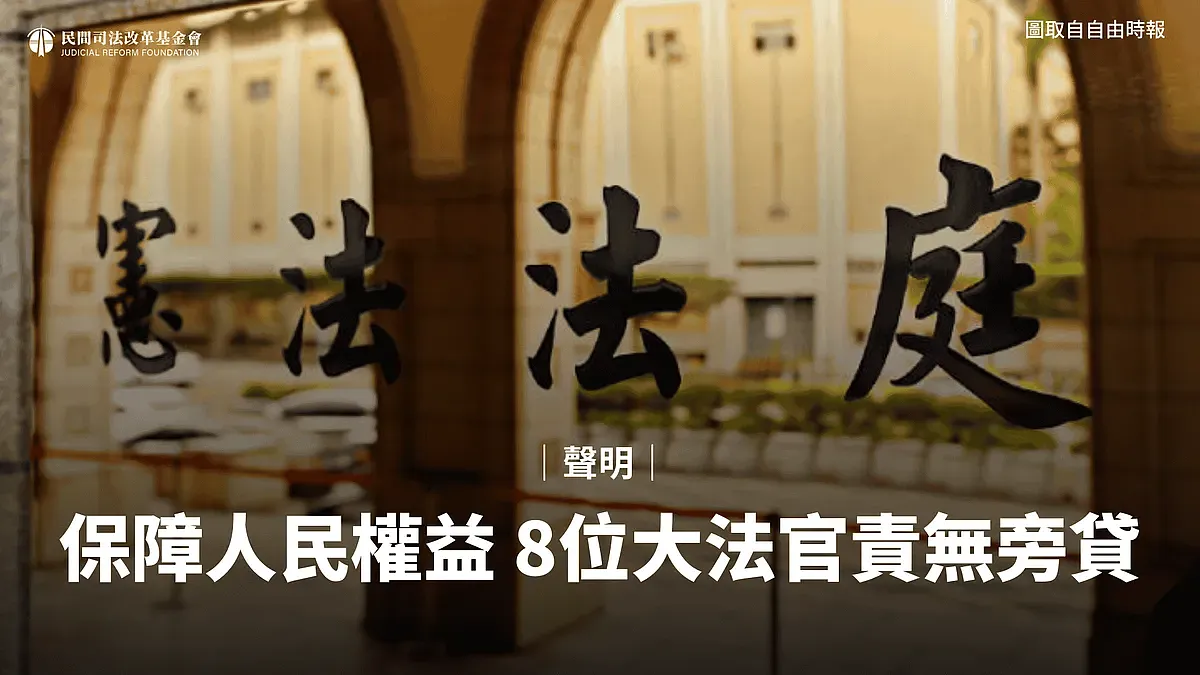
Statement|Safeguarding People's Rights and Interests: The 8 Grand Justices Have an Inescapable Duty
Last edited: 2026-08-24
The Constitutional Court rendered Judgment No. 1 of 2026 today (Case Concerning Defense Counsel's Quasi-Appeal Against a Detention Disposition). The Judicial Reform Foundation (JRF) issues the following statement:
- The Constitutional Court has a constitutional obligation to render judgments. Its continued operation and protection of the people's rights and interests are commendable.
- The JRF deeply regrets the absence of Grand Justices Tsai Tsung-jen, Yang Hui-chin, and Chu Fu-mei from the deliberation of this judgment, and calls upon the three Grand Justices to participate in the Constitutional Court's deliberations in future cases.
- The JRF urges President William Lai to nominate new Grand Justices as soon as possible to fill the vacancies on the Constitutional Court.
1. The Constitutional Court has a constitutional obligation to render judgments. Its continued operation and protection of the people's rights and interests are commendable
After a 328-day shutdown, the Constitutional Court rendered Judgment No. 1 of 2025 on December 19, 2025, declaring the amendments to the Constitutional Court Procedure Act promulgated on January 23, 2025 (hereinafter the "Newly Amended Constitutional Court Procedure Act") invalid and thereby enabling the Constitutional Court to resume operations. The JRF believes that rendering judgments is part of the Constitutional Court's constitutional duties under the Constitution of the Republic of China (Taiwan). Accordingly, the Court's prompt rendering of another judgment after the Newly Amended Constitutional Court Procedure Act ceased to have effect, addressing a major constitutional controversy concerning the people's rights and interests, is commendable.
It must be emphasized that numerous cases concerning the protection of the people's rights and interests have already been accepted by the Constitutional Court and remain pending. By comparison, during the first two years after the new Constitutional Court system was established, in 2022 and 2023, the Court rendered 20 judgments each year. However, after the terms of seven Grand Justices expired in 2024, when the Court rendered 11 judgments, no substantive judgment was rendered in any accepted case until Judgment No. 1 of 2025. During this 417-day period, constitutional remedies and protections for the people were effectively left in an unprecedented void of more than 400 days since the establishment of the Constitutional Court.
The JRF calls upon and encourages the Constitutional Court to continue rendering judgments protecting the people's rights and interests as soon as possible, so that the many cases that have long awaited relief during this period of constitutional inaction can finally be addressed.
2. The JRF deeply regrets the absence of Grand Justices Tsai Tsung-jen, Yang Hui-chin, and Chu Fu-mei from the deliberation of this judgment, and calls upon the three Grand Justices to participate in the Constitutional Court's deliberations in future cases
This judgment was rendered by five Grand Justices, while Grand Justices Tsai Tsung-jen, Yang Hui-chin, and Chu Fu-mei declined to participate in its deliberation. Regarding the three Grand Justices' refusal to participate in the deliberation of Judgment No. 1 of 2025, the JRF stated immediately after that judgment that, since Judgment No. 1 of 2025 constituted a valid and duly rendered constitutional judgment binding on the people nationwide and on all government authorities, the Grand Justices should be expected to participate continuously in the deliberation of subsequent cases before the Constitutional Court and faithfully perform the duties entrusted to them by the Constitution of the Republic of China (Taiwan).
However, the three Grand Justices again declined to attend the deliberation of this judgment and fulfill their constitutional duties. The JRF deeply regrets their absence. Nevertheless, the JRF continues to call upon the three Grand Justices to participate in the deliberation of cases before the Constitutional Court in the future.
3. The JRF urges President William Lai to nominate new Grand Justices as soon as possible to fill the vacancies on the Constitutional Court!
In addition, the JRF emphasizes that although Judgment No. 1 of 2025 invalidated the Newly Amended Constitutional Court Procedure Act, thereby allowing the Constitutional Court to continue operating, President William Lai should still nominate new Grand Justices as soon as possible to fill the vacancies on the Court.
In practice, rendering judgments requires not only deliberation among the Grand Justices, but also a sufficient number of Grand Justices to share the work of authoring opinions so that the Court can efficiently handle its substantial caseload of accepted cases. With vacancies still remaining on the Constitutional Court, it is difficult to expect the current backlog to be handled efficiently. In an opinion accompanying Judgment No. 1 of 2025, a Grand Justice warned that the backlog accumulated over more than a year could "overflow and burst like a barrier lake." The opinion further noted that, since the new system under the Constitutional Court Procedure Act took effect, the number of newly filed cases has surged, while only eight Grand Justices currently bear the workload. As many as 96 cases awaiting deliberation and decision have accumulated, including many requiring prompt disposition. It was roughly estimated that clearing the backlog could take more than six years, demonstrating the substantial pressure created by the accumulation of cases.
The foregoing demonstrates that, if the Court must rely solely on the current Grand Justices, it will be difficult to expect the backlog to be handled efficiently. Many important cases involving the people's rights and interests are likewise unlikely to obtain relief in the short term.
Therefore, in order to promptly ensure the protection of the people's procedural and constitutional rights, the JRF calls upon President William Lai to engage in substantive consultations with the Legislative Yuan as soon as possible, incorporate more diverse representatives into the review and recommendation process, and complete the next round of nominations for Grand Justices without delay.
Press Contact
Elvin Lu, Attorney-at-Law, Director of the Legal Policy Department, Judicial Reform Foundation
Liao Weicheng, Associate Researcher, Legal Policy Department, Judicial Reform Foundation
Telephone: 02-2523-1178#37
Email: elvin@jrf.org.tw
This article is an AI-generated translation of the original Chinese text. In the event of any discrepancy, the Chinese version shall prevail.