
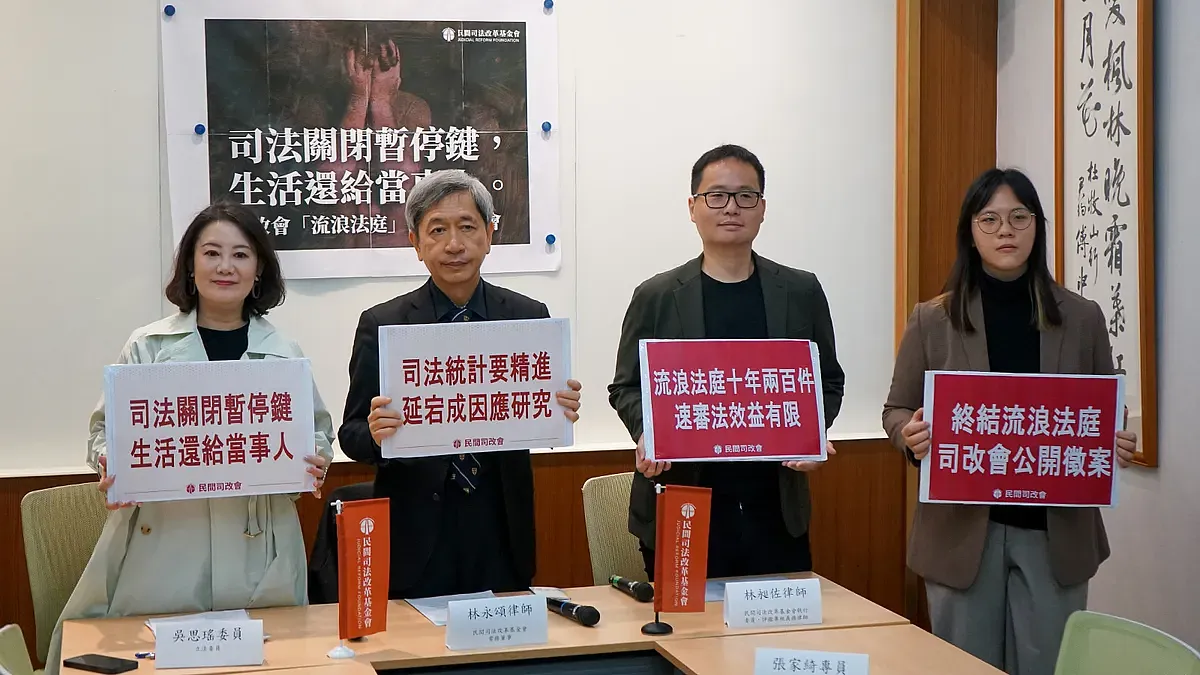
Press Release | Turning Off the Judicial Pause Button, Returning Lives to Litigants: JRF's "Wandering Court" Case Solicitation Press Conference
Last edited: 2026-08-24
Having previously assisted Mr. Guo-long Zhang and Mr. Fang-ze Ke, two of the petitioners in J.Y. Interpretation No. 725 whose criminal proceedings lasted for 30 years before they were finally acquitted, the Judicial Reform Foundation (JRF) is deeply aware of the immense suffering that "wandering court" cases inflict on litigants and their families. Recently, the JRF received another complaint from a litigant whose criminal case, first prosecuted in 2006, has remained unresolved for 20 years. Throughout these protracted proceedings, judges have changed frequently and defendants have passed away one after another due to old age, while the attorneys handling the case have often been able to do little more than ask their clients to remain patient.
Upon further investigation, the JRF discovered that this is far from an isolated case. We therefore make the following demands, calling on the judicial system to squarely confront the problem of "wandering court" cases and seek systemic solutions:
1. More than 200 civil and criminal cases have remained unresolved for over 10 years since first-instance proceedings began, demonstrating the limited effectiveness of the Criminal Speedy Trial Act in bringing an end to "wandering court" cases.
2. The Judicial Yuan must improve its long-standing practices regarding the collection of statistics, research, and review of unresolved cases, and genuinely confront the difficulties that complex cases pose for frontline judges, the resulting long-term burden on the judiciary, and the prolonged toll of litigation on the parties involved.
3. The JRF is formally launching a public call for cases, effective immediately. We welcome the Taiwan Bar Association, local bar associations, and members of the public to submit relevant cases. We also call on all sectors of society to jointly examine the causes of "wandering court" cases and develop systemic solutions.
1. More than 200 civil and criminal cases have remained unresolved for over 10 years since first-instance proceedings began, demonstrating the limited effectiveness of the Criminal Speedy Trial Act in bringing an end to "wandering court" cases
To ensure fairness, legality, and promptness in criminal trials while safeguarding human rights and the public interest, the Criminal Speedy Trial Act was promulgated on May 19, 2010. The Act provides certain legal consequences for cases in which more than eight years have elapsed since the commencement of first-instance proceedings without a final judgment, in recognition of the potential infringement of a defendant's right to a speedy trial.
Although civil and administrative proceedings do not have statutory provisions equivalent to those of the Criminal Speedy Trial Act, courts nevertheless have a legal obligation to investigate evidence promptly and thoroughly, ensure fair and appropriate procedures, and carefully determine the facts in order to safeguard the people's constitutional right of access to the courts.
However, according to statistical data obtained with the assistance of Legislator Wu Szu-yao's office, as of the end of May 2025, 145 civil cases and 41 criminal cases before Taiwan's high courts had remained without a final judgment for more than 10 years since the commencement of first-instance proceedings. Another 28 civil cases were pending in the district courts, bringing the total to more than 200 cases.
Civil and Criminal Cases Before High Courts That Had Remained Without a Final Judgment for More Than 10 Years Since the Commencement of First-Instance Proceedings
| Institution | Civil Cases, End of May 2025 | Criminal Cases, End of May 2025 |
|---|---|---|
| Taiwan High Court | 95 | 37 |
| Taiwan High Court Taichung Branch Court | 28 | 2 |
| Taiwan High Court Tainan Branch Court | 8 | 2 |
| Taiwan High Court Kaohsiung Branch Court | 14 | 0 |
| Taiwan High Court Hualien Branch Court | 0 | 0 |
| Taiwan High Court Kinmen Branch Court | 0 | 0 |
| Total | 145 | 41 |
Civil and Criminal Cases Before District Courts That Had Remained Without a Final Judgment for More Than 10 Years Since the Commencement of First-Instance Proceedings
| Institution | Civil Cases, End of May 2025 | Criminal Cases, End of May 2025 |
|---|---|---|
| Intellectual Property and Commercial Court | 1 | 0 |
| Taiwan Taipei District Court | 2 | 0 |
| Taiwan Shilin District Court | 2 | 0 |
| Taiwan New Taipei District Court | 3 | 0 |
| Taiwan Taoyuan District Court | 1 | 0 |
| Taiwan Hsinchu District Court | 0 | 0 |
| Taiwan Miaoli District Court | 0 | 0 |
| Taiwan Taichung District Court | 15 | 0 |
| Taiwan Nantou District Court | 0 | 0 |
| Taiwan Changhua District Court | 1 | 0 |
| Taiwan Yunlin District Court | 0 | 0 |
| Taiwan Chiayi District Court | 0 | 0 |
| Taiwan Tainan District Court | 1 | 0 |
| Taiwan Kaohsiung District Court | 1 | 0 |
| Taiwan Ciaotou District Court | 0 | 0 |
| Taiwan Kaohsiung Juvenile and Family Court | 0 | 0 |
| Taiwan Pingtung District Court | 0 | 0 |
| Taiwan Taitung District Court | 0 | 0 |
| Taiwan Hualien District Court | 0 | 0 |
| Taiwan Yilan District Court | 0 | 0 |
| Taiwan Keelung District Court | 0 | 0 |
| Taiwan Penghu District Court | 0 | 0 |
| Taiwan Kinmen District Court | 1 | 0 |
| Taiwan Lienchiang District Court | 0 | 0 |
| Total | 28 | 0 |
Moreover, although Articles 5, 7, and 8 of the Criminal Speedy Trial Act contain provisions addressing criminal proceedings that have continued for many years, their effects are limited to restricting the duration of detention, allowing mitigation of a defendant's sentence, and limiting the number of appeals. They provide little assistance in protecting the right to a speedy trial of parties whose cases remain pending at the first instance or who have consistently maintained their innocence while being forced to "wander" through the courts. Civil and administrative proceedings, moreover, have no comparable statutory protections.
2. The Judicial Yuan must improve its long-standing practices regarding the collection of statistics, research, and review of unresolved cases, and genuinely confront the difficulties that complex cases pose for frontline judges, the resulting long-term burden on the judiciary, and the prolonged toll of litigation on the parties involved
After receiving complaints from litigants, the JRF wrote to the Judicial Yuan pursuant to the Freedom of Government Information Law to request relevant statistical information, hoping to examine the causes of "wandering court" cases and develop possible solutions. Regrettably, in May 2025, the Judicial Yuan responded in writing that "the existing official statistical reports do not contain the relevant statistical data, and we therefore regret that we are unable to provide it."
Only after the JRF sought assistance from Legislator Wu Szu-yao's office and obtained the relevant data did we discover, to our surprise, that more than 200 civil and criminal cases before Taiwan's district courts and high courts had remained unresolved for more than 10 years since the commencement of first-instance proceedings.
Courts should certainly be commended for conducting meticulous proceedings in pursuit of the truth and clarity in legal relationships. Yet the reality can be extraordinarily difficult. In the case recently brought to the JRF's attention, for example, prosecutors indicted more than 40 defendants, making it extremely difficult for the court merely to clarify the underlying factual relationships. As the proceedings dragged on and defendants passed away one after another, the court subsequently issued judgments dismissing the prosecutions against those defendants.
The RCA pollution case provides another example. Radio Corporation of America illegally disposed of organic solvents, resulting in large numbers of workers developing cancer. Faced with 445 victims, the court of first instance took eight years and went through four presiding judges before it was able to render a judgment. When courts face cases of such extraordinary complexity, could the judicial administration adopt supporting measures—such as reducing the number of other cases assigned to the judges handling them—so that judges can devote more time and attention to clarifying the complex legal and factual relationships involved and render lawful judgments at an earlier stage?
Identifying the reasons why these cases have remained pending for more than 10 years is the first step toward developing solutions. Yet the Judicial Yuan's response suggests that the judicial administration has not genuinely confronted the burden on the judiciary and the prolonged toll on litigants caused by cases remaining unresolved for years. It appears to lack even basic systems for collecting statistics and conducting research on the issue.
By comparison, ordinary legal controversies are routinely addressed through annual conferences at which judges, prosecutors, and defense attorneys jointly discuss difficult legal questions. Yet the difficulties faced by the litigants behind these more than 200 cases have largely been left for individual judges handling the cases to bear on their own.
At a time when the burden on the judicial system is already approaching a breaking point, delays in more than 200 cases affect not only the judges handling them, but also prosecutors, defense counsel, litigants, and their families. Does the judiciary have the capacity to switch off the "pause button" and give litigants their lives back?
The JRF is deeply concerned. We solemnly call on the Judicial Yuan to immediately improve its collection of statistics and commitment to research, and to ensure that systemic delay does not become the endpoint of justice.
3. The JRF is formally launching a public call for cases, effective immediately. We welcome the Taiwan Bar Association, local bar associations, and members of the public to submit relevant cases. We also call on all sectors of society to jointly examine the causes of "wandering court" cases and develop systemic solutions
The JRF has long been committed to building a fair, impartial, and trustworthy judicial system. To investigate more deeply the causes of the "wandering court" problem and develop solutions capable of bringing long-pending cases to an end, we are convening this press conference to publicly solicit relevant cases from the Taiwan Bar Association, local bar associations, and the general public.
Whether a case is civil, criminal, or administrative, the JRF sincerely welcomes litigants, defense attorneys, litigation representatives, and members of all sectors of society to submit complaints concerning cases that have remained without a final judgment for more than 10 years since the commencement of first-instance proceedings.
Your individual case can become an important driving force for judicial reform. An in-depth examination of why cases are left to "wander" through the courts serves not only to resolve individual disputes and prevent litigants' lives from remaining indefinitely suspended. At a time when judges and prosecutors are already facing immense workloads, it can also help identify different categories of cases that become stalled and determine what forms of systemic support the judicial administration should provide.
The JRF calls on all sectors of society to jointly examine the causes of "wandering court" cases, work together to address the chronic problems of the judicial system, and develop institutional solutions that allow justice to arrive on time.
Press Conference Time
10:00 AM, January 15, 2026
Press Conference Location
Room 102, Legislative Yuan Research Building (Chung-Hsing Building), No. 3-1, Sec. 1, Jinan Rd., Zhongzheng Dist., Taipei City
Attendees
- Wu Szu-yao | Legislator
- Lin Yung-sung | Standing Director, Judicial Reform Foundation
- Freddy Lim | Executive Committee Member and Pro Bono Attorney, Judge and Prosecutor Evaluation Division, Judicial Reform Foundation
- Zhang Jiaqi | Legal Specialist, Judicial Reform Foundation
Press Contacts
Zhang Huazhe, Director of the Case Action Department, Judicial Reform Foundation
02-2523-1178
ven@jrf.org.tw
Zhang Jiaqi, Legal Specialist, Case Action Department, Judicial Reform Foundation
04-2329-2372#14
jc@jrf.org.tw
This article is an AI-generated translation of the original Chinese text. In the event of any discrepancy, the Chinese version shall prevail.