
JRF Newsletter: October 2025
Who Is Trapped in the Shadow of Extreme Sentences for Drug Offenses? From the "Constitutional Court Massacre" to "Arbitrary Legislative Amendments by Agencies"
Last edited: 2026-08-24
"Such a bizarre outcome can be described as a rare massacre of petitions in the history of constitutional interpretation in our country." — This was the comment left by Grand Justice Huang Chao-yuan in his dissenting opinion on Constitutional Judgment No. 13 of 2023. However, the cautionary implication of these words clearly failed to shake the Ministry of Justice's imbalanced drug policy.
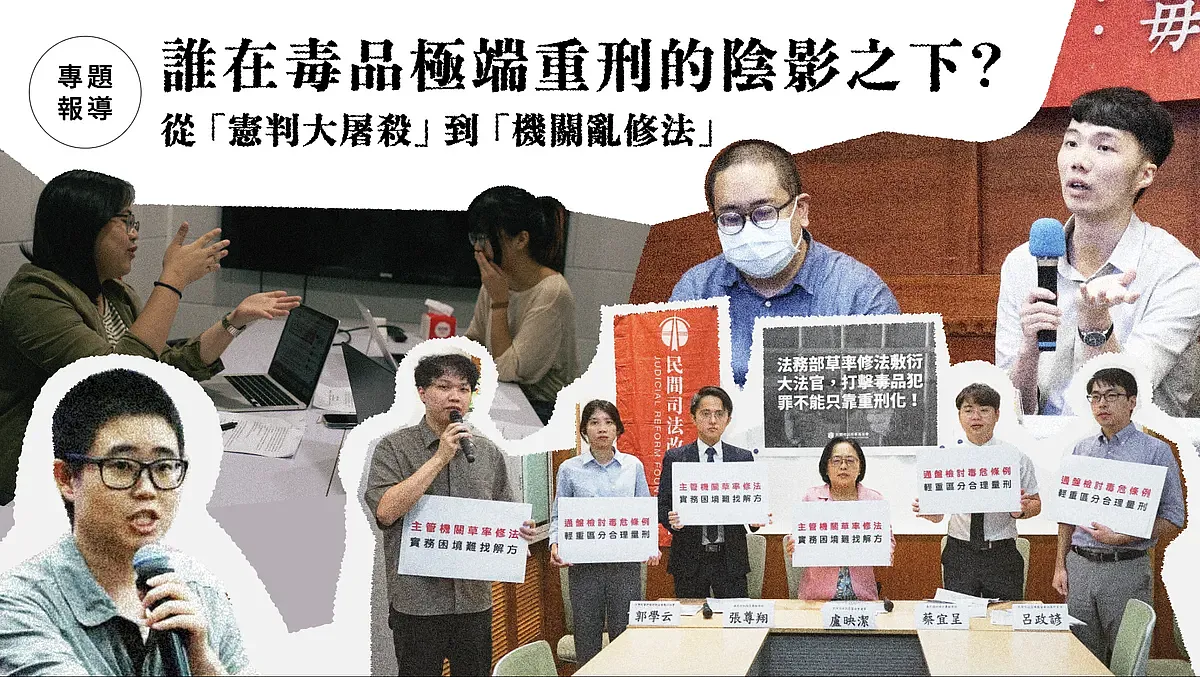
Last July, in response to Constitutional Judgment No. 13 of 2023, the Ministry of Justice proposed a newly amended draft of the Narcotics Hazard Prevention Act. This October, JRF proposed a civil society draft version in hopes of alleviating the problem of "minor offenses carrying heavy penalties" caused by the extreme punitive drug prevention policy. Shortly after the press conference for the civil society draft version, the Ministry of Justice immediately issued a statement to counter it.
What seems like a heated recent debate is actually an age-old judicial reform issue. Looking back at past discussions and advocacy for legal amendments, we realize in the blink of an eye that ten years have already passed.
Whenever JRF's discussions on related issues appear on social media, there are always people who might not have finished reading the draft or the statement and question: "So does JRF support drug decriminalization?" or "Shouldn't drugs carry the sole penalty of death?" Not only do these comments completely miss our stance, but we also firmly believe that such discussions are of no help in improving the dilemmas faced by judicial practice on the ground regarding drug cases.
We very much hope that through this issue of the newsletter, everyone can see the lives actually impacted behind the law through the stories of the few litigants whose cases were accepted under Constitutional Judgment No. 13 of 2023. We also look back at JRF's continuous efforts over the past ten years through various cases, doing our utmost with limited manpower to respond to the influx of letters from correctional institutions. Following the delivery of the Constitutional Judgment, we restarted the Drug Hazard Committee and completed two versions of the civil society draft, presenting the direction for a fair and reasonable drug legal system that volunteer lawyers and scholars strive to advocate together.
▼I am not a drug dealer, yet I was sentenced to 15 years in prison | After the Judgment

◎Text | Mido, Editing | Lo Li-han, Photography | Li Chao-yen
"Such a bizarre outcome can be described as a rare massacre of petitions in the history of constitutional interpretation in our country." — This was the comment left by Grand Justice Huang Chao-yuan in his dissenting opinion on Constitutional Judgment No. 13 of 2023. This criticism is not an exaggeration: over 2,500 litigants filed for constitutional interpretation, arguing that the statutory penalty of only the death penalty or life imprisonment under Article 4, Paragraph 1 of the Narcotics Hazard Prevention Act (the offense of manufacturing, selling, or transporting Category 1 narcotics) violates the principle of proportionality. Faced with such a massive number of petitioners, the Constitutional Court accepted only 8 of them, while over 99% of the remaining petition cases were dismissed, practically closing off the space for people to seek relief through constitutional litigation.
Having been "chosen" by the Constitutional Court to become one of the few 8 accepted petitioners, the story of Lin Shu-hui (a pseudonym) appears exceptionally ironic. At only 19 years old, she was sentenced to 15 years and 3 months of imprisonment because the court determined she had "jointly sold narcotics" with her boyfriend on 3 occasions.
On those 3 occasions, she merely answered the phone according to her boyfriend's instructions and handed packages to people who came to pick up the goods. The remuneration received for these 3 occasions was merely NT$1,000 for the first time, and NT$2,000 each for the subsequent two times. She stated that she was only helping to pass things along, did not know the contents, and was not the mastermind of the transaction. In this case, Lin Shu-hui's role was clearly minor and her profit limited. Yet, in the end, she was sentenced more heavily than the primary drug dealer—her ex-boyfriend, whose sentence was 11 years.
"I just never expected that the one who would end up with the heaviest sentence was me."
Looking back at the day of the incident, her ex-boyfriend was taking a shower when the phone rang, and she casually answered it. The person on the other end of the line said, "I've arrived, bring the stuff down." Lin Shu-hui complied without asking a single extra question. Until one day in 2008, when she and her boyfriend returned to Pingtung from Taipei, police officers from the Kaohsiung City Police Department came to arrest them. Although she was released without bail that day, her life felt as though the pause button had been pressed ever since.
Six years after the incident, in 2014, she finally received the written indictment. By that time, her life was already completely different—she had long since broken up with her ex-boyfriend, remarried, and given birth to a child who was just over a year old. When the indictment from the Pingtung District Prosecutors Office was delivered to her hands, she was completely stunned. "I was truly shocked. I thought to myself, the child has already been born, why is this charge still here? Why not indict earlier, why wait so many years?"
Recalling that past, she had repeatedly asked her then-boyfriend: "How come you have so much money?" Her boyfriend would always casually say: "Don't ask too much, this is to protect you. If something happens one day, you won't know anything." She smiled bitterly and said: "Indeed, I didn't know anything. I just never expected that the one who would end up with the heaviest sentence was me."

◎Text | Tsai Shang-heng, Editing | Li Ming-ju, Photography | Li Chao-yen
Last July, in response to Constitutional Judgment No. 13 of 2023, the Ministry of Justice proposed a newly amended draft of the Narcotics Hazard Prevention Act. This October, JRF proposed a civil society draft version in hopes of alleviating the problem of "minor offenses carrying heavy penalties" caused by the extreme punitive drug prevention policy. Shortly after the press conference for the civil society draft version, the Ministry of Justice immediately issued a statement to counter it.
What seems like a heated recent debate is actually an age-old judicial reform issue. Looking back at past discussions and advocacy for legal amendments, we realize in the blink of an eye that ten years have already passed. This article will examine the bumpy road of drug legislation reform together with everyone by sorting through JRF's 10-year advocacy process for amending the Narcotics Hazard Prevention Act.

◎Text | Liao Wei-cheng
Legacy of Harm
In early 2024, the "Task Force on the Amendment of the Narcotics Hazard Prevention Act" (Drug Hazard Committee) of the Judicial Reform Foundation was established, holding its first dedicated committee meeting in March.
The catalyst for the establishment of the Drug Hazard Committee was that in August 2023, the Constitutional Court issued a constitutional judgment—Constitutional Judgment No. 13 of 2023 [Case Concerning the Sale of Category 1 Narcotics]. The intent of this constitutional judgment was that the current statutory penalty for the crime of selling Category 1 narcotics as "death or life imprisonment" is overly harsh and therefore requires legal amendment.
Concerned that the competent authority for legislative amendments, the Ministry of Justice, would often perfunctorily handle legal amendments, JRF has historically also proposed its own civil society draft version as a counter-proposal on important issues, ensuring clearer demands for subsequent advocacy on the issue. Following this constitutional judgment, for the amendment of the Narcotics Hazard Prevention Act, we gathered a group of scholars, lawyers, and colleagues from the JRF Secretariat to initiate research and discussions time and again, gradually completing this legislative amendment draft.
This article is an AI-generated translation of the original Chinese text. In the event of any discrepancy, the Chinese version shall prevail.