

JRF Newsletter: December 2025
On the Road to the Ordinary: The Full JRF 30th Anniversary Profile Special Is Now Online!
Last edited: 2026-08-24
"Becoming an ordinary person" is the main theme of the JRF's 30th-anniversary special exhibition. The significance of this theme emphasizes that over the past 30 years, the JRF has gathered the strength of many people from the bottom up to transform the once extraordinary judicial image into today's ordinary normality—monitoring whether the rights that most people now take for granted are truly implemented for everyone. As someone who has participated in the JRF for 30 years, I am thrilled to see that during the exhibition period, over 1,700 visitors attended in Taipei and Taichung, and more than 30 volunteer lawyers joined in giving lectures and leading guided tours, demonstrating the vitality of cross-generational collaboration within the JRF.
This 30th-anniversary special issue featuring interviews with key figures was compiled during the preparation of the exhibition. Senior secretariat colleague Su Chien-ho—who jokingly describes himself as "forced into the profession" due to a judicial miscarriage of justice—led younger colleagues in visiting and recording interviews with "long-time participating volunteers of the JRF." In addition to familiar faces like Attorney Lin Yung-sung and myself, the interviews included senior figures who once dedicated themselves to grassroots judicial reform, such as Professor Chu Hai-yuan, Attorney Lin Feng-cheng, Attorney Kao Yung-cheng, and Attorney Huang Jui-ming. We also included the transcript of an interview with Attorney Chen Chuan-yueh from the 25th anniversary. People come and go on the path of judicial reform, but every phase of everyone's participation has not been easy. As the 30th anniversary drew to a close, our colleagues organized these writings and attached a chronology of judicial reform milestones so that everyone can review them together. We hope this brings you a little strength, allowing you to see that historical agency lies within the relentless efforts of civil society.
While organizing these transcripts, we received the sudden news that our beloved former Chairperson, Attorney Kao Jui-cheng, had passed away. We hereby express our gratitude for his lifelong contributions to the JRF, judicial reform, and Taiwanese society, and extend our condolences to his family.
Chairperson, Judicial Reform Foundation
Attorney Huang Hsu-tien
Sincerely
▰ Professor Chu Hai-yuan
The strength of the JRF lies precisely in its ability to flexibly form short-term or long-term coalitions according to the needs of issues, rallying long-term cooperative civil society partners and related community groups concerned with the issues, and amplifying the public influence of judicial reform advocacy through coalition formats.
▰ Attorney Chen Chuan-yueh
The work of judicial reform is multifaceted and very complex. Although our efforts over the years have yielded some dedication and a few results, we must not be complacent with these. Instead, we should use these minor achievements to encourage ourselves, unite and work hard together, and continue to engage in judicial reform work. Whether contributions are substantial or bit-by-bit, every single one is a highly meaningful endeavor.
▰ Attorney Huang Hsu-tien
Joining the JRF is like opening a door to public participation, allowing Attorney Huang to find a space to voice his dissatisfaction with the judiciary at the time. Attorney Huang noted that back then, the JRF gathered many senior figures from the legal community, as well as his senior schoolmates and contemporaries. Holding various ideas about the judicial environment, through continuous discussion and exchange, everyone developed proactive judicial reform actions, tightly binding him to judicial reform for the next 30 years.
▰ Attorney Lin Yung-sung
The path of judicial reform is not easy; it is not only time-consuming, but frustrations and obstacles also repeatedly arise. Unlike conservative legal elites aligned with the establishment, Attorney Lin's absolute sense of justice and courage to not fear offending others truly embody the organizational characteristic of the JRF in speaking out boldly. However, beyond steadfast determination, how to continuously maintain strength within the endless valley where success remains unknown is also an important challenge for judicial reform workers.
▰ Attorney Lin Feng-cheng
The greatest asset of the JRF is its people. From the early seniors who founded the JRF in an era when the judiciary was still quite traditional, conservative, and closed, stepping forward to speak out without fear of being regarded as troublemakers, to later gradually gathering a group of people with a sense of justice who transcended personal professional interests and demonstrated the power of collective action.
▰ Attorney Kao Yung-cheng
The reason the "Judicial Reform Foundation" is called "grassroots" implies seeing where the people's suffering lies and remembering that judicial reform is for ordinary citizens. Even though Taiwanese society has progressed, it is still some distance away from a truly ideal state, and the ultimate goal as an advocacy group is to "eliminate itself"—hoping that one day, Taiwan will no longer need judicial reform.
▰ Attorney Huang Jui-ming
As the JRF moves toward its 30th year, Taiwan is also experiencing a storm of parliamentary overreach. Attorney Huang believes that at this time, Taiwan must re-evaluate the pros and cons of its institutional framework, while the JRF can step outside party roles and make greater efforts. The reason the JRF has survived to this day is that we live in a relatively free and democratic country, which gives us the opportunity to gather like-minded people, raise funds externally, and jointly strive for our ideals.
30th Anniversary Complete Special Issue
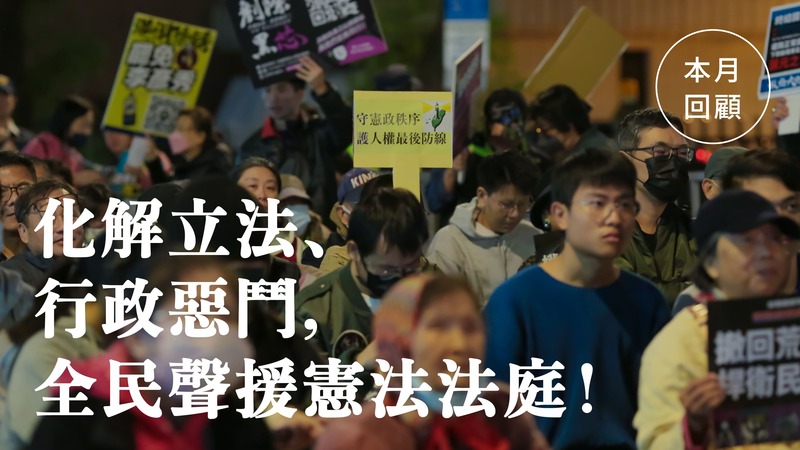
On December 20 of last year (2024), the Legislative Yuan passed the third reading of the amendments to the Constitutional Court Procedure Act (hereinafter the "Constitutional Court Procedure Act"), raising the threshold for Constitutional Court deliberations and repeatedly blocking the presidential nominees for Grand Justices, effectively paralyzing the Constitutional Court for nearly a year. Academia and civil groups repeatedly urged the Constitutional Court to independently resume operations. Today, on the 19th of this month, the Constitutional Court issued "Constitutional Judgment No. 1 of 2025" (hereinafter the "Judgment")—meanwhile, 3 Grand Justices did not participate in the case deliberations and chose to separately submit a "Dissenting Opinion on the Constitutional Court Judgment" expressing different views—declaring the aforementioned amendments by the Legislative Yuan to be unconstitutional.
The Foundation believes that this Judgment prevents the judicial power from being hollowed out by the legislative power, restoring its function of checking legislative and administrative abuse, thereby upholding the principle of the separation of powers and aligning with the constitutional intent to protect the rights of the people.
As political polarization and confrontation become increasingly severe, the Foundation calls on the general public and legal professionals to jointly support this Judgment and ensure that the Constitutional Court exercises its power to stabilize the constitutional order.
Accordingly, the Foundation puts forward 3 statements as follows:
1. The Foundation supports the reasoning and conclusion of this Judgment, and recognizes the significant positive meaning of the Constitutional Court engaging in judicial self-salvation to uphold the separation of powers and stabilize the constitutional order.
2. The Constitutional Court is the ultimate interpreter of the Constitution. Based on judicial autonomy, conviction in upholding the constitutional order, and rigorous constitutional interpretation, it rendered this Judgment without procedural flaws. Even if there are differing opinions among Grand Justices, they should be reflected through participation in case deliberations, which constitutes the faithful fulfillment of the duties conferred by the Constitution.
3. Both the legislative and executive powers have the obligation to faithfully abide by the Constitution and uphold the constitutional order; if there are constitutional disputes that cannot be negotiated, they should be mediated through the Constitutional Court. Neither party should arbitrarily interpret the Constitution as a political tool to exacerbate constitutional conflicts. Furthermore, the ruling and opposition parties should rationally negotiate the personnel consent appointments for Grand Justices and refrain from making the Constitutional Court a sacrifice to political competition.

Regarding the Artificial Intelligence Basic Act (hereinafter the "AI Basic Act") passed by the Legislative Yuan today, the JRF, as an organization long concerned with digital rule of law, expresses deep concern that the provisions fail to fully implement the commitment to "people-centrism." Beyond vague development principles lacking substantive binding force, the Act lacks substantive rights protection mechanisms, fails to restrict AIs posing severe hazard risks, and leaves the content and effects of risk categorization to industry players to formulate their own industry guidelines. Overall, this Act has missed its opportunity to serve as the framework legislation expected of a basic act; instead, it reads like an industrial development white paper filled with policy declarations.
We solemnly call upon legislators to face the potential impacts of AI technology on social equity and individual autonomy, refrain from lingering on this development policy document bearing the name of a "Basic Act," and swiftly initiate the next wave of legislative engineering to remedy the unfinished business urgently needed for AI governance:
1. People's empowerment in the AI era: Swiftly legalize the "right to know, right to explanation of decisions, and right to human review"; ensure the implementation of the "right to equality, right to remedy, and right to policy participation"
2. Establish safety boundaries: Swiftly legislate to monitor AI misuse scenarios carrying risks of severe hazards
3. Reject the law of the AI jungle where the strong prey upon the weak: The government should immediately formulate actionable laws protecting the people to fill the vacuum of industry self-regulation
This article is an AI-generated translation of the original Chinese text. In the event of any discrepancy, the Chinese version shall prevail.