
JRF Newsletter: January 2026
Some Say Donating Is Like Stargazing. Will You Support Us?
Last edited: 2026-08-24
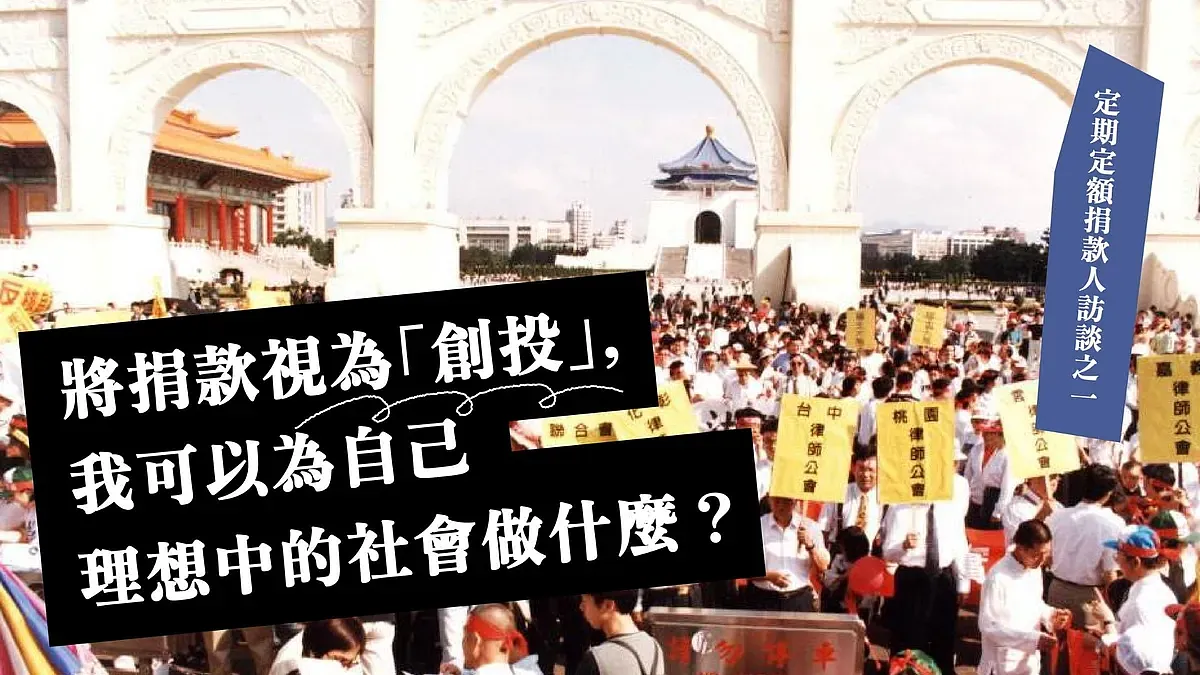
As the Judicial Reform Foundation (JRF) marks its 30th anniversary, we made a special endeavor. Historically, JRF's funding has relied heavily on major donations, with stable, regular, recurring donors making up only a tiny fraction of our revenue sources. To understand what drives these partners—spread across various professions and age groups—to choose to invest their resources in the long, arduous journey of judicial reform amidst the noise of social issues, we interviewed five recurring donors with diverse backgrounds. Among them are a graduate student in sociology in their early twenties, an engineer striving in the tech industry, a seasoned NGO practitioner, a freelance writer who formerly worked as an editor, and a supporter living abroad who still cares about Taiwan's pulse. Despite their different backgrounds, they share a common value: the hope for the sustainable development of the rule of law in society.
When Life Memories Overlap with Initial Judicial Intentions: Empathy for Being Wronged
W, currently a graduate student, initially came to JRF as a volunteer with classmates to assist in advocacy for wrongful conviction rescue. Their concern for wrongful conviction issues actually stems from an unshakeable memory from junior high school. While studying in the school's self-study room, the desk W used was maliciously vandalized. Without any evidence, the director of student affairs simply made a subjective judgment to brand W as the culprit and made them spend their favorite physical education class of the whole week receiving punishment. The anger and helplessness of being unable to prove one's innocence transformed, when they grew up and encountered wrongful conviction issues, into firm support for the innocent and social advocacy. They believe that everyone in life has experienced being wronged to varying degrees; if one can use this shared empathy to speak up for those who cannot voice themselves, that is the most important meaning of participating in society.
Freelance worker C also resonates with human stories. During college, out of curiosity, C wrote a letter to Chiou Ho-shun, who was in prison, and received a reply. This letter acted like a window, revealing living, breathing individuals behind a baffling judicial system. For C, legal provisions may be profound, but the regrets and pain behind wrongful convictions are a language everyone can understand. What C saw at JRF was not only persistence in legal professionalism, but also the safeguarding of every individual's plight within the system.
Read the Full Interview Record

Next, we will take you into the "inner circle" of JRF. Through the perspectives of two lawyers who have long participated in organizational affairs and fundraising—Attorneys Jen Hsiao-hsiang and Lai Chiu-hui—we pragmatically share why they are willing to carve out time from their busy legal practices to invest in this seemingly endless reform, and, in their eyes, the substantive weight behind every donation.
Curiosity and a Sense of Mission: Why Do Lawyers Want to Do Judicial Reform Too?
For these two lawyers, their catalysts for stepping into JRF differed. Attorney Lai Chiu-hui's involvement began with the March Youth Movement (318 Movement), when she joined the defense work as a member of the volunteer lawyers' group. For her, engaging in public interest is not an extra sacrifice, but a return to the original intent of the legal profession. She quoted Article 1 of the Attorney Regulation Act: "Attorneys shall have as their mission the protection of human rights, the realization of social justice, and the promotion of democracy and the rule of law." In her view, "human rights lawyer" should not be a special label, because protecting human rights should be the shared responsibility and belief of all attorneys.
Attorney Jen Hsiao-hsiang's start, on the other hand, carried a sense of curiosity about NGO operations. During her internship at the Legal Aid Foundation, because her supervising attorney participated in the rescue of the Hsieh Chih-hung wrongful conviction case, she began contacting organizations like JRF and Taiwan Association for Innocence. This experience showed her how a case can mobilize the collaboration and long-term investment of multiple organizations beyond legal provisions. Later, upon the invitation of her seniors, she officially joined JRF's Executive Committee. Despite her busy daily legal practice, she chose to remain in the "inner circle" to observe and support institutional change through a different identity.
Read the Full Interview Record

Entering the new year, the Judicial Reform Foundation's momentum remains full. Throughout January, we shuttled between multiple press conferences and advocacy campaigns.
From following up on the latest progress regarding whether the Constitutional Court can fully resume normal operations, to continuing to promote the hope of redress in wrongful conviction rescues; facing external judicial intimidation, we solemnly declared "zero tolerance for sovereignty aggression"; meanwhile, regarding the chaos of "indiscriminate disclosure of investigations," we strongly demanded the prompt clarification of responsibility for leaks, refusing to let judgment before trial damage public trust in the judiciary.
Every statement is both an immediate response to current events and systemic issues, and an action to fulfill the blueprint for judicial reform. Below, we invite you to review our key work this month together.
Statement|Safeguarding People's Rights and Interests: The 8 Grand Justices Have an Inescapable Duty
1. The Constitutional Court inherently has the duty under the Constitution to render judgments; maintaining its operations and safeguarding the rights and interests of the people is commendable.
2. Regarding the absence of Grand Justices Tsai Tsung-chen, Yang Hui-chin, and Chu Fu-mei from the deliberation of this judgment, the Foundation expresses deep regret and calls upon the three Grand Justices to attend the deliberations of the Constitutional Court in the future.
3. The Foundation calls upon President Lai Ching-te to promptly nominate new Grand Justices to fill the vacancies in the Constitutional Court.
Press Release|Reflecting on Stagnant Reforms on the Eve of Judicial Day: The Lai Administration Should Restart Social Dialogue and Build Reform Consensus
1. President Lai should promptly put forward candidates for the President of the Judicial Yuan and Grand Justices; the Legislative Yuan should review their suitability upholding rationality and professionalism.
2. The Lai administration should swiftly propose policies to effectively alleviate judicial overwork and prevent judicial paralysis.
3. Judicial reform is not just about cracking down on fraud; the Lai administration should fulfill its pre-election commitments and restart social dialogue on judicial reform.
4. The Lai administration should seek a cross-party consensus as much as possible to promote judicial reform and human rights protection.
Chiou Ho-shun Case Rescue Team Statement|Wronged for 37 Years, Support Chiou Ho-shun, Return Judicial Justice to Him!
1. The Chiou Ho-shun case is fraught with controversies and is an unquestionable unfair trial!
2. We invite all sectors of society to continue supporting A-shun!
Statement|Zero Tolerance for Sovereignty Aggression: The Judicial Reform Foundation's Statement Regarding the China Taiwan Affairs Office Infringing Upon Taiwan's Judicial Sovereignty
1. We sternly condemn China's judicial intimidation tactics against Taiwan and safeguard Taiwan's free and democratic constitutional order.
2. We call upon the government to establish effective preventive measures that meet human rights standards to ensure judicial independence and human rights protection.
Press Release|Taking the Pause Button Off the Judiciary, Returning Lives to the Parties Involved: JRF's "Wandering Court" Case Solicitation Press Conference
1. Civil and criminal cases pending in the first instance for over ten years exceed 200 cases; the effectiveness of the "Special Criminal Speedy Trial Act" in ending wandering courts is limited.
2. The Judicial Yuan's long-standing statistics, research, and reviews on unclosed cases must be improved to genuinely face the problems where frontline complex cases are difficult to close, causing long-term burdens on the judiciary and litigation fatigue for the parties involved.
3. The Foundation is officially launching its public case solicitation right away. We welcome the Taiwan Bar Association, local bar associations, and the public to provide relevant cases. The Foundation also calls on all sectors to jointly discuss the causes of "wandering courts" and deliberate on systemic solutions!
Statement|Indiscriminate Disclosure of Investigation in Espionage Case May Impede Investigation; Relevant Authorities Should Promptly Clarify Leak Responsibility
1. Extensively reporting content that ought to be kept confidential during an investigation not only damages the credibility of investigative agencies but may also impede the investigation of related cases.
2. The Ministry of Justice lacks active measures, and its credibility has plummeted to rock bottom.
3. Judgment before trial does not serve the public interest; relevant authorities should promptly clarify responsibility for leaks.
 ◎ Chen Kuan-chen, Legal Specialist, Judicial Reform Foundation
Time slips through our fingers, and I have unconsciously spent three years at JRF.
As the seasons turn and the Lunar New Year approaches once again, my desk is still piled high with letters from prisons everywhere. Every day, aside from my other routine duties, I spend my time opening countless scattered letters on my desk one by one, using "replies" to build connections with "them."
As usual, walking into the office and looking at the letters placed on my desk, a different color was mixed among the layers of white envelopes. As I opened them one by one, I felt both warmth and helplessness.
These were cards written to me and to JRF partners by the students inside the prisons before the New Year; some students even wrote Spring Festival couplets by hand. Looking at the stroke-by-stroke ink marks, it is hard to imagine they completed such beautiful calligraphy in a crowded and narrow space.
Yet I could not help wondering: they clearly do not have much money left, yet they insist on spending money every year on cards just to say thank you to us... is it really necessary? I might even be unable to respond to them due to the sheer volume of letters.
When I wrote to inquire, the students replied and answered my confusion: because inside the high walls, this is the only way they can thank those who once reached out a helping hand to them.

The Lunar New Year is fast approaching, and JRF extends early New Year greetings to all readers! Throughout 2025, having just passed our 30th anniversary, we never stopped our footsteps in case rescue, legislative advocacy, or rule of law education.
Currently, the position of President of the Judicial Yuan remains vacant, and the promotion of judicial reform faces numerous obstacles. Facing volatile domestic and international situations, JRF will release a new generation of the Judicial Reform Blueprint in 2026, continuing to use civil power to voice grievances against injustices, safeguard Taiwan's democracy and rule of law, and defend the rights and freedoms of the people.
JRF's small recurring donors still number fewer than 200, a current situation we urgently wish to reverse in our donation structure. This Lunar New Year, JRF has prepared donor-exclusive red envelopes as usual, making it easy for you to bless 3 friends with instant good fortune + invite 3 friends to "chin-ma" (Taiwanese for "right now") join in doing judicial reform! Whether showing concern or supporting with small donations, every bit is vital strength!
Heading into the Year of the Horse, we wish you HORSE after HORSE of success!
This article is an AI-generated translation of the original Chinese text. In the event of any discrepancy, the Chinese version shall prevail.