
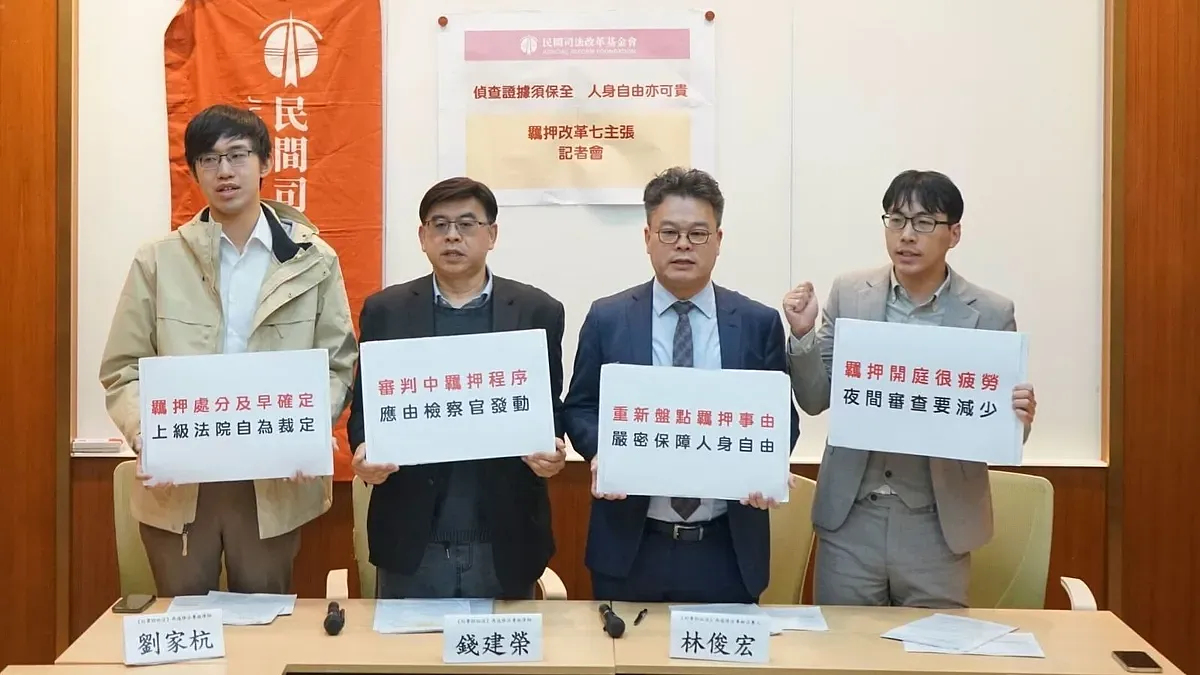
Press Release | "Preserving Evidence in Investigations Requires Safeguards, Yet Personal Liberty is Precious": JRF's Press Conference on Seven Proposals for Detention Reform
Last edited: 2026-08-24
JRF Civil Version of the Amendment to the Code of Criminal Procedure (Detention)
Last year (2025), numerous high-profile criminal cases sparked intense public debate regarding issues such as "detention decisions repeatedly bouncing between the first and second instances," "whether detention on the grounds of suspected collusion is appropriate," and "the prosecutor's right of interlocutory appeal." Concurrently, legislative caucuses and individual lawmakers introduced multiple amendment bills concerning these various issues, which underwent committee deliberations.
Drawing upon past multi-party insights and academic theories regarding the improvement of detention practices, this Foundation has drafted our own civil version of the provisions, putting forward seven key directions for the reform of our country's detention system as follows:
1. In addition to "flight," bail should also be confiscated if a released defendant engages in "destroying evidence" or "colluding on testimony."
2. The interlocutory appeal procedure for detention reviews should be adjudicated directly by the higher court.
3. During trial proceedings, the detention review procedure must be initiated upon a prosecutor's motion rather than ex officio by the court.
4. "Risk of colluding on testimony" as a ground for detention should be restricted to application "during the investigation stage."
5. The duration and upper limits of alternatives to detention should be explicitly regulated.
6. Reduce late-night detention hearings to prevent judges, prosecutors, and defense counsel from conducting detention review proceedings under physical and mental exhaustion.
7. The threshold for felony detention should revert to general detention standards.
1. In addition to "flight," bail should also be confiscated if a released defendant engages in "destroying evidence" or "colluding on testimony"
Defendants posing a risk of flight, destroying evidence, or colluding on testimony may, with court permission, "avoid detention" by posting bail. However, pursuant to Article 118 of the current Code of Criminal Procedure, a defendant's bail is confiscated only in the event of "flight." If it is discovered that a defendant, upon regaining freedom, engages in improper conduct such as "destroying evidence" or "colluding on testimony," the court may well detain the defendant anew, yet it lacks the legal basis to confiscate the bail bond.
In investigative and litigation practice, "the risk of destroying evidence or colluding on testimony" has consistently been the primary ground for detaining defendants. Taking data from the past three years as an example, defendants detained on this ground outnumbered those detained for "risk of flight" by nearly eightfold. This phenomenon may be related to the insufficient availability under our current system of alternative detention measures that courts can select and effectively apply when dealing with the destruction of evidence and collusion. For instance, apart from bail, measures such as wearing electronic shackles can more effectively prevent a defendant from fleeing; conversely, the destruction of evidence and witness collusion are exceedingly difficult to guard against—all the more so today with the proliferation of various messaging applications. If bail cannot be confiscated upon discovering such improper conduct, it clearly lacks a deterrent effect on defendants.
In light of this, this Foundation recommends adding "destroying evidence" and "collusion" as grounds for bail confiscation to strengthen deterrence against improper conduct by defendants, while granting courts greater flexibility in applying alternatives to detention.
2. The interlocutory appeal procedure for detention reviews should be adjudicated directly by the higher court
In current detention practice, lower and higher courts frequently engage in a repetitive cycle of interlocutory appeals and remands regarding detention rulings, thereby further prolonging the time required to reach a final, definitive detention determination. For instance, the detention proceedings in the "sand truck crashing into the Presidential Office incident" experienced a cycle of five remands across five instances. Recent high-profile cases, including the cases of Ko Wen-je and Cheng Wen-tsan, have exhibited similar patterns.
Addressing this issue, certain legislators proposed amendments stipulating that prosecutors shall not be permitted to file interlocutory appeals against court rulings concerning detention.
This Foundation believes that this situation has indeed plunged defendants into a state of prolonged procedural uncertainty in litigation. Furthermore, while the rapid and repeated alterations of court decisions are the outcomes of judicial independence, they undeniably tend to invite public misunderstanding or suspicion in appearance. Nevertheless, prohibiting a specific party in litigation from filing an interlocutory appeal risks leaving questionable initial decisions unexamined by a higher appellate court.
In summary, referencing the Judicial Yuan's 2017 legislative proposal, this Foundation recommends that when a higher court deems an interlocutory appeal well-founded, it should revoke the original ruling and render a ruling itself, thereby avoiding the protracted litigation and the弊 of frequent, rapid fluctuations in detention decisions.
3. During trial proceedings, the detention review procedure must be initiated upon a prosecutor's motion rather than ex officio by the court
In the structural design of a judicial system, the court should act as a neutral arbiter rather than the initiator of litigation procedures—this is a matter of course under the "accusatorial principle." Because detention is a disposition concerning personal liberty, the detention review procedure must also strictly observe this principle as a paramount commandment.
However, under our country's current detention system "during trial," the court makes determinations ex officio on its own initiative. This Foundation contends that, as scholars have pointed out, this regulatory model embodies the roles of the detention "initiator," the "decision-maker," and the trial "judge" all in a single person. Such inquisitorial procedural norms effectively transform judges into a modern-day "Justice Bao" in detention proceedings, violating the realization of the accusatorial principle in litigation.
Accordingly, this Foundation argues that whether during the investigation or trial stage, detention review procedures must be initiated upon a prosecutor's motion before the court conducts a review to grant or deny detention, thereby thoroughly separating the roles of the detention "initiator" and "decision-maker" to safeguard and realize human rights.
4. "Risk of colluding on testimony" as a ground for detention should be restricted to application "during the investigation stage"
Article 101, Paragraph 1, Subparagraph 2 of our country's Code of Criminal Procedure stipulates: "There is factual ground to believe that there is a risk of destroying, forging, or altering evidence, or colluding with accomplices or witnesses." This serves as one of the grounds for detaining a defendant. Recently, some lawmakers opined that the so-called "collusion" (namely "colluding on testimony") is susceptible to abuse in practice and introduced amendment bills last year seeking to delete this ground for collusion.
This Foundation believes that when evaluating this ground for detention, discussions ought to differentiate between the "investigation stage" and the "trial stage."
Regarding the investigation stage, because criminal cases often remain shrouded in obscurity and numerous pieces of evidence have yet to be consolidated, there is a compelling public interest and practical necessity to prevent witness collusion. Consequently, completely excising "collusion" from the grounds for detention would exert detrimental impacts on the collection and preservation of evidence in investigations as well as on considerations of public order.
However, once litigation has entered the trial stage (i.e., post-indictment), whether collusion should still serve as a ground for detention is certainly open to debate. This Foundation maintains that once a case has entered the "trial" stage, it should be recognized that prosecutors have already completed the collection and preservation of evidence. Moreover, considering that prosecutors can demand witnesses to "take an oath" during the investigation and use such testimony as evidence for future convictions, and that witnesses who commit perjury are subject to penalties under the Criminal Code for the crime of perjury, the phenomena of defendants or witnesses "retracting testimony" or "giving inconsistent testimonies" during the post-indictment trial stage will not result in defendants escaping criminal prosecution on that basis.
Viewed in this light, maintaining the defendant's "risk of colluding with accomplices or witnesses" as a ground for detention after entering court proceedings runs counter to the principle of equality of arms in litigation, and risks inclining judges toward a psychological predisposition of the defendant's guilt, thereby compressing the principle of presumption of innocence.
Therefore, this Foundation recommends that the detention ground of "collusion" under Article 101, Paragraph 1, Subparagraph 2 of the Code of Criminal Procedure should be restricted to application solely "during the investigation stage"; once prosecutors have secured sufficient evidence to indict a defendant, they may no longer apply for the defendant's detention on the grounds of a "risk of colluding on testimony."
5. The duration and upper limits of alternatives to detention should be explicitly regulated
Under current law, specific time limits are prescribed solely for the duration of detention, whereas dispositions of "bail, custody to a responsible person, or restriction of residence" are subject to no statutory time limits. Such regulatory gaps have resulted in actual cases where defendants endure exceptionally prolonged periods of alternative measures.
Furthermore, for alternative measures enumerated in Article 116-2 of the Code of Criminal Procedure (e.g., technological surveillance, surrender of passports), the law merely adopts a broad legislative formula stating that courts "may prescribe a reasonable period" without specifying concrete time limits. In practice, although court rulings specify definite deadlines in their main text and supplement them with regulations such as the "Directions for the Execution of Technological Equipment Monitoring of Criminal Defendants" regarding "technological surveillance," the law generally imposes no explicit requirements and lacks concrete restrictions on the total upper limit of "reasonable time."
Although the aforementioned various "alternatives to detention" do not inflict fundamental rights infringements upon citizens as intensely as detention itself, the absence of explicit upper-limit regulations (time restrictions) means that these alternative measures will ultimately encroach upon citizens' rights to a certain degree over extended periods, necessitating corresponding regulatory frameworks for their duration. Accordingly, this Foundation recommends that time restrictions for alternatives to detention should, depending on their nature, be aligned with the duration periods applicable to detention or restrictions on leaving the country or sea, thereby safeguarding citizens' rights.
6. Reduce late-night detention hearings to prevent judges, prosecutors, and defense counsel from conducting detention review proceedings under physical and mental exhaustion
In current judicial practice, detention review proceedings are frequently conducted during the night, leaving defendants, defense counsel, judges, and prosecutors utterly exhausted. When a court decides during the night to impose alternative measures instead of detention, awkward situations may also arise where the defendant is unable to secure bail or manpower is difficult to arrange to ensure the defendant surrenders travel documents like passports.
Investigating the root causes, current detention review procedures merely prohibit proceedings during the "deep night" rather than during the "nighttime." However, the definition of "deep night" under current law—spanning from 11:00 PM to 8:00 AM the following morning—is evidently distinct from the definition of "nighttime," which runs from sunset to sunrise.
This Foundation believes that once nighttime arrives, defendants, defense counsel, judges, and prosecutors alike risk conducting review proceedings and making decisions under physical and mental exhaustion. Even if defendants obtain a prompt outcome, it is not necessarily conducive to safeguarding their rights. Because detention is a disposition intimately tied to a defendant's personal liberty, review proceedings ought to be examined with rigorous procedures. Therefore, this Foundation suggests that detention review procedures should draw upon the jurisprudential rationale of the "prohibition of nighttime interrogation," advancing the time point at which interrogations must/may be requested to occur during daytime hours on the following day.
Meanwhile, because seasonal variations cause sunrise and sunset times to fluctuate daily throughout the year, practical inconveniences arise that diverge from modern societal routines. Consequently, this Foundation further recommends revising the definition of "nighttime" concurrently, standardizing it as running from 8:00 PM to 8:00 AM the following morning. Accordingly, defendants transferred to court for detention review before 8:00 PM can still receive a timely interrogation.
7. The threshold for felony detention should revert to general detention standards
Prior to the rendering of Judicial Yuan Interpretation No. 665, Article 101, Paragraph 1, Subparagraph 3 of our country's Code of Criminal Procedure stipulated: "3. The offense committed is punishable by the death penalty, life imprisonment, or imprisonment for a minimum term of not less than five years" as a ground for detaining a defendant. Subsequently, pursuant to Interpretation No. 665, which mandated that this subparagraph must at least incorporate "reasonable grounds" as a mental threshold requirement, the current legislative model of "lowered detention thresholds for felonies" was established.
However, the declaratory model of Interpretation No. 665 has itself been subject to widespread academic criticism.
An opinion attached to that Interpretation pointed out that there is no inherent correlation between committing a felony and whether one would consequently obstruct prosecution, trial, or execution proceedings; thus, varying detention requirements based on the crime committed violates the proportionality principle. Another opinion maintained that our country's felony detention grounds differ in standard from those in Germany and cannot be equated (Germany limits felony detention grounds to merely 8 provisions, whereas our country features over 100 crimes eligible for felony detention; by comparison, our provisions are manifestly overly broad). Consequently, the Interpretation's emulation of the German declaratory model lacks persuasiveness.
Furthermore, following Interpretation No. 665, although the Supreme Court in practice attempted to theoretically distinguish between the mental thresholds of "reasonable grounds" and "factual grounds to believe," practitioners have argued that because the content of "factual grounds to believe" is inherently hollow and lacks objective quantitative standards, building yet another abstract and hollow standard of "reasonable grounds" upon this abstract foundation ultimately leaves decisions entirely to the subjective discretion of individual judges.
Synthesizing the above, this Foundation believes that lowering the felony detention threshold via "reasonable grounds" under Article 101, Paragraph 1, Subparagraph 3 of the current Code of Criminal Procedure not only lacks sufficient legislative justification for its purpose, but also presents insurmountable operational difficulties in practice for distinguishing it from "factual grounds to believe." Accordingly, because "detention is a disposition restricting personal liberty," this Foundation recommends deleting this subparagraph so that suspected felony cases revert to the same mental threshold applied in general cases for detention review procedures, thereby demonstrating procedural prudence.
JRF Civil Version of the Amendment to the Code of Criminal Procedure (Detention)
Press Conference Time
Wednesday, February 4, 2026, at 10:00 AM
Press Conference Location
Room 101, Legislative Yuan Researchers' Building (Chung-Hsing Building), No. 3-1, Sec. 1, Chinan Rd., Zhongzheng Dist., Taipei City
Attendees
- Lin Chun-hung|Convener, Code of Criminal Procedure Reengineering and Amendment Special Group, Judicial Reform Foundation
- Chien Chien-jung|Attorney, Code of Criminal Procedure Reengineering and Amendment Special Group, Judicial Reform Foundation
- Yang Shih-cheng|Attorney, Code of Criminal Procedure Reengineering and Amendment Special Group, Judicial Reform Foundation
- Liu Chia-hang|Attorney, Code of Criminal Procedure Reengineering and Amendment Special Group, Judicial Reform Foundation
Press Contacts
Lu Cheng-yen, Deputy Executive Director, Judicial Reform Foundation
Telephone: 02-2523-1178 ext. 37
Email: elvin@jrf.org.tw
Liao Wei-cheng, Associate Researcher, Legal Policy Department, Judicial Reform Foundation
Telephone: 02-2523-1178 ext. 20
Email: wayne@jrf.org.tw
This article is an AI-generated translation of the original Chinese text. In the event of any discrepancy, the Chinese version shall prevail.