
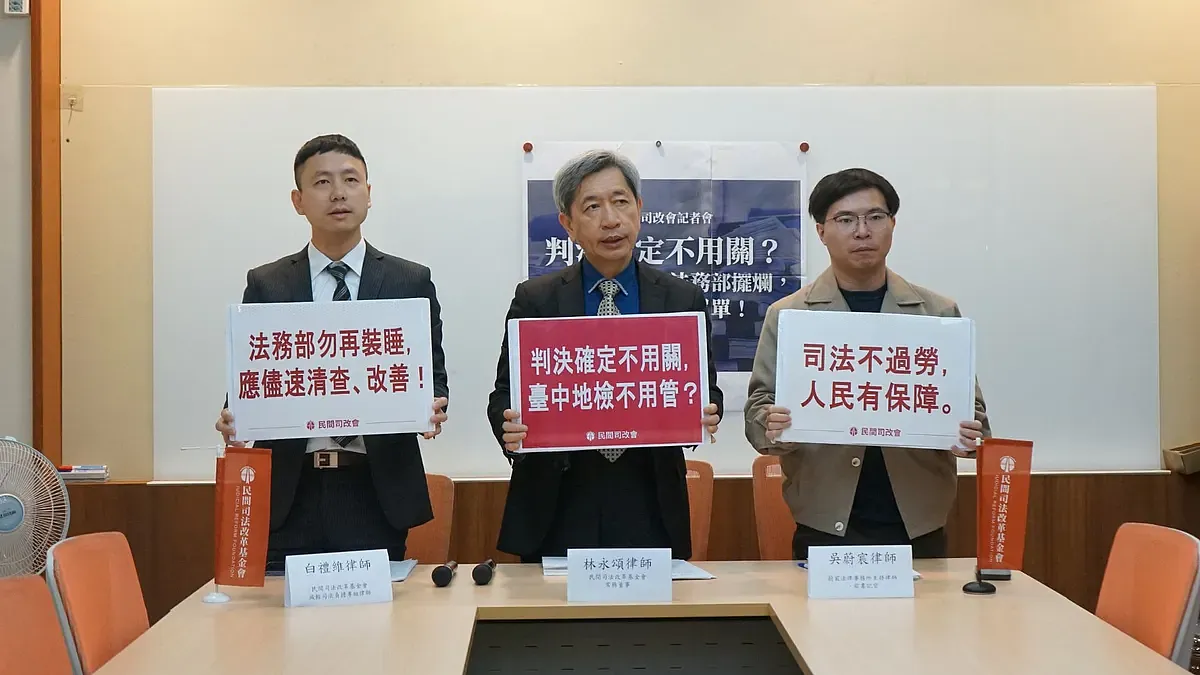
Press Release | Finalized Verdicts Don't Need to Be Served? Court Clerks Overworked, Ministry of Justice Shirks Responsibility—Who Foots the Bill for Systemic Failures!
Last edited: 2026-08-24
In June 2024, the Judicial Reform Foundation (hereinafter referred to as the Foundation) received a petition from a citizen surnamed Shih. Shih stated that he had been convicted of fraud by criminal judgment from the Taichung Branch of the Taiwan High Court in October 2019, receiving a final sentence of 3 years and 10 months of imprisonment. However, despite Shih repeatedly and proactively inquiring with the Taichung Branch of the Taiwan High Court and the Taiwan Taichung District Prosecutor's Office about the execution date following the finalization of the verdict, he did not receive an execution notice until nearly five years later, in June 2024.
In January 2026, the Control Yuan issued its investigative findings on this case, holding that the handling clerk, reviewing section chief, and approving prosecutor at the Taiwan Taichung District Prosecutor's Office all failed to discover that the execution of this case had been omitted, revealing gross negligence in administrative procedures. Furthermore, the investigation pointed out that given the massive volume of execution cases across district prosecutors' offices, similar omissions of sentence execution are a matter of serious concern, and all related systems must be improved.
In response, the Foundation issues the following statement:
1. Finalized Judgments Left Unexecuted: The Taichung District Prosecutor's Office Must Conduct a Thorough Review
The execution of a prison sentence constitutes a severe restriction on personal freedom. Although Shih committed a crime in the first place, he repeatedly and proactively inquired about matters related to sentence execution after the verdict became final, yet prosecutorial agencies repeatedly ignored him, waiting until five years later—when Shih had married, had a child, and gotten his life back on track—to demand that he face punishment. This action inflicted a major shock on his life and family, constituting a grave infringement upon individual rights.
After accepting Shih's petition, the Foundation officially wrote to the Taiwan Taichung District Prosecutor's Office (Attachment 1) and the Taichung Branch of the Taiwan High Court (Attachment 2) on November 5, 2024, seeking to clarify the reasons for the five-year delay in executing this case, and demanded that they conduct proactive inspections and establish preventive mechanisms. However, the Taiwan Taichung District Prosecutor's Office responded on November 27 of the same year (Attachment 3) stating that it had previously replied to Shih and that the case was already closed. As seen in the official document sent by the Taiwan Taichung District Prosecutor's Office to Shih in July 2024 (Attachment 4), the office maintained that the prosecutor acted in accordance with the law in executing the sentence and that no illegality was found, while completely omitting any mention of the adverse impact caused to Shih by the years of delayed execution.
Nevertheless, as shown in the reply letter from the Taichung Branch of the Taiwan High Court to the Foundation (Attachment 5), the court had already forwarded the case for execution as early as November 2019. Due to the negligence of relevant personnel, the Taiwan Taichung District Prosecutor's Office failed to execute the sentence. Even after repeated inquiries by the party concerned, the office still failed to conduct a proactive review, issuing a new execution notice only five years later. While the personnel involved clearly committed administrative negligence, the Taiwan Taichung District Prosecutor's Office turned a blind eye.
While it is never too late to mend, "passive coping" cannot conceal administrative indolence. Yesterday (February 23, 2026), the Taiwan Taichung District Prosecutor's Office issued a press release (Attachment 6) claiming that it has strengthened internal controls and reviews. While the Foundation considers the direction of remediation correct, we must solemnly point out that these actions were clearly a "passive make-up exam" forced by the Control Yuan's investigation.
Even more regrettably, the press release issued by the Taiwan Taichung District Prosecutor's Office attributed the five-year delay to "heavy workloads" and "momentary oversight," while intentionally erasing the fact that Shih had "repeatedly and proactively inquired" about the execution date over the five-year period, and failing to utter a single word about the profound impact this caused on Shih.
Had the Control Yuan not intervened in the investigation, did the Taiwan Taichung District Prosecutor's Office intend to continue covering up this outrageous administrative failure? By simultaneously admitting administrative negligence while dodging and covering up its previous disregard for public inquiries and the Foundation's official correspondence, this pale defense of "negligence but no illegality" is not only cold indifference to the five years of torment suffered by the party concerned, but also a secondary injury to the credibility of the judiciary.
2. The Ministry of Justice Must Stop Feigning Sleep: It Should Promptly Investigate Similar Cases and Actively Deliberate Improvement Mechanisms
The Control Yuan's investigative findings on this case (Attachment 7) point out that the entire incident stemmed from serious administrative negligence across multiple links in the prosecutorial system's case allocation, execution, and archiving processes: Clerk Lai of the Information Division failed to process case allocation; Clerk Huang of the Execution Division and former Prosecutor Hsieh failed to initiate procedures; former Section Chief Li and former Prosecutor Hsieh failed to discover the omission prior to archiving; and then-Chief Prosecutor Chen Hung-ta bore supervisory responsibility for inadequate command and control. This clearly shows that the previous official replies from the Taiwan Taichung District Prosecutor's Office stating that "the prosecutor executed the law in accordance with the law and no illegality was found" are evidently inconsistent with the facts.
Given that the repeated responses from the Taiwan Taichung District Prosecutor's Office have consistently evaded the core issues, causing it to forfeit the credibility expected of a prosecutorial agency, the Foundation grew deeply concerned. In February 2025, the Foundation issued an official letter requesting the Ministry of Justice to exercise administrative supervision in accordance with the law, clarify the causes of the delay, pursue administrative responsibility for the personnel involved, and establish preventive mechanisms. However, the Ministry of Justice has yet to provide any response to this day, let alone take any further proactive action.
The accurate execution of criminal penalties is vital to the nation's judicial authority. Although district prosecutors' offices handle a massive volume of cases daily and frontline personnel bear excessive workloads—and while the omission of execution in this case may stem from systemic helplessness—the Ministry of Justice, as the competent authority, is derelict in its supervisory duties if it fails to prevent such negligence through systemic measures, such as case allocation reviews, revisions to the Criminal Penalty Execution Manual, tracking case numbers for convicted prisoners under prosecution, and checking criminal records prior to archiving.
The Foundation solemnly reiterates its call for the Ministry of Justice to adopt the recommendations of the Control Yuan's investigative findings, promptly investigate whether there are similar unexecuted cases, and deliberate improvement mechanisms. The Ministry of Justice must also face up to the long-standing resource shortages within the prosecutorial system and respond to public expectations with concrete actions. Judicial credibility is not built on the fantasy that "the judiciary never makes mistakes," but rather on the institution's courage to admit and correct mistakes when they occur. However, the attitude demonstrated by the Ministry of Justice and the Taiwan Taichung District Prosecutor's Office in handling this case reveals not the impartiality expected of a judicial organ, but rather evasiveness that sidesteps the core issues.
Such an erroneous and disappointing attitude not only harms the public, but is also a disaster for the staff working within the judicial system.
3. The Judicial System Must Seriously Confront Labor Crises to Prevent Systemic Errors Caused by Institutional Deficiencies
The fact that this case was delayed for five years due to administrative negligence further exposes how the phenomenon of judicial overwork may be deteriorating into "judicial paralysis." According to the Control Yuan's investigative findings, the case allocation room of the Information Division at the Taiwan Taichung District Prosecutor's Office had to process 38,853 execution cases and 7,544 probation cases in 2019, totaling an astronomical 46,397 cases, with an average daily allocation volume of about 181 cases. Furthermore, constrained by operational timeframes and staffing allocations, the division "did not even have reviewing or approval personnel," causing errors at the source of case allocation to be intercepted in time.
In addition, the labor burden of the Execution Division was equally staggering. The handling clerk for this case had an individual intake volume reaching 2,060 cases in 2019, while the annual case intake volume for each execution prosecutor ranged between 8,000 and over 10,000 cases. Under such immense operational pressure, not only the Taiwan Taichung District Prosecutor's Office, but also the New Taipei and Taocheng District Prosecutor's Offices, have maintained high average daily case intake volumes of over 200 to nearly 300 cases in their case allocation and execution operations over the past six years. As stated in statements by frontline personnel, the extreme imbalance between human resources and caseloads has rendered management mechanisms practically defunct in actual operations, let alone maintaining precise cross-checking and reviews.
Judicial personnel are citizens as well, and their basic labor rights and human dignity ought to be protected and cared for by the state system. Whether judges, judicial affairs officers, judicial assistants, or court clerks, if relevant authorities fail to face and fundamentally resolve the problem of personnel depletion, institutional deficiencies will continue to magnify, forming a vicious cycle where "heavy workloads lead to brain drain, and brain drain exacerbates overwork." Newly received investigative cases across district prosecutors' offices nationwide reached 670,000 in 2024, an increase of over 180,000 cases compared to 500,000 in 2020. Conversely, New Taipei District Court recently experienced a massive exodus of court clerks—sparking collective resignations where out of 71 open positions, only 2 people reported for duty (news link available in Attachment 8)—serving as an epitome of this vicious cycle.
The Foundation calls upon the Judicial Yuan and the Ministry of Justice to confront the problems of excessive burdens and insufficient resources among judicial personnel, and to accelerate the deliberation of plans to alleviate judicial burdens. Only by establishing a system that allows judicial personnel to operate in good health can we truly fulfill the protection of people's rights. We urge that judicial overwork must never be allowed to become a normalized hazard that damages public rights and trust in the judiciary.
Attachment 1: Official letter from the Judicial Reform Foundation to the Taiwan Taichung District Prosecutor's Office dated November 5, 2024
Attachment 2: Official letter from the Judicial Reform Foundation to the Taichung Branch of the Taiwan High Court dated November 5, 2024
Attachment 3: Reply letter from the Taiwan Taichung District Prosecutor's Office dated November 27, 2024
Attachment 4: Official document replying to Mr. Shih from the Taiwan Taichung District Prosecutor's Office dated July 30, 2024
Attachment 5: Reply letter from the Taichung Branch of the Taiwan High Court to the Foundation dated November 12, 2024
Attachment 6: Press release from the Taiwan Taichung District Prosecutor's Office dated February 23, 2026
Attachment 7: Control Yuan Investigative Findings from January 2026
Attachment 8: News report link regarding the massive exodus of court clerks at the New Taipei District Court, with only 2 reporting for duty out of 71 open positions.
Time
10:00 AM, February 24, 2026
Location
Room 103, Legislative Yuan Research Building (No. 3-1, Sec. 1, Chinan Rd., Zhongzheng Dist., Taipei City)
Attendees
Lin Yung-sung, Attorney at Law │ Standing Director, Judicial Reform Foundation
Pai Li-wei, Attorney at Law │ Special Project Attorney for Alleviating Judicial Burdens, Judicial Reform Foundation
Wu Wei-chen, Attorney at Law │ Managing Attorney, Wei-Chen Law Office; Former Court Clerk
Press Contacts
Chang Hua-che, Director of Case Action Department, JRF 02-25231178#22 ven@jrf.org.tw
Yeh Po-chun, Legal Specialist of Case Action Department, JRF 02-25231178#31 bj@jrf.org.tw
This article is an AI-generated translation of the original Chinese text. In the event of any discrepancy, the Chinese version shall prevail.