
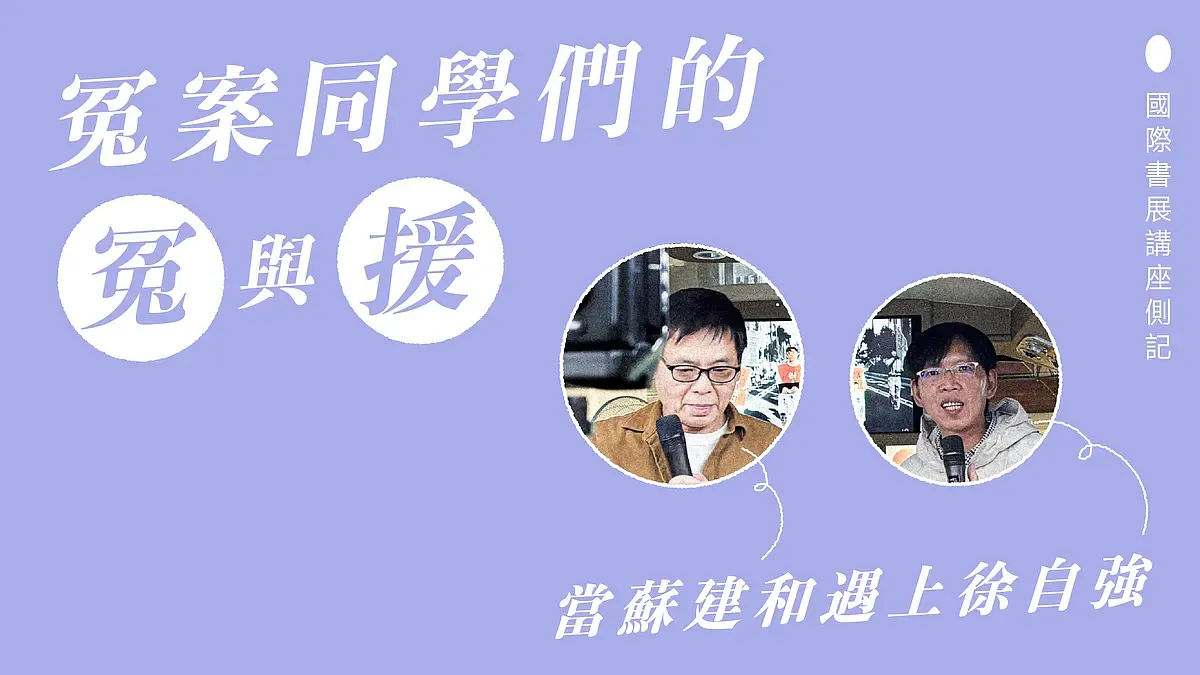
Sidelights | The "Wrongful Conviction" and "Relief" of Wrongful Conviction Classmates: When Su Chien-he Met Hsu Tzu-chiang | 2026 International Book Exhibition Lecture
Last edited: 2026-08-25
The moon has its waxing and waning, and people have unpredictable fortunes
As we waited to enter the book exhibition, it suddenly started to rain, giving the sensation of someone's life changing color overnight without any warning... and you have no idea when that storm in your life will finally stop? This is the story of the wrongful convictions of Hsu Tzu-chiang and Su Chien-he. Two people who originally did not know each other were both imprisoned for crimes they never participated in, extending helping hands to one another amidst their wrongful suffering and providing relief. At the book exhibition, we heard these two wrongful conviction classmates personally talk about their years of injustice and how they restarted their lives after wrongful imprisonment. We hope this can awaken the public's concern for Taiwan's judiciary, allowing the Su case to move toward the dawn once again after a long darkness.
Hsu Tzu-chiang on the Harm Inflicted on Defendants by Wrongful Convictions
In wrongful conviction cases, besides the defendants losing their original ordinary and normal lives, the family members behind them also bore tremendous pressure. To appeal for justice for Su Chien-he and Hsu Tzu-chiang, both of their fathers worked themselves to exhaustion and passed away early in life. Even if the state eventually returned their innocence and pronounced them not guilty and released them, adapting again to the operation of society after years of prison life, or finding a job to support oneself, proved particularly difficult. The state takes no responsibility to compensate for these unspeakable harms; after all, a victim's life for over twenty years has been completely stripped away—how could the state possibly return a normal life to the victim? Although we cannot say Taiwan's judiciary has made zero progress, the speed of progress still needs to be faster. To a judge, a victim of wrongful imprisonment may simply be a case number; but to the victim, it was their entire life.
Su Chien-he's Life of Wrongful Imprisonment
After Su Chien-he was imprisoned for a criminal case in 1991, he endured inhumane torture and coerced confessions, and was sentenced to death by judges at the time with the verdict finalized. At that time, he was only 19 years old, just about to unfold the beautiful youth of his life, yet he was trapped in a detention center, living in constant fear of having his life taken away any day. Su Chien-he's father ran everywhere, petitioning and appealing for his son. Fortunately, he encountered the Taiwan Association for Human Rights, which was willing to provide legal relief. In 2003, Su Chien-he was retried and acquitted, and released in court.
After getting out of prison, Su Chien-he spent a long time doing physical and mental rehabilitation. He had been inexplicably locked up for 11 and a half years, and had worn 2-kilogram leg irons for a long period, causing deep dents in his leg bones that prevent him from running normally to this day. Furthermore, for as long as 10 years, he could only survive on cold instant noodles in prison, leaving his body extremely frail upon his immediate release. Even more bitterly, the National Taxation Bureau directly called Su Chien-he, demanding that he quickly pay off the taxes he owed the state. How could this be tolerated? The state said not a word about the faults it had committed, ignoring the victims as if they were air, yet relentlessly pressing for the collection of debts. At first, Su Chien-he could not find a job in society at all. Later, the then-Homeland Education Foundation took him in. Afterwards, he went to work as a volunteer at the Judicial Reform Foundation, assisting with the data entry of petition forms for Hsu Tzu-chiang. In 2005, Su Chien-he and Hsu Tzu-chiang both petitioned the JRF, hoping that our country's judicial appraisal units would be more scientific and impartial. Otherwise, overly crude police investigation procedures truly harm too many innocent people. Some people consequently lost their marriages, lost their careers, lost beloved family members, and so on. For these permanent harms, the state only looks on coldly, leaving the parties involved to bear them alone. After Su Chien-he was released, the litigation continued until his acquittal was finalized in 2012. This process was painfully and lengthily beyond human imagination; if not for a strong will and the endless love of his family, it would have been truly difficult for a wrongly imprisoned person to endure such plight.
Sweep the snow from your own doorstep, and pay no heed to the frost on your neighbor's roof?
Ultimately, Su Chien-he and Hsu Tzu-chiang, classmates who got to know each other and rescued one another because of wrongful imprisonment, earnestly appealed to everyone to place greater importance on human rights issues in society. Do not think that you could never become the next unfortunate person and turn a blind eye to tragic things happening to others. Everyone relies on social stability to enjoy a peaceful life. As members of society, we should care more about social pulses and trends. When incidents of collective social harm against individuals occur around us, we hope everyone can offer more care and assistance; this is the benevolent concept and correct mindset that a good social citizen ought to possess.
This article is an AI-generated translation of the original Chinese text. In the event of any discrepancy, the Chinese version shall prevail.