
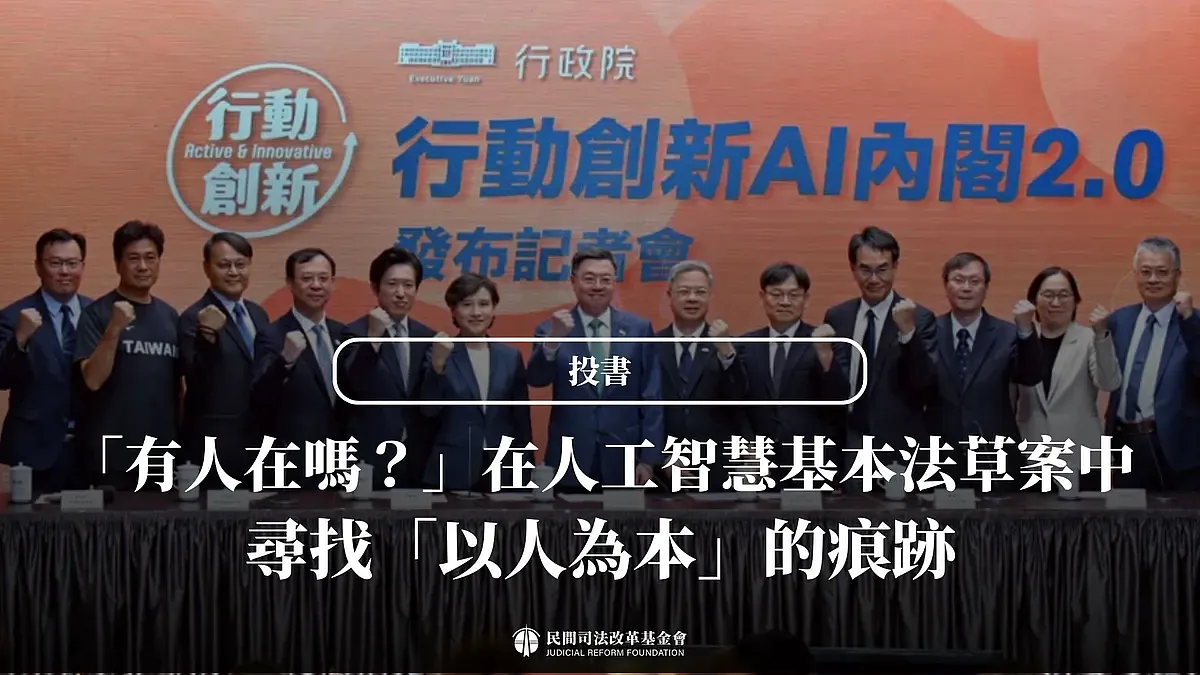
“Is Anyone There?” — Searching for a Human‑Centric Vision in Taiwan’s Draft AI Basic Act
Last edited: 2026-08-25
Artificial intelligence (AI) is developing rapidly and is increasingly embedded in everyday life. Governments around the world are actively developing policy frameworks and legal blueprints to regulate it, and Taiwan is no exception. Taiwan’s draft Artificial Intelligence Basic Act has now entered cross-party negotiations in the Legislative Yuan and may well pass during the current legislative session. Yet when we open this much-anticipated “blueprint for the century,” we cannot help but ask: Is anyone there?
Beyond debating whether AI will replace human labor, we should be equally concerned about whether its misuse could push existing structural injustices into a self-reinforcing feedback loop. If AI systems are trained on biased or unequal datasets, automated decision-making will inevitably reproduce and amplify those injustices.
Not Only Faster Decisions—But the Automation of Injustice
When misused, AI can become an accelerator of social inequality, widening the gap between the powerful and the vulnerable. Individuals subject to automated decision-making systems risk becoming mere objects—defined, categorized, and decided upon by opaque algorithms. This unequal power relationship between “decision-makers” and “those being decided upon” is precisely where democratic legislatures must intervene, using legal frameworks to restore balance and accountability.
Unfortunately, while the draft Artificial Intelligence Basic Act prominently proclaims a “human-centric” vision in its legislative purpose, it merely sets out seven broad principles and fails to establish concrete mechanisms for human rights protection. The overall orientation of the draft still prioritizes technological development above all else. If a basic law intended to serve as a foundational blueprint cannot establish a core framework for protecting human rights, it is difficult to claim that it is truly human-centric.
At a minimum, an Artificial Intelligence Basic Act should serve two essential functions in protecting human rights:
-
To confer enforceable rights upon individuals, equipping people with basic means of self-protection when confronting technological risks and asymmetries of power; and
-
To clearly prohibit certain AI applications, establishing ethical and rule-of-law boundaries that society collectively agrees must not be crossed.
In the context of AI governance, individuals should enjoy at least the following rights: the right to be informed, the right to an explanation of automated decisions, the right to opt out of automated decision-making, the right to equality, the right to effective remedies, and the right to participate in policymaking. Civil society organizations such as the Judicial Reform Foundation are currently promoting a Digital Bill of Rights to comprehensively reassess the rights that must be protected—and the obligations the state must assume—in the age of AI and the broader digital environment. The aim is to ensure that the principles of liberal democracy and institutional checks and balances are not eroded by a “development-first” approach to digitalization.
In our time, any meaningful human rights movement must include the advancement of digital rights awareness. As a foundational law guiding Taiwan’s governance of emerging digital technologies, the draft Artificial Intelligence Basic Act would miss a historic opportunity if it fails to establish robust safeguards for individual rights or to delineate clear boundaries for prohibited AI uses. If legislation is not enacted now, when will it be?
*This article is published on Opinion
This article is an AI-generated translation of the original Chinese text. In the event of any discrepancy, the Chinese version shall prevail.