

Sidelights|Understanding and Handling Racial Discrimination on Campus|Workshop
Last edited: 2026-08-25
Li Po-han: "Understanding Discrimination: Using Campus Controversy Incidents as Examples"
Emily Chan / New York Pro Bono Attorney
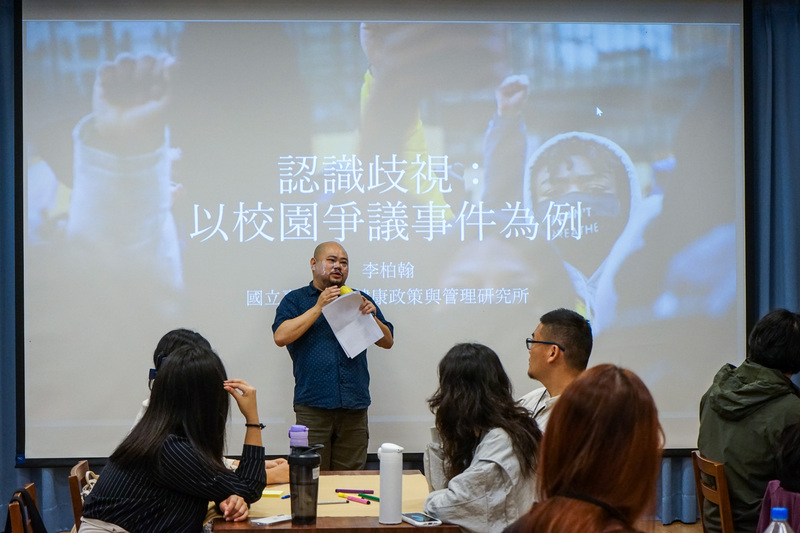
The Campus as the Starting Point of Socialization and the Significance of Higher Education
Professor Po-Han Lee pointed out that the campus is the place where everyone spends the most time during the first half of their lives. It is not only a place to learn subject knowledge, but also a crucial space for exploring self-identity and undergoing socialization. Universities are entrusted with high expectations to be arenas that are rational, objective, and dedicated to knowledge production, often using "meritocracy" as a standard of measurement. However, Professor Lee reminded us that if we only look at the final output while ignoring the gaps in family capital, social connections, and historical background behind each student, this surface-level fairness actually conceals structural inequalities.
The Evolution of the Concept of Equality: From Formal to Substantive and Transformative
Professor Lee explained that the goal of eliminating discrimination is to achieve equality. The concept of equality in international human rights law, such as the International Convention on the Elimination of All Forms of Racial Discrimination (ICERD) and the Convention on the Elimination of All Forms of Discrimination against Women (CEDAW), has undergone the following evolution:
-
Formal Equality: Advocates treating everyone the same, but often ignores individual differences and needs.
-
Protectionist Equality: Recognizes differences but adopts "segregated" protection, such as early Indigenous reservation areas, which is not true equality.
-
Substantive Equality: Recognizes differences and their historical causes, includes everyone through diverse systems, and allows "temporary special measures," such as bonus point systems or guaranteed quotas, to bridge structural gaps.
-
Transformative/Inclusive Equality: A recent trend advocating for the direct removal of systemic barriers to make the environment accessible.
Diverse Forms of Discrimination: Not Just Malice, But Structure
Discrimination depends not only on intent but also on effect, and more often reflects structural and institutional gaps:
-
Direct and Indirect Discrimination: Including explicit differential treatment, or systems that are neutral on their surface but result in inequality, such as height restrictions or single-language regulations.
-
Structural and Systemic Discrimination: Entire social systems or state policies routinely marginalizing specific groups. For example, laws presupposing Chinese as the written language constitute structural inequality for groups whose native language is not Chinese.
-
Intersectional Discrimination: Individuals occupy a uniquely vulnerable position due to possessing multiple identities (e.g., Indigenous + female + disabled), and single-issue equal rights policies often overlook them.
Professor Lee specifically mentioned microaggressions commonly found on campus. These refer to everyday interactions, such as a teacher mispronouncing an Indigenous name or classmates making jokes about the bonus point system. Although such behaviors may not stem from malice, their long-term accumulation severely harms students' sense of belonging and mental health.
A deeper problem behind microaggressions is structural discrimination. NTU's "Furious 4.05" freedom of speech incident (during the 2023 NTU Freedom of Speech Month, students expressed prejudice against the Indigenous student admission bonus system via banners) reflected the conflict between "negative freedom of speech" (freedom from interference) and "positive freedom of speech" (having a sense of security when speaking). When certain speech suppresses the speaking space of vulnerable groups, university administration should establish more effective ethnic equality mechanisms.
Furthermore, contemporary controversies are not merely issues of research ethics, but concern how knowledge production itself is built upon a colonial legacy. For example, the Mayuan Tribe remains incident (from 1930 to 1960, NTU excavated remains from the Mayuan public cemetery without obtaining the tribe's consent) is a classic product of structural discrimination and a colonial context. Putting aside that this completely violates research ethics—even though in that era even the Nazis could use poison gas to study brains—the university chose to excavate an Indigenous cemetery rather than a Han Chinese cemetery, showing that the knowledge production of the time was built on an indifference to Indigenous culture. The university is still learning how to practice transitional justice through apologies, repatriation, and compensation.
Moving Toward an Inclusive Campus Environment
Finally, Professor Lee urged that universities, especially public universities, are not only educational institutions but also public institutions with a human rights obligation to prevent discrimination. The campus should not merely be an educational unit composed of teachers and students, but a support system jointly built by the entire administrative staff and community. Only by understanding the human rights obligations of higher education as a social institution, actively responding to structural discrimination and historical injustices, strengthening the cultural sensitivity of faculty and staff, and establishing active measures such as grievance mechanisms to address daily microaggressions and long-term structural inequalities, can we truly construct a friendly and equal campus environment.
Chang Wen-chen: "Equality and Non-Discrimination"
Su Chiu-tzu, Chang Chih-chi / New York Pro Bono Attorney

Starting from the provisions of the Constitution of the Republic of China (Taiwan) and the contents of the two international human rights covenants—the International Covenant on Civil and Political Rights (ICCPR) and the International Covenant on Economic, Social and Cultural Rights (ICESCR)—Professor Chang Wen-chen explored how equality and non-discrimination guaranteed by law can be implemented across different categories. For instance, Article 7 of the Constitution of the Republic of China (Taiwan) explicitly enumerates only five categories protected against inequality: "sex, religion, race, class, or party affiliation." In contrast, the two covenants adopted about twenty years later encompass categories such as "race, colour, sex, language, religion, political or other opinion, national or social origin, property, birth or other status," demonstrating that with the evolution of the times, categorizations have become more nuanced, and the scope deemed by society to be protected by the right to equality and the principle of equality has broadened.
Professor Chang pointed out that the Constitution of the Republic of China (Taiwan) does not seem to explicitly define "equality" as a right or a principle, preserving interpretive possibilities. Equality is generally divided into three levels: the first is formal equality, which allocates the same resources for different conditions; the second is substantive equality, which allocates different resources for different conditions; and the third is the removal of barriers so that differences in conditions are no longer significant. Beginning with Judicial Yuan Interpretation No. 485, the concept of equality articulated by the Grand Justices is one of "substantive equality," holding that the legislature may enact reasonable differential treatment based on differences in the nature of various matters. Thus, the key question becomes how to determine whether such differential treatment is reasonable. To examine whether differential treatment is reasonable, the principle of proportionality must be introduced to test the connection between means and ends.
Looking across our country's constitutional review standards, differential treatment concerning different protected categories is divided into three tiers: lenient, intermediate, and strict standards of review. For cases involving people across the Taiwan Strait or administrative grants, a lenient standard of review is mostly adopted, requiring the purpose to be in the public interest and a reasonable connection between the means and ends. For cases involving color, visual impairment, sexual orientation, sexual autonomy, and gender, an intermediate standard of review is mostly adopted, requiring the purpose to serve a significant public interest and a substantial connection between the means and ends. For cases involving the acquisition of Indigenous status or severe restrictions on personality rights, a strict standard of review is adopted, requiring the purpose to serve a particularly important or urgent public interest and a direct and absolutely necessary connection between the means and ends.
Equal Protection Measures on U.S. University Campuses: An Introduction to Stanford University and Columbia University
Su Chiu-tzu, Chang Chih-chi / New York Pro Bono Attorney

Taking Stanford University in California, U.S., as an example, its relevant regulations explicitly list "race, color, religious creed, national origin, ancestry, physical or mental disability, reproductive health decision-making, medical condition, genetic information, marital status, sex, age, sexual orientation, gender, gender identity, gender expression, military status or military obligation, veteran status, and any other characteristic protected by law" as protected characteristics. Relevant personnel are prohibited from discriminating on the basis of the aforementioned characteristics, which also reflects the detailed categorization and expanded protection found in modern campus anti-discrimination measures. In handling discrimination-related grievance cases, Stanford University has established a dedicated office for overall management, applying different procedures according to the type of protected characteristic. In cases of campus racial discrimination and hate incidents, if a student's behavior is investigated and determined to be discriminatory, depending on the severity of the circumstances, the student may face disciplinary actions such as campus bans, scholarship cancellation, suspension, or expulsion.
Taking Columbia University as another example, its anti-discrimination policy is a systemic design built upon legal requirements and university autonomy, with its core purpose being to ensure that the campus environment complies with relevant federal, state, and local regulations while maintaining a safe and discrimination-free learning space. This policy not only reflects legal requirements such as Title VI of the Civil Rights Act of 1964 and Title IX of the Education Amendments of 1972, but also implements them concretely through internal mechanisms. In practical operation, the policy provides a complete grievance procedure. Anyone can file a report through multiple channels, including online, written, or oral methods. Once a case enters the procedure, it is first subject to preliminary review by an internal university unit, and temporary measures are adopted when necessary, such as restricting contact or suspending enrollment, to prevent potential harm from expanding. Subsequently, cases may enter informal or formal procedures depending on the circumstances. Informal procedures emphasize mediation and restoration to avoid disciplinary punishment, while formal investigations are conducted by a dedicated panel to gather evidence and make determinations based on a "preponderance of the evidence" standard. By definition, the policy treats discrimination as unfavorable treatment based on a protected status, encompassing multiple dimensions such as age, race, gender, and religion; if it further creates a hostile environment, it constitutes discriminatory harassment.
In addition, the policy explicitly prohibits retaliation against complainants or related personnel to safeguard procedural fairness. Notably, the policy does not distinguish punishments by the type of discrimination, but determines them based on the circumstances of each individual case, including factors such as the severity of the behavior, the scope of impact, and whether there are precedents. Punishments can range from warnings to expulsion, demonstrating that the system emphasizes flexibility and the principle of proportionality. Overall, through clear legal foundations and procedural design, this anti-discrimination policy not only provides avenues for grievances and remedies but also plays a role in prevention and education, embodying the high regard that higher education institutions place on fairness and justice.
By contrasting the anti-discrimination measures of Stanford University and Columbia University with the procedures of our universities for handling "ethnic equality" grievance cases, our universities currently face difficulties in establishing relevant mechanisms, perhaps due to insufficient resources resulting from inadequate relevant regulations, or because our concepts of ethnic equality need to be further developed. If resources or opportunities become available to establish relevant specialized units within our colleges and universities in the future, the practices and related procedures of Stanford University and Columbia University in establishing dedicated offices to centrally handle various types of discrimination cases may serve as useful references and benchmarks.
This article is an AI-generated translation of the original Chinese text. In the event of any discrepancy, the Chinese version shall prevail.