
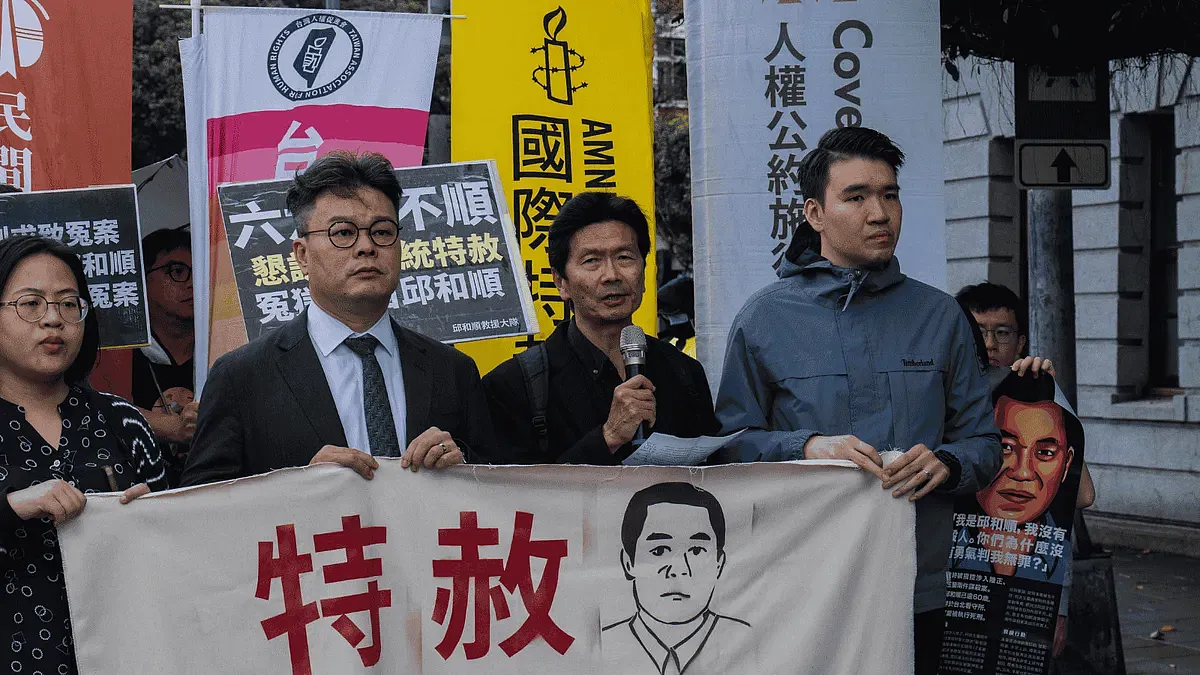
Remarks by Hsu Wei-chun | Press Conference on "Sixes All Wrong: Earnestly Appealing to President Lai for a Presidential Pardon for Wrongful Death Row Inmate Chiou Ho-shun"
Last edited: 2026-08-25
Chiou Ho-shun received an unfair trial; his guilty verdict was based on co-defendant confessions extracted through torture and a voice spectrogram analysis report that violated scientific methods. The fact of police torture to extract confessions was not only corroborated by an audio recording left behind by the police themselves, resulting in the conviction of police officers, but there were also police officers from a police station in Hsinchu County who witnessed the torture process. Based on such facts of torture-extracted confessions, as well as the obvious discrepancies in the criminal facts confessed by co-defendants under improper interrogation, if our judiciary is one that strictly adheres to the principle of the rule of law and strictly adheres to the principle of adjudication based on evidence, Chiou Ho-shun and others should have been acquitted long ago.
Unfortunately, the Chiou Ho-shun case occurred during an era when the judiciary was still under authoritarian rule, even predating the Chiang Kuo-ching case. In this era, torture to extract confessions was a customary tactic used by the authoritarian regime, a routine practice for the state to ensure a sense of security through violence. Moreover, in this era, turning a blind eye or closing one eye to torture for confessions was a habit of the judicial system. Even more unfortunately, the judicial system thus developed a reliance on confessions obtained under torture. This reliance has so profoundly affected the cognition of judicial personnel that the courts could piece together their own imagined criminal story from the severely conflicting criminal narratives among co-defendants. The third misfortune is that this profound impact has persisted into the post-democratization era, continuing up to the High Court ruling in 2016 that dismissed Chiou Ho-shun's motion for a retrial, and even the Su Chien-ho case that is still ongoing today.
This is why, when police officers from the Hsinchu County police station stood up to testify before the court regarding the fact that Chiou Ho-shun had been subjected to torture, the court promptly dismissed the motion for a retrial, cutting off the judiciary's opportunity for self-correction.
Among the cases of redressing judicial injustices by the Transitional Justice Commission, a large proportion involved the fact of torture to extract confessions at the time. The difference in Chiou Ho-shun's case is merely that it is not a political case. But ultimately, the Chiou Ho-shun case is also the product of systematic state violence and a judicial injustice that requires redress.
We acknowledge that the judiciary is operated by humans and is therefore incapable of being completely infallible. However, torture is a human rights violation absolutely prohibited by international human rights law and an illegal act long prohibited by domestic law. For the judiciary to turn a blind eye to torture and rely on confessions obtained through torture to convict people is, in any case, an error that cannot be sympathized with or excused. Let alone sentencing someone to death as a result.
Chiou Ho-shun has been subjected to wrongful judicial treatment for 38 years. He has been deprived of his freedom by the state for 38 years and remains on the death row execution list. The judiciary has closed its doors, preferring to watch Chiou Ho-shun grow old in the detention center due to judicial errors, awaiting execution by the state there. However, a judicial error is also a state error. If the judiciary refuses to return freedom to Chiou Ho-shun, then we must appeal to President William Lai , who represents the state, not to repeat the mistakes of the Chiang Kuo-ching case. Please pardon Chiou Ho-shun, fulfill the responsibility of a state representative, and return freedom to Chiou Ho-shun.
This article is an AI-generated translation of the original Chinese text. In the event of any discrepancy, the Chinese version shall prevail.