
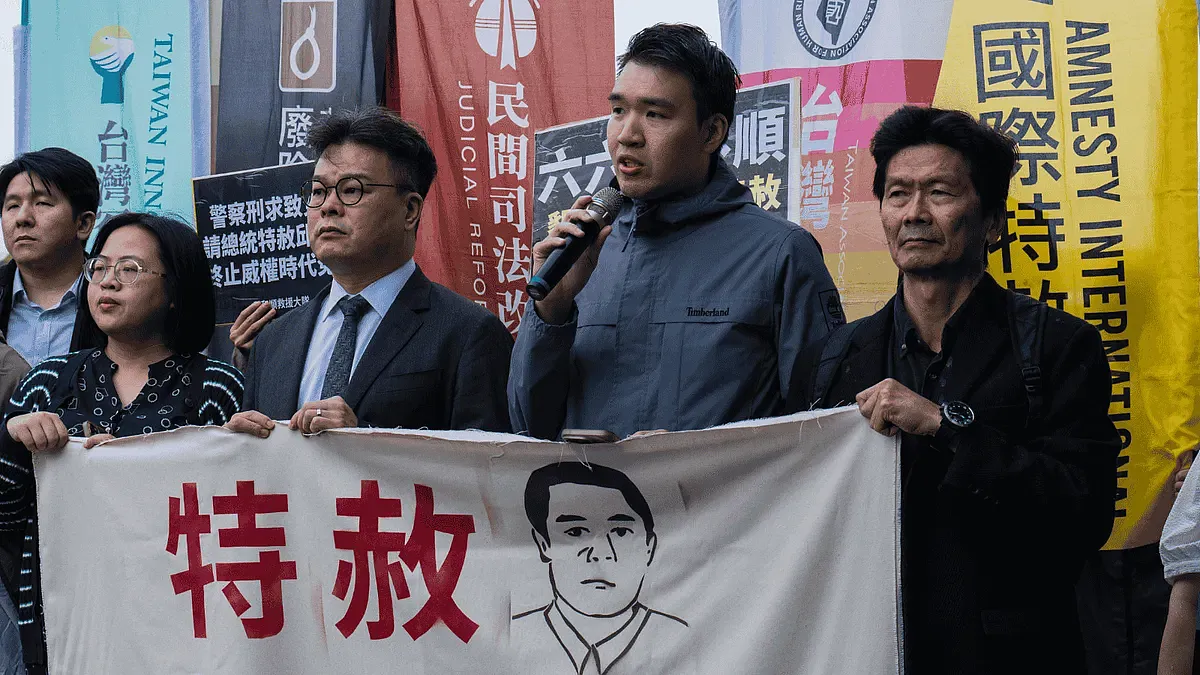
Remarks by Chang Chih | Double Sixth Great Inconsistencies: Earnestly Imploring President Lai to Pardon Wrongfully Convicted Death-Row Prisoner Chiou Ho-shun Press Conference
Last edited: 2026-08-25
I would like to speak about the significance represented by the Chiou Ho-shun case from the perspective of the international community.
When the international community talks about Taiwan, two things are frequently mentioned: human rights and freedom. Taiwan is viewed as one of the societies in Asia that continues to make progress in human rights and freedom.
Yet precisely for this reason, we must think further: Is Taiwan merely limited to "preventing a regression in human rights"? Or, when faced with clear human rights violations, will it demonstrate a high degree of acknowledging its mistakes and possess the courage to correct them? Returning to the Chiou Ho-shun case. When a judgment has repeatedly been pointed out to contain major flaws, and when an individual has been imprisoned for 38 years, does our government have the courage to confront such an error and bring about change?
A Test of the State's Human Rights Obligations
Since 2013, Taiwan has subjected itself to the review of international experts through the state reporting review mechanism under the two Covenants. From the first review recommending sentence reduction to the third review explicitly recommending a pardon, the message from international review experts has remained consistent: The Chiou Ho-shun case is a human rights issue that the Taiwanese government must squarely address. This May, we will usher in the fourth review of the two Covenants. However, the significance of international treaty reviews to the Chiou Ho-shun case has never been limited to how international experts evaluate Taiwan; rather, when these recommendations are repeatedly raised, whether Taiwan chooses to fulfill its obligations to international human rights standards.
Scrutiny by International Judicial Mechanisms
In 2019, the "Mock Asian Human Rights Court," composed of legal experts from multiple countries, accepted and adjudicated the Chiou Ho-shun case. Following comprehensive judicial proceedings, the court found that the Taiwanese government clearly violated Articles 7 and 14 of the International Covenant on Civil and Political Rights in the Chiou Ho-shun case—namely, the prohibition of torture and the obligation to guarantee a fair trial. In other words, the state ought to guarantee that the people are free from torture and inhuman treatment, and receive a fair trial. Yet, the Taiwanese government failed to do either in the Chiou Ho-shun case.
Collective Appeals from the International Human Rights Community
In the same year, 2019, the International Federation for Human Rights (FIDH) held its 40th Congress in Taipei. As one of the largest human rights organizations in the world, this was the first time in nearly a century since FIDH's founding that it held its congress in Asia. At that time, the congress passed an ad hoc resolution titled "Condemning the Use of the Death Penalty in Taiwan, Especially in the Case of Chiou Ho-shun," calling upon the Taiwanese government to reexamine the human rights violations in the Chiou Ho-shun case and provide relief. That year, in welcoming President Tsai Ing-wen's first term, FIDH also put forward eight human rights recommendations, the very first of which called upon the President to pardon Chiou Ho-shun.
Amnesty International's Continuous Advocacy and Relief Efforts
Amnesty International has continuously promoted relief actions for Chiou Ho-shun since 2009. We consistently oppose the death penalty, torture, and unfair trials. From calling to ensure a fair trial prior to retrials, to issuing press releases and open letters after the death sentence became final pointing out that this case violates the International Covenant on Civil and Political Rights, and demanding a halt to executions and the initiation of a retrial; thereafter even launching global urgent actions, Write for Rights, and international petitions to mobilize global members and supporters in ongoing solidarity. To this day, the Office of the President continues to receive letters of solidarity from all over the world.
The aforementioned stances and actions from the international community all point to the same thing: The Chiou Ho-shun case has long ceased to be a mere individual case, but rather a major human rights violation event continuously monitored by the international community. What these voices care about is actually very simple: Will Taiwan allow a person who has clearly suffered unjust treatment to remain trapped within institutional errors?
Today's Taiwan stands at a moment of choice: whether to let this case continue to be a stain on Taiwan's human rights record, or to choose to face the mistake head-on, shoulder the obligation of human rights protection, and bring this historical error to an end.
The Chiou Ho-shun case has spanned more than thirty years, and after exhausting all judicial remedies, it remains unable to obtain substantive justice.
Therefore, we call upon the President to exercise the power of pardon and pardon Chiou Ho-shun. This is not merely for the relief of an individual case, but furthermore to convey a clear signal to the international community: Taiwan is willing to shoulder the responsibility of protecting human rights.
This article is an AI-generated translation of the original Chinese text. In the event of any discrepancy, the Chinese version shall prevail.