
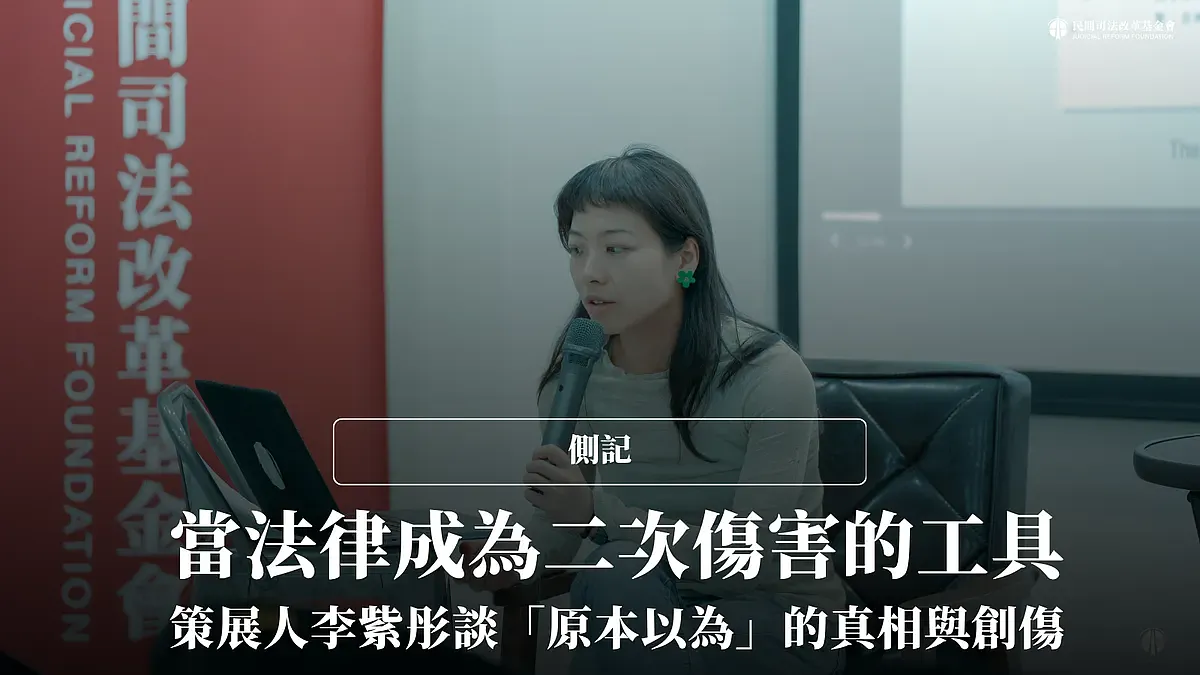
Sidelights | When the Law Becomes a Tool for Secondary Victimization: Curator Li Tzu-tung Discusses the Truth and Trauma of "What We Thought We Knew"
Last edited: 2026-08-25
Moderator: Huang Lin-ying / Part-time Graphic Design Specialist, JRF
Speaker: Li Tzu-tung / Artist and Curator
Foreword
In late March, the Taichung Office of the Judicial Reform Foundation (JRF) welcomed the opening of the special exhibition "What We Thought We Knew," inviting artist Li Tzu-tung to serve as the curator. Li Tzu-tung is not only an artist but also a whistleblower from the 2023 "MeToo" movement. In her opening lecture, she shared how she transitioned from a survivor of sexual violence to a "defendant" within the judicial system, and how she attempts through art to lead the public in seeing the truth beyond judicial judgments.
From Speaking Out to Defendant: The Law and Strategic Lawsuits Against Public Participation (SLAPP)
In 2023, after exposing a well-known literary figure for alleged sexual harassment, Li Tzu-tung was criminally prosecuted by the individual for "defamation," with seven fellow whistleblower netizens also named as co-defendants. She pointed out that this phenomenon is known internationally as Strategic Lawsuits Against Public Participation (SLAPP), where perpetrators use legal proceedings to subject the accused to tremendous mental and financial pressure during prolonged litigation. Although the final outcome was a non-prosecution disposition, she lamented that in certain contexts, the judiciary instead becomes a tool for persecuting parties. For survivors, trauma occurs not only at the moment of the violence, but also through the misunderstandings, blame, and legal persecution inflicted by the system and environment after speaking out.
The Four Quadrants of Truth: Why Did We "Think We Knew"?
In her lecture, Li Tzu-tung lucidly analyzed the limitations of the law in determining "truth." She proposed four quadrants of truth:
- Objective Truth: Evidence and records valued by the courts; however, gender equality cases often occur in private spaces, where objective evidence is frequently extremely scarce.
- Subjective Truth: The personal experiences voiced by survivors, which, though frequently ignored by the judiciary, form the core of the MeToo movement.
- Normative Truth: Society's redefined values regarding consent and respect.
- Active Truth: Systemic changes brought about through action and legislation (such as anti-SLAPP measures).
Using a "confusion matrix" model, she explained that the judicial system fears "false positives" (wrongfully judging an innocent person) the most, whereas survivors most frequently face "false negatives"—where, despite genuine harm, they fail to obtain a fair trial result due to insufficient evidence.
Exhibition Highlights: Dialogue with Legal Chatbots to Reclaim Bodily Sovereignty
This exhibition translates these profound reflections into interactive spaces:
- Lawyer Dialogue Space: The curator interviewed seven lawyers with diverse life backgrounds and created dialogue chatbots from them. Visitors can discover that lawyers hold varying views on gender equality cases, with some emphasizing evidence and reconciliation, while others value restorative justice.
- Feminist Combat Space: Emphasizing "subjective truth," this space provides the booklet *Body Gratitude / Revenge Script*, allowing participants to write scripts for their own bodies and reclaim their right to speak.
- Glossary Notes: The exhibition venue features over 300 vocabulary cards addressing manipulation, healing, and foundational theories (such as gaslighting and scapegoating), helping the public identify the psychological dilemmas they find themselves in.
Conclusion: Healing is a Long-Term Struggle of Repeated Oscillations
During the Q&A session, Li Tzu-tung honestly shared her healing journey, emphasizing that stepping out takes an extremely long time, and it took her 10 to 12 years to speak out. She advised survivors to seek professional resources, such as counseling subsidies from the Garden of Hope Foundation, and to attempt to shift their immediate echo chambers to find communities capable of understanding and supporting them.
The special exhibition "What We Thought We Knew" is not only an art exhibition, but also a profound reflection on power, law, and the self. JRF sincerely invites the public to visit the exhibition and find new understandings of justice and healing amidst the various misalignments of "what we thought we Knew."
This article is an AI-generated translation of the original Chinese text. In the event of any discrepancy, the Chinese version shall prevail.