
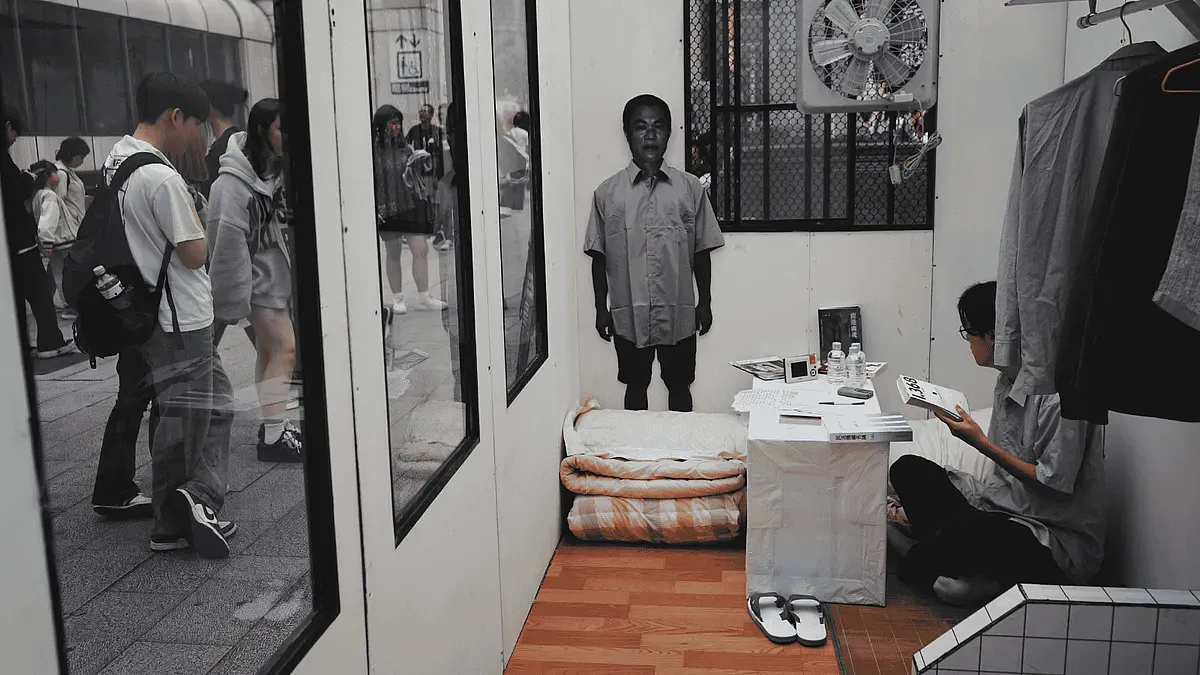
"So That's Where Uncle Ho-shun is Locked Up!" 1.368-Pyeong Cell Recreated in Ximending as Civil Groups Call on President Lai Ching-te to Pardon Chiou Ho-shun and End 38 Years of Injustice
Last edited: 2026-08-28
To raise public awareness about the Chiou Ho-shun case, the Association for the Rescue of Chiou Ho-shun held a street-support action on April 11 at the Ximen MRT Station titled "So That's Where Uncle Ho-shun is Locked Up! Chiou Ho-shun's 38 Years of Youth, Gone in a Flash!" Through immersive exhibitions and public participation, citizens were able to directly experience the conditions of prolonged imprisonment. The event called upon President Lai Ching-te to face this case squarely and grant a pardon as soon as possible.
Chiou Ho-shun has been detained since 1988, marking a staggering 38 years behind bars. From the age of 28 to his current age of 66, he is the prisoner who has spent the longest time awaiting the execution of a death sentence in Taiwan's history. The case has long lacked clear evidence, yet convictions were secured through torture and coerced confessions, highlighting the structural problems of judicial injustice under the authoritarian regime. The volunteer legal team and the rescue association formally submitted a petition for a pardon to President Lai Ching-te on April 7, earnestly pleading with the President to exercise the power conferred by the Constitution to grant Chiou Ho-shun a full pardon absolving him of his crimes and sentences, thereby ending this injustice spanning 38 years and realizing belated justice and freedom.
This action erected a simulated detention space measuring 1.368 pyeong on the streets of Ximending, replicating the Tucheng Detention Center. It was collaboratively built by Hsu Tzu-chiang, a wrongfully convicted death row survivor, allowing the public to directly experience the living conditions of inmates. On-site, volunteers took turns playing Chiou Ho-shun, actually entering the cell block and improvising interpretations under the theme "If You Were Chiou Ho-shun" in half-hour increments to present the lifestyle of long-term deprivation of liberty. The event also opened the cramped space to the public, allowing them to physically understand the oppression and isolation brought by prolonged confinement, and further reflect on how state violence and authoritarianism are imposed on ordinary people.
Lee Ming-che, a human rights worker who suffered wrongful detention and political persecution in China for five years, attended the event and experienced the cell block firsthand. He remarked that when watching the 8:00 PM television drama "Justice Pao" in the past, whenever Judge Pao was about to hand down a sentence, he would often strike the gavel heavily and declare with majestic authority, "In this case, both human and physical evidence are present, the crime is conclusively proven, and you still dare to quibble?" Compared to the Chiou Ho-shun case, this case had no physical evidence: the fingerprints on the ransom note left by the perpetrators at the time did not match those of Chiou Ho-shun and the others; the audio of the ransom recording, after voiceprint comparison, also did not match the defendant Chiou Ho-shun. Not only were the skull and limbs of the victim, K'o Hung Yu-lan , never found, but Lu Cheng 's whereabouts also remain a mystery to this day. Furthermore, with no witnesses, how did the court determine that the guilt of Chiou Ho-shun and others was conclusively proven? And how did it dare to sentence someone to death in such a case?
Assistant Professor Lin Tzu-wei from the College of Law at Fu Jen Catholic University shared from his own life journey, stating that more than twenty years ago when he was still studying in the law department, textbooks already pointed out obvious flaws in the Chiou Ho-shun case; today, as he teaches at a law school, students still ask, "Why is this case still not over?" This precisely highlights the gravity of the problem: a case that has been repeatedly identified by UN human rights covenant experts as violating fair trial rights and harboring major human rights flaws—despite numerous applications for retrials, extraordinary appeals, and constitutional interpretations—remains locked out by the judiciary.
Chang Yu-meng, Chairperson of the Taiwan Youth Generation Good Association, stated in his speech that the Chiou Ho-shun case represents the judicial injustice of Taiwan's past. Through improper interrogation methods such as torture and coerced confessions, Chiou Ho-shun was made to endure nearly 40 years of imprisonment. Our generation should shoulder historical responsibility and moral courage to confront the judicial errors of the past. Since the judicial organs cannot face their mistakes, the president naturally ought to make good use of the constitutional power of pardon to rectify historical errors.
Wang Hsi, a legal officer at the Taiwan Association for Human Rights, asked everyone to try looking at it from their own perspective, believing that everyone has likely experienced feelings of grievance and injustice at some point in their lives. Starting from such an experience, if our judicial system cannot continuously reduce the possibility of making mistakes, nor effectively correct the occurrence of errors, the risk of this instability is ultimately borne by all citizens who use the judicial system—mildly making us feel unfair, and severely impacting our rights to bodily integrity and life.
Chen Yi-chin, Standing Supervisor of the Taiwan Association for Democracy in Education, spoke entirely in Taiwanese Southern Min, emphasizing the life experience of A-shun as a living person. How does a country treat people who are locked up? Chiou Ho-shun has been locked up for 38 years. Every day he wakes up in the exact same tiny space. The outside world is changing, but your life has stopped. You do not know the future, and you do not even know if you have a "tomorrow." Is a situation like this merely "serving a sentence"? Or is it actually a form of long-term, grinding attrition?
Lin Po-wei, President of the National Taiwan University Big Discussion Society, previously applied as a student to the Taiwan Association for Public Advocacy (Judicial Reform Foundation) to organize the Haiwan Tiankuang Campus Exhibition, and this time he also participated in the Ximending street-support action. He mentioned that over the recent period, Taiwan has experienced a "wave of democratic make-up lessons." Through countless tragic cases from the martial law era, we have learned how much harm authoritarian rule during the martial law period can inflict on society. Aside from political cases, there were also a massive number of non-political cases during the martial law era marked by major flaws such as pervasive torture during investigation and trial processes—and Chiou Ho-shun is one such case. We call upon President Lai Ching-te to pardon Chiou Ho-shun. We hope that we, these cross-generational partners, can together look forward to Chiou Ho-shun returning to the light of day and gaining his freedom.
Thanks to volunteers Hsiao-na, Chien-jung, Yang Yen, Yu-yun, I-chun, Chun-yen, Ba-liu, Po-wei, Kuan-fu, Gu-xiong, Shang-heng, You-yu, Yu-chun, Ching-yao, and others for participating in the action of portraying Chiou Ho-shun.
This article is an AI-generated translation of the original Chinese text. In the event of any discrepancy, the Chinese version shall prevail.