
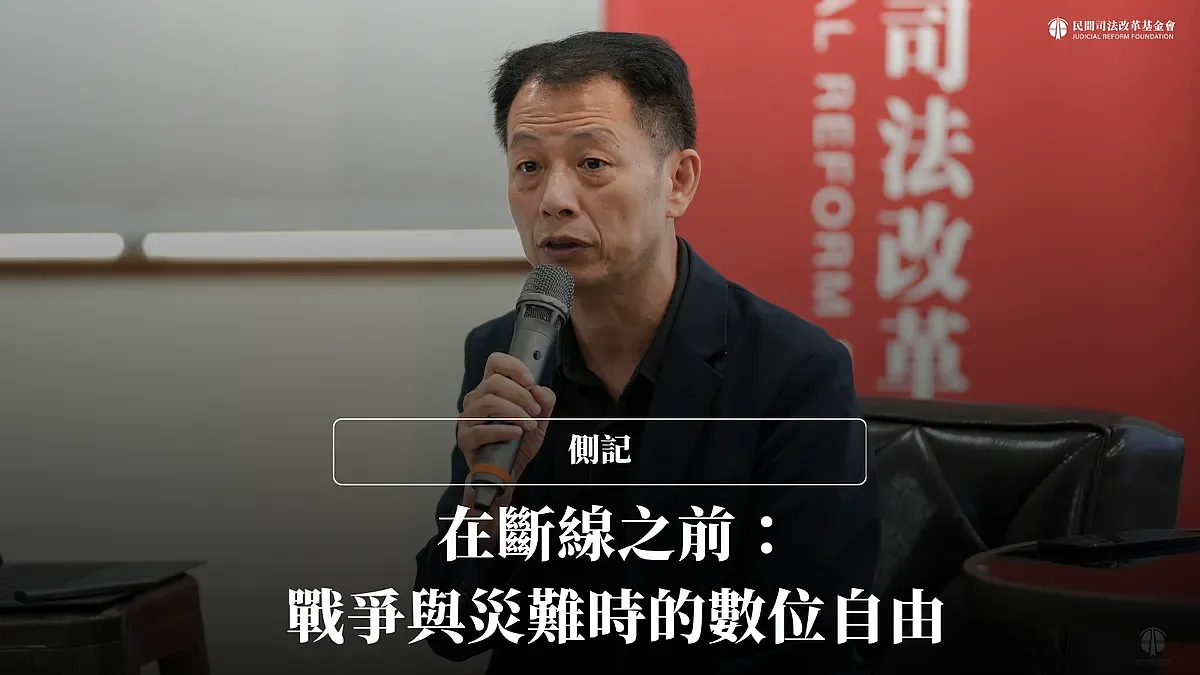
Sidelights | Before the Disconnection: Digital Freedom in Times of War and Disaster
Last edited: 2026-08-26
Moderator: Lu Shi-jun / Chairperson, Judicial Practice Research Committee, Taichung Bar Association
Speaker: Kenny Huang / Chairman, Taiwan Network Information Center (TWNIC), Chair of the Executive Council of the Asia-Pacific Network Information Center (APNIC), and Ph.D. in Information Management, National Chengchi University
When Digital Connectivity Becomes a Lifeline
Moderator Attorney Lu Shi-jun pointed out that modern society has entered an era where "everyone has a smartphone." Mobile phones are not only daily social tools, but also widely intertwined with critical fields such as international finance, healthcare, national defense, and national security. In recent years, Taiwan's submarine internet communication cables (subsea cables) have been frequently damaged—for instance, the 2024 early-year disconnection incident involving a vessel with Chinese background triggered judicial prosecution and sentencing under the Telecommunications Management Act. This demonstrates that maintaining the "resilience" of communication networks under natural disasters or military conflicts has become a national-level issue.
From "Cybersecurity Defense" to "Digital Resilience"
Dr. Huang emphasized that the socio-economic impact of digital tools has grown incomparably:
- Economic Importance: Globally, 60% of GDP is generated using digital tools. Among the top ten companies by market capitalization worldwide, as much as 90% of their market value is directly or indirectly related to Information and Communication Technology (ICT).
- Strategic Shift: Traditional cybersecurity focuses heavily on ex-ante defense (such as password setting and two-factor authentication). However, in extreme wartime scenarios, the focus must shift to "resilience"—that is, assuming that systems will fail, while ensuring that functionality can be rapidly restored after failure and minimizing the impact.
Insights from the Russia-Ukraine War: The Three Pillars of the Digital Battlefield
Using examples from the Russia-Ukraine war, Dr. Huang summarized the key measures of digital resilience:
- Distributed Architecture and Data Backup: Following the outbreak of the war, Ukraine swiftly distributed and backed up national-level data (such as .ua domain information) across six locations worldwide. Dr. Huang pointed out that there is often a flawed domestic assumption that "data must be localized." In fact, apart from a few restrictions under the Personal Data Protection Act and human biosensing data, the regulatory environment for cross-border backup is relatively relaxed, and an emergency data relocation mechanism should be established.
- Public-Private Partnerships and Civil-to-Military Use: The intervention of Starlink changed the course of the war. Originally a civilian satellite communication service, it supported drone guidance and artillery calibration during wartime, demonstrating the "indestructible" nature of low-Earth orbit satellites characterized by high-speed movement and frequency hopping.
- Flexibility in Policies and Regulations: Wartime requires emergency legal authorization to bypass lengthy peacetime procedures. For instance, Ukraine amended its regulations in response to the war, permitting administrative data to be temporarily transferred to overseas clouds.
Information Vacuum and Cognitive Warfare
During wartime, communication disruptions lead to an "information vacuum."
- Fake News Threats: AI-generated deepfakes are extremely low in cost, and machine learning enables extremely rapid self-correction.
- Cognitive Manipulation: When the public is in a state of information scarcity, any message—true or false alike—becomes psychological nourishment, making cognitive warfare even more destructive in an information-vacuum environment. Dr. Huang suggested establishing a single official information channel and using authoritative information for "hedging," rather than relying solely on speech censorship
Taiwan's Current Status and Directions for Improvement
Taiwan appears relatively vulnerable regarding subsea cables and communication infrastructure:
- Lengthy Administrative Procedures for Subsea Cables: Currently, the permitting procedures for subsea cable construction involve multiple ministries such as the Ministry of Culture, the Ministry of the Interior, and the Ministry of Transportation and Communications, taking an average of 36 months to complete the process and ranking among the least efficient globally. Dr. Huang suggested streamlining the investigation and approval process and moving toward a specialized act with "unified jurisdictional authority."
- Whole-of-Society Resilience: The Presidential Office has established the "Whole-of-Society Defense Resilience Committee" to integrate food, energy (raising wartime reserves to 14–30 days), healthcare, and national defense budgets (projected to increase to 3–5% of GDP). This requires everyone from the central government down to local governments and even individuals (preparing a three-day survival backpack) to share the responsibility of resilience.
Conclusion and Q&A
The lecture concluded with a discussion on the rule of law and the protection of human rights:
- Principle of Proportionality: Attorney Lu Shi-jun emphasized that when the government restricts people's rights, it must comply with the principle of a constitutional state, avoid using "sledgehammers to crack nuts," and be subject to supervision by an independent judicial organ (such as the Constitutional Court).
- Legal Evolution: Article 72 of the Telecommunications Management Act has been amended to increase criminal penalties for damaging subsea cables and to introduce penalties targeting virtual (hacker) attacks, carrying a prison sentence of not less than three years and up to ten years.
This lecture revealed that "network disconnection" in modern warfare is no longer a hypothetical scenario, but an inevitable attack vector. Safeguarding digital freedom cannot rely solely on technical defenses; it requires a comprehensive transformation encompassing regulatory frameworks, transnational cooperation, and whole-of-society defense awareness. As Dr. Huang noted, when disaster strikes, the only SOP should be flexible "resilience" rather than rigid peacetime standard operating procedures.
This article is an AI-generated translation of the original Chinese text. In the event of any discrepancy, the Chinese version shall prevail.