
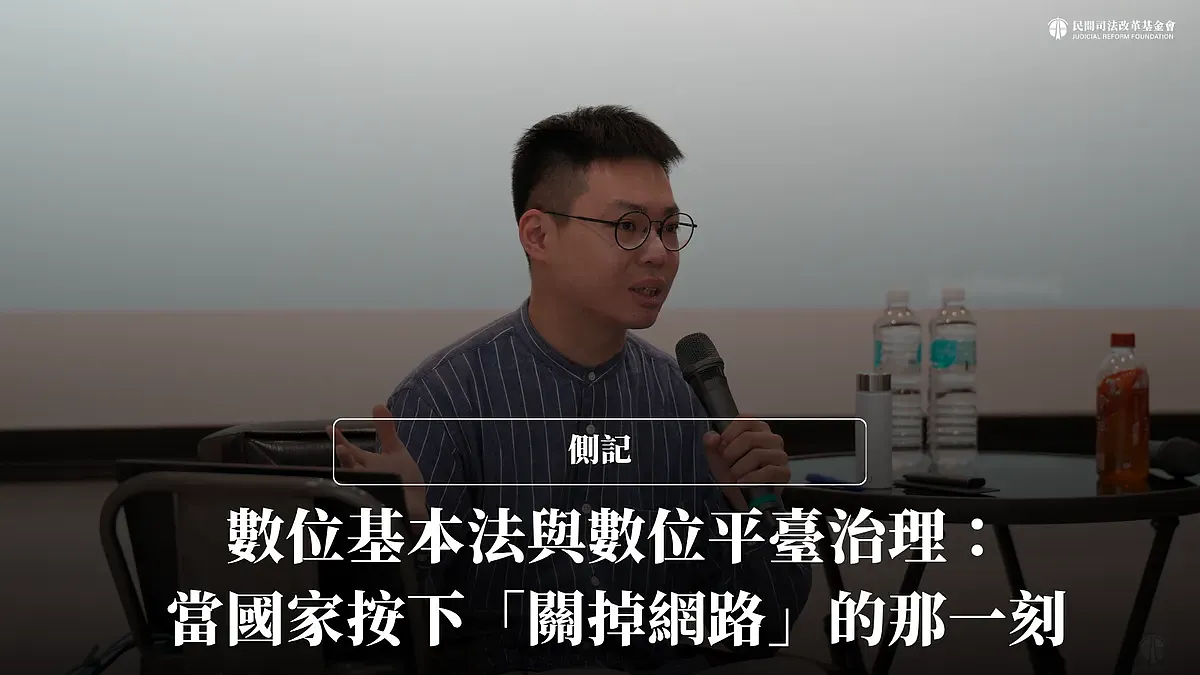
Sidelights | The Digital Basic Act and Digital Platform Governance: The Moment the State Presses the "Kill Switch"
Last edited: 2026-08-26
Moderator: Chuang Tzu-hsuan / Attorney, JRF Digital Law Working Group
Speaker: Yang Han-zhong / JRF Digital Law Working Group
Today, as digital life deeply permeates society, internet communication has become an extension of people's rights. However, when state administrative power intervenes in digital space, is our customary freedom of connectivity quietly changing? The Judicial Reform Foundation invited Yang Han-zhong, a member of the Digital Law Working Group, to provide an in-depth analysis of how the state achieves "internet management" through policy and technical means.
From "Notice and Takedown" to "Complete Shutdown": Multi-layered Digital Restrictions
Yang categorized the ways the state restricts the internet from light to heavy levels. The most common is "notice and takedown," where government agencies discover illegal content (such as fraud or anti-epidemic violations) and notify platforms to remove it. More advanced measures include:
- Keyword blocking: The state provides specific lists for websites to hide related information in search results.
- DNS RP (Response Policy / Stopping Resolution): This is currently one of Taiwan's most severe technical interventions. Competent authorities can require network institutions to unbind specific URLs and IP addresses so that users cannot access those websites, such as blocking pirated audio and video websites.
- Physical internet shutdown: This is an approach under extreme scenarios, such as the state directly cutting off national internet communications during the civil war in Sudan.
The "Chilling Effect" Under Heavy Fines: Platforms Forced to Become Censors
The report points out that Taiwan's current legal mechanism places tremendous pressure on platform operators. According to the Tobacco Hazards Prevention Act, if a platform is deemed to have "accepted the dissemination" of illegal tobacco product information, even if the content is user-generated, the platform may still face heavy fines ranging from NT$400,000 to NT$2 million.
This "punish first, notify later" mechanism has led to a strong "chilling effect": to avoid cumulative fines amounting to tens of millions of dollars (operators have previously received penalty notices as high as NT$26.8 million), platforms tend to adopt the strictest strategy of "better to mistakenly ban than to let go," and even directly ban user accounts suspected of violations. This excessive censorship often stems from inconsistent standards by administrative agencies in defining "illegal content," making it difficult even for professional legal departments to judge, ultimately damaging the freedom of expression of ordinary citizens.
Expanding Administrative Power: Surveillance and "Individual Internet Disconnection"
In addition to content censorship, the expansion of state administrative power in data acquisition is also alarming.
- Database access requirements: Yang revealed that the Taiwan High Prosecutors Office once requested API integration with platforms, intending to directly enter operator databases to view users' purchase records, browsing pages, and communication footprints. This move was strictly rejected by operators due to a lack of legal authorization.
- Digital warning system: According to the Money Laundering Control Act, if the police suspect an account is involved in money laundering, they can issue a "warning disposition" to a specific individual, restricting their use of electronic payment and online auction functions for up to five years. Such digital restrictions targeted at specific individuals substantially constitute a form of "individual internet disconnection."
The Future of Digital Rule of Law: Calling for "Safe Harbors" and Transparency
Taiwan currently faces procedural justice challenges in digital governance. Many internet-blocking measures (such as DNS RP) are not based on judicial judgments, but rather cite the immediate disposal power under Article 36 of The Administrative Execution Act, lacking clear legal basis and remedy channels. According to statistics, in the first half of 2024 alone, more than 52,000 websites in Taiwan were requested to stop resolution, yet the public knows almost nothing about the content of these websites and the reasons for their blocking.
In response to the current situation, Director Yang and the JRF Digital Law Working Group put forward the following recommendations:
- Adopt the "Safe Harbor Principle": Referring to the civil codes of the European Union and Germany, if operators promptly remove content after receiving a notice, they should enjoy a safe space from liability to avoid over-censorship.
- Implement transparency reports: Require the state and platforms to make public statistics on content takedowns and data access, ensuring that public authority is not abused.
- Establish an independent monitoring mechanism: A professional committee similar to "iWIN Internet Content Rating Foundation" should be established to provide immediate remedies and judgments before entering the courtroom, balancing the "demand for immediate disposition" with "fundamental human rights."
Conclusion: Behind the daily routine of binge-watching shows and online shopping, the power struggle between the state and platforms is reshaping our digital borders. How to find a balance between maintaining public order and safeguarding freedom of expression will be the most critical proposition in the legislative process of the Digital Basic Act.
This article is an AI-generated translation of the original Chinese text. In the event of any discrepancy, the Chinese version shall prevail.