
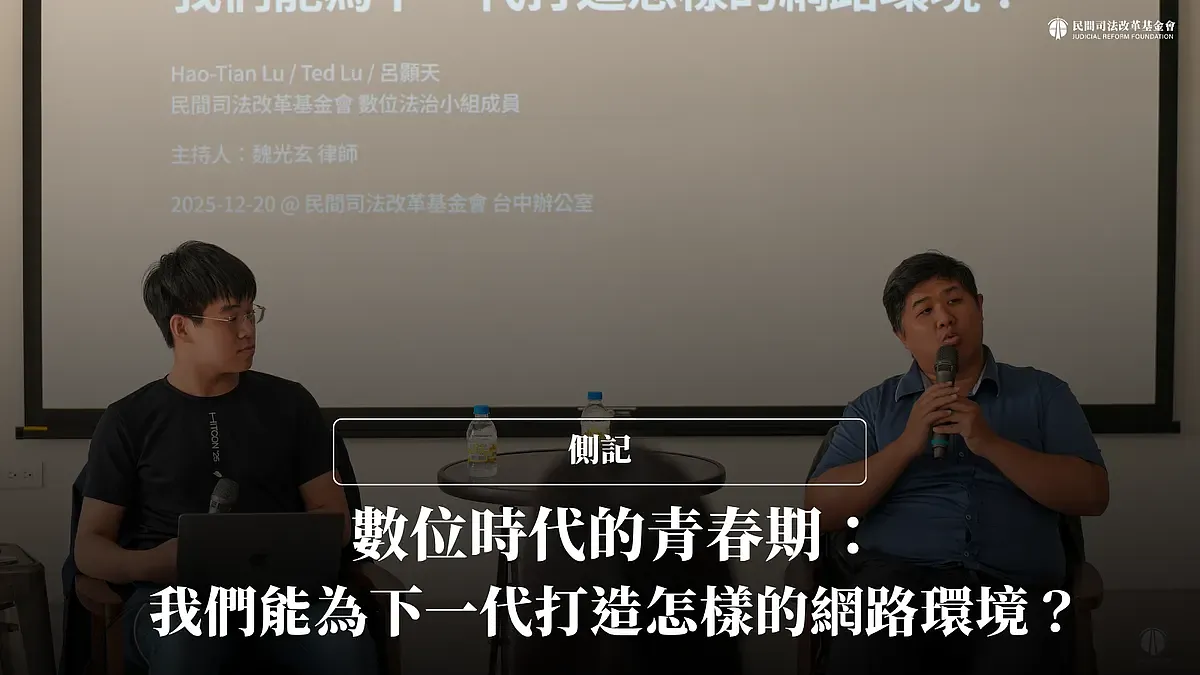
Sidelights | Adolescence in the Digital Age: What Kind of Online Environment Can We Build for the Next Generation?
Last edited: 2026-08-26
Moderator: Wei Guang-xuan / Attorney, Member of the Executive Committee, Judicial Reform Foundation
Speaker: Lu Hao-tian / Member of the Digital Legal Affairs Group, Judicial Reform Foundation
Modern society has entered the era of "digital engineering," where every human action is datafied, making the application and regulation of digital tools a critical issue in contemporary democratic society.
Moderated by Attorney Wei Guang-xuan, this lecture invited Lu Hao-tian, a member of the JRF Digital Legal Affairs Group with a technical background, to delve into international trends in digital legal affairs and the digital literacy Taiwan ought to possess.
Australia's Social Media Ban: Striking a Balance Between Regulation and Freedom
The lecture first focused on Australia's recently passed Online Safety Act 2021 and related amendments. The legislation sets the age threshold for social media use at 16, covering platforms such as Instagram, Facebook, X, TikTok, and YouTube that feature "interaction between two or more users," "free communication," and "posting functionality."
Lu pointed out that Australia's move aims to mitigate the negative impacts of social media on adolescents, such as the "comparison psychology" and mental health issues triggered by Instagram Stories. However, this has also raised concerns regarding censorship mechanisms and the right to privacy, including how to effectively verify age (such as requiring ID documents or facial recognition) and whether it creates the risk of depriving people of their right to information.
The Attention Economy: The Commodification of Digital Behavior
The lecture revealed that the essence of the modern digital environment is the "attention economy." When users watch YouTube ads or scroll through social media, they are effectively acting as "cheap labor," selling their personal attention to platforms and capital at an extremely low price.
- Algorithmic Polarization: To retain users' attention, platforms use algorithms to exacerbate social polarization. Taking Russian troll farms as an example, they use fake accounts to manufacture confrontation in U.S. social issues, trapping users with different stances inside information bubbles where they attack one another, thereby achieving the goal of tearing society apart.
- Addiction and Loss of Focus: "Doomscrolling" causes users to unconsciously consume massive amounts of time, even triggering existential crises and causing them to lose their observational capacity toward real life.
Shifting from "Media Literacy" to "Universal Digital Empowerment"
Lu argued that traditional "media literacy" (such as verifying the truth or falsehood of news) is no longer sufficient to address digital challenges. Society requires a more fundamental "universal digital empowerment" and "digital nourishment":
- Digital Autonomy: Users should have the right to understand the governance models, commercial logic, and data collection practices behind digital tools.
- Countering Monopolies: Tools not controlled by algorithms should be promoted, such as using RSS readers (like Feedly) to curate information sources independently, or using privacy-respecting search engines like DuckDuckGo.
- Privacy Protection Practices: Users should be encouraged to actively manage their digital footprints, such as using email forwarding services (aliases) to track the sources of personal data leaks, or carefully reviewing privacy terms upon registering for services and courageously proposing amendments to platforms.
Conclusion: Building a Web of "Social Resilience"
Faced with rampant scam crimes (with annual losses in Taiwan reaching tens of billions of NTD) and the expansion of administrative power (such as financial restrictions resulting from digital warning systems), the state often tends to pressure platforms or adopt measures like internet shutdowns and DNS spoofing.
However, Lu emphasized that the true solution lies in building "social resilience." This is not merely a safety net woven unilaterally by the government, but a defensive mechanism intertwined by every citizen possessing rights awareness, actively participating in the formulation of digital policies, and jointly safeguarding rights amidst digital shocks. "We are the last generation capable of shaping the digital future," Lu appealed, emphasizing that only through personal awareness and action can a healthier online environment be built for the next generation.
This article is an AI-generated translation of the original Chinese text. In the event of any discrepancy, the Chinese version shall prevail.