
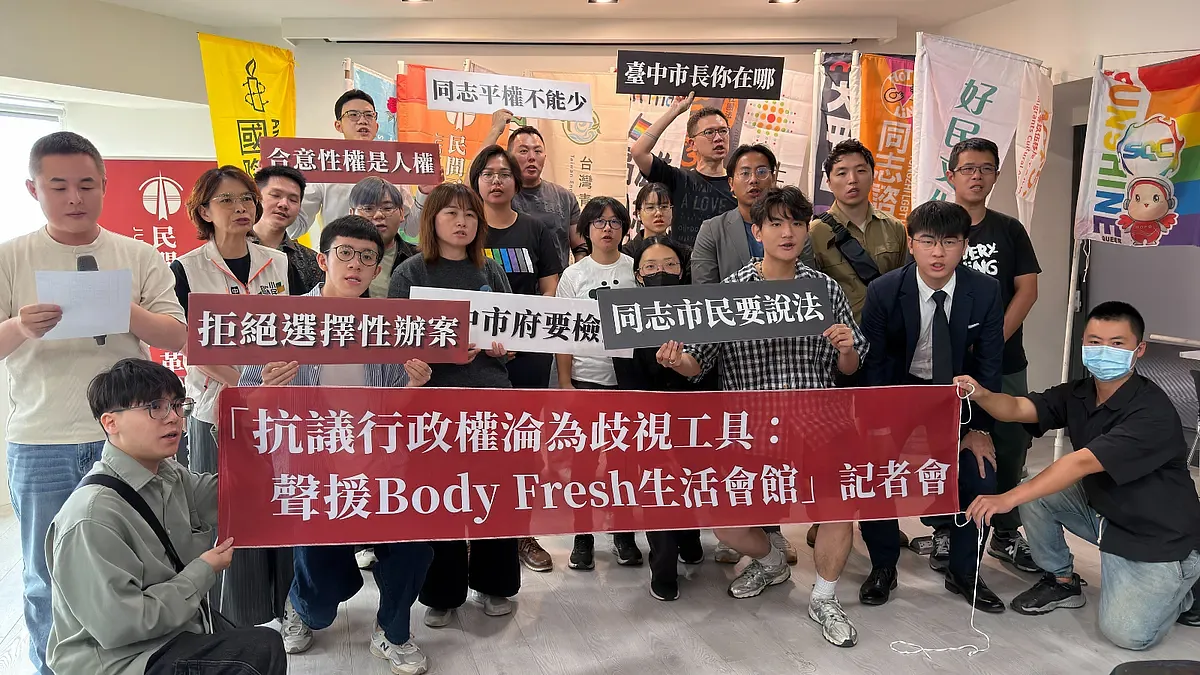
Press Conference | Protesting Executive Power as a Tool of Discrimination: In Solidarity with Body Fresh Bathhouse
Last edited: 2026-08-26
Regarding the recent forced closure of the owner of the Body Fresh gay bathhouse, all organizations represented here express their profound regret and stern condemnation. This case is not merely an isolated administrative disposition dispute; it highlights how public authority utilizes systemic discrimination to progressively squeeze the social living space of sexual minority groups.
1. Fan Shun-yuan, Secretary-General of Gider Taiwan
(1) Key Timeline of the Case
This case originated in April 2025 when a member of the public photographed people queuing outside the bathhouse and uploaded the photos to a social media platform. The Sixth Precinct of the Taichung City Police Department (hereinafter referred to as the Precinct) initiated an investigation and search based on this; on January 26, 2026, it was discovered that the Precinct's investigative photos and videos were leaked to the media, followed the next day by extensive reporting replete with biased and discriminatory remarks against the gay community, sparking intense societal backlash and protests.
Subsequently, Gider Taiwan immediately issued a statement and petition. As of 10:00 PM on April 16, 2026, a total of 79 organizations and 2,270 individuals joined in solidarity, alongside support from over 10 countries, demonstrating considerable international attention to the development of this case.
On February 2, 2026, the Precinct met with Gider Taiwan, proposing internal reviews and improvements, and stating it would issue a public statement at an appropriate time. However, subsequent administrative enforcement actions—such as police spot-checks and joint inspections by the Taichung City Urban Development Bureau—compelled the parties involved to announce their formal closure on April 13, and company dissolution proceedings are currently underway.
(2) Clarifying Facts and Protesting Fake News Bullying
The Precinct's proactive leakage of investigative information, which provoked strong public backlash, not only violated the principle of non-publicity of investigation, but also revealed numerous factually incorrect messages in the process. For instance, prior to opening, the bathhouse had consulted with the Taichung City Urban Development Bureau on administrative matters, and after confirmation, was duly registered for business and issued uniform invoices—contrary to the police's claims of "operating without a license," nor was it operating as a sex trade venue.
When the Precinct conducted its "sting operation" in October 2025, there was no actual sex work taking place on-site. Yet, relying solely on the testimonies of three customers questioned on the day of the raid (even though these three customers were in different spaces at the time and had no contact whatsoever), the authorities prosecuted the bathhouse owner for procuring commercial sex. Furthermore, brand-new condoms and lubricant intended for epidemic prevention, as well as brand-new underwear kept locked away in a warehouse and not for sale, were all described as sex toys littering the premises. Moreover, a dust-covered, ownerless syringe discarded in a medical waste bin was directly weaponized by the Precinct to accuse the owner of drug use (a charge that ultimately resulted in a disposition of non-prosecution).
(3) Rejecting Bureaucratic Responses: Taichung City Government Must Confront the Executive Branch's Systemic Bias Against Gay People
When Gider Taiwan met with the Precinct on February 2, 2026, the Precinct proactively proposed strategies for internal review, process improvement, and public statements. Yet, it subsequently took zero concrete action, eventually deflecting the matter with bureaucratic rhetoric after receiving citizen petitions, claiming via a reply from the Taichung City Police Department that "the procedures in this case were lawful" and that "the discriminatory text was not provided by the Precinct," thereby concluding that no public explanation was necessary. This refusal to engage in dialogue demonstrates that the administrative apparatus ignores the tangible harm inflicted by systemic bias on the gay community, and is undoubtedly a blatant disregard for the "principle of fair treatment" inherent in the rule of law.
At the same time, the administrative system is riddled with systemic gender-discriminatory (inequitable) problems. Three "gay-idol police officers" were unable to attain autonomy over their own bodies within the workplace, forced instead into undercover operations and subsequent media statements expressing that they were "under a lot of pressure" and "sacrificed too much." This sufficiently illustrates that the Taichung City Police Department has neglected the establishment of a friendly workplace.
Over the years, the Taichung City Government has consistently achieved top-tier ratings in gender equality evaluations. Yet this incident mirrors the suppression of the AG Fitness Center by police 28 years ago. When administrative procedures become a weapon to compress the living space of gay individuals, and the city government fails to promptly correct the spread of discriminatory remarks stemming from the police's press release, it not only severely erodes the social sense of belonging of sexual minority groups, but also causes the previously accumulated values of equal rights to face substantial regression.
2. Tsai De-xian, Attorney, Gender Committee Member of the Judicial Reform Foundation
(1) Explaining the Principle of Non-Publicity of Investigation and Its Spirit: The Sixth Precinct of the Taichung City Police Department Has Violated Relevant Regulations
The initial investigation and subsequent information disclosure in this case have violated the principle of non-publicity of investigation. This principle is enshrined in the Code of Criminal Procedure, and the Regulations Governing Non-Disclosure of Investigations further demonstrate its profound significance. The primary purpose of this principle is to protect defendants and litigation-related parties from being misperceived by others before indictment, safeguarding their reputation, privacy, and safety.
Article 8 of the Regulations Governing Non-Disclosure of Investigations mentions exceptional circumstances—such as when a case involves false facts that need clarification or erroneous information that needs correction—under which prosecutors or police may work to set the record straight and make statements. Article 10 of the Regulations Governing Non-Disclosure of Investigations explicitly stipulates that when an event must be publicized, the investigative authority shall designate a spokesperson or agency head to make statements, rather than allowing ordinary police officers or personnel to covertly leak case-related content to the media.
Tsai De-xian, attorney for the Judicial Reform Foundation, stated that at midnight on the night before the press conference, he checked the official website of the Sixth Precinct of the Taichung City Police Department and found no formal statements or press releases related to the incident. The only trace was a press release describing the incident found within a specialized zone named "Police Intelligence Report" on the Police Broadcasting Service, and the two photographs used in that text differed from the images previously appearing in news media.
In this case, investigative data was proactively leaked by the Precinct on January 26, 2026; the parties involved only learned of their indictment via an announcement on the Taichung District Prosecutors Office website on January 30, and received the indictment documents in March. Throughout this, the Precinct failed to make public explanations in accordance with relevant regulations, thereby violating the principle of non-publicity of investigation.
(2) The Sixth Precinct of the Taichung City Police Department Illegally Adopted "Intent-Inducing" Investigative Tactics
Attorney Tsai De-xian stated that how investigations and inquiries are conducted is of utmost importance; while the police department faces difficulties in law enforcement, principles and the law must still be observed. Paragraph 3, Article 3 of the Police Power Exercise Act explicitly stipulates: "In exercising their powers, police officers shall not use entrapment, instigation of criminal offenses, or other unlawful means." As revealed in Supreme Court Criminal Judgment 108-Tai-Shang-2916, "entrapment instigation" in academic theory belongs to one form of "entrapment investigation." Under American and Japanese practical operations, "entrapment investigation" can be divided into two types: first, "creation-of-intent entrapment investigation," and second, "opportunity-provision entrapment investigation." The former refers to situations where the perpetrator originally had no criminal intent, and solely due to the design and enticement of judicial police powers, is instigated to form criminal intent. Once their actions formally conform to the execution of a criminal act, they are arrested—a practice known in legal practice as "entrapment instigation" (or instigation to commit a crime). The latter refers to situations where the perpetrator already has committed or possesses criminal intent, and judicial police, upon learning of this to obtain evidence, merely provide an opportunity, designing an enticement method to feign reciprocal conduct with them to expose criminal evidence, arresting and investigating them once they commence execution—known in practice as "sting operations," which constitute a legitimate investigative technique.
For example, if someone has already asked online, "Who wants to buy drugs?," and the police follow the lead to conduct a stakeout and make an arrest, this constitutes a sting operation. Conversely, actively enticing and instigating a person who originally had no criminal intent constitutes illegal entrapment instigation, and according to the Supreme Court's view, evidence obtained thereby must be absolutely excluded. The police department's intent in handling cases should be to maintain social peace; when society is already peaceful, police provoking offenses is not a state of affairs desired by society. For example, the three undercover police officers mentioned earlier by Gider Taiwan Secretary-General Fan Shun-yuan engaged in active contact, encouragement, or persuasion, which clearly fits the definition of creation-of-intent entrapment investigation (i.e., entrapment instigation).
This venue itself did not provide any sex trade. Under peaceful conditions, prosecutors and police should not disrupt the status quo by actively creating criminal intent, conducting searches, and passing judgment on their morality. Such a state of affairs should not occur. Supreme Court Judgment 99-Tai-Shang-6730 has also pointed out that in determining whether state entrapment investigations comply with due process of law, one must comprehensively consider whether there is a legal basis, whether the case type involves a direct victim, whether the defendant originally possessed criminal intent or tendencies, whether the entrapment behavior constituted passive recording or passive consent versus active contact, encouragement, or persuasion, and whether the method, means, and degree of entrapment complied with the proportionality principle. One can no longer rely solely on the defendant's subjective criminal intent as the sole standard of judgment.
Although we recognize the difficulties prosecutors and police face in law enforcement, unlawful methods cannot be employed. Assuming the case ultimately results in a non-prosecution disposition or even an acquittal, can the reputation lost by the defendant during this process be recovered? People might simply feel there was insufficient evidence—and this is precisely why the principle of non-publicity of investigation is so vital.
3. Cheng Chih-wei, Director of the Taiwan Tongzhi (LGBTQ+) Hotline Association
(1) Lessons from Others Can Overcome Our Own Shortcomings: Taiwan's LGBT Rights Must Not Move Backward
Director Cheng Chih-wei shared the Taiwan Tongzhi Hotline Association's 2023 visit to Sydney, where he was particularly moved by their "Silver Rainbow Unit." As countries worldwide currently face aging populations, this unit handles elderly LGBT-friendly services within the public sector and hospitals. He believes that LGBT friends living in Taiwan also care about their aging future, yet many long-term care institutions and geriatric hospitals today are managed by religious groups.
Director Cheng Chih-wei explained that surveys conducted by the "Silver Rainbow" unit among medical institution staff revealed that elderly LGBT individuals tended to show resistance and fear toward workers and social workers wearing medical-related uniforms. Subsequent investigations uncovered that in the 1970s of that country, police used batons to suppress LGBT activists, even leaking news to relevant media outlets, exposing individuals' real names, and linking their behavior to misconduct. When these LGBT movement participants grew old, the fear and impression of those police atrocities of yesteryear resurfaced, resulting in their phenomenon of fearing police and professionals.
Director Cheng Chih-wei reminded everyone that such events are not distant from us. Even more than 30 years after the AG incident, Taiwanese society still witnesses police suppressing LGBT spaces and humiliating LGBT individuals today. During Taiwan's AG incident back then, police entered the space with loaded guns, claiming that sex work was taking place. Photographs captured condoms and two naked people embracing. That case entered a very protracted legal process, and AG was forced to close down amid it. Director Cheng Chih-wei posed a question to the attendees: If police really rushed in, would anyone genuinely continue to hug each other naked?
Was that snapshot driven by momentary passion, or compliance under public authority? The answer is self-evident. Data from the Taiwan Tongzhi Hotline Association's surveys and interviews regarding elderly LGBT individuals in recent years shows that bathhouses and other LGBT spaces are among the few places where LGBT friends can shed their everyday masks and comfortably be themselves. The existence of such friendly spaces is crucially important for LGBT individuals or anyone else.
(2) Progress Should Not Mean Standing Still, Nor Should It Degenerate into Superficial Evaluation Formalities
The Taichung City Government frequently wins accolades such as the Golden Award for Gender Equality and first place in the six special municipalities' gender equality evaluations. Yet why is it that amid such outstanding performance, the police act as though they have never received any gender equality education? Viewing from the perspective of LGBT groups, observing the current status of LGBT organizations and policies in Taipei and Kaohsiung simultaneously, Taichung's development of LGBT spaces and the government's supportive attitude are relatively slower compared to the other two major cities.
"Progress should not mean standing still, nor should it degenerate into superficial evaluation formalities." Director Cheng Chih-wei concluded by calling upon local leaders and government agencies in Taiwan to demonstrate the same responsibility as the Commissioner of the Australian Federal Police—who once publicly apologized for past law enforcement errors committed by the police system against the LGBT community—by facing historical mistakes and immediately halting heavy-handed oppression against LGBT spaces.
4. Statements of Solidarity from Other Organizations
Hao Si-jie, representative attending on behalf of the Taiwan Sex Worker Rights Advocating Association, stated that the association is present today to express its support for the nationwide LGBT community, to call for a review of unnecessary and erroneous law enforcement performances, and to dismantle the social moral stigma against the LGBT community and the erotic industry.
Hsieh Yun-hsi, Chairperson of the Kaohsiung Lesbian Gay Bisexual Transgender Queer Pride Association, stated that as an organizer of pride parades, LGBT spaces are extremely vital to the LGBT community. This incident is extremely violent and heartbreaking. LGBT movements started over 30 years ago, and never did she expect to hear of a similar situation repeating itself in 2026. This is precisely why we must continue holding pride parades; we hope to continuously advance the social and cultural atmosphere and spaces. It would be a great pity if we have the spaces, but our culture fails to keep up.
An-Chun Chung, Deputy Secretary-General of the Taiwan AIDS Prevention Association, shared that he once called a local police station to report a case, and the dispatcher was extremely furious, reminding him of his experience 15 years ago when Gider was driven out of the community. Society still has a long way to go. This press conference is not meant to make things difficult for anyone, but to make Taiwan better. We can help you; let us examine what else we can do and review what has happened.
5. Joint Demands of the Organizations
- Establish external oversight mechanisms: The Taichung City Government should formulate clear law enforcement guidelines for joint inspections to prevent executive power from degenerating into a tool of stigmatization.
- Implement systemic bias courses: The Taichung City Government must mandate ongoing education for agency heads and supervisors to eradicate discriminatory mentalities within the bureaucratic system.
- Promote an anti-discrimination act: We call upon relevant authorities to attach importance to the Anti-Discrimination Act and jointly improve systemic bias and discrimination issues from a legislative standpoint.
Organizing Organization
Gider Taiwan
Co-organizing Organization
Judicial Reform Foundation
Supporting Organizations
1095 Immigrant and Migrant Workers Culture Association, HERO Drug-Love Healing and Recovery Center, OBA Party, Taiwan Youth Ideology Association, Taiwan Alliance to End the Death Penalty, Gender Equality Student Advocacy Coalition, Chinese Yu-Hsin-Shu Association, Taiwan Tongzhi (LGBTQ+) Hotline Association, Taiwan Gender Equity Education Association, Taiwan Sex Worker Rights Advocating Association, Taiwan Rainbow Civil Rights Association, Taiwan AIDS Prevention Association, Kaohsiung Lesbian Gay Bisexual Transgender Queer Pride Association, Chinese Democratic Academy, Taiwan Hepatitis Information and Service Association, Southern Rainbow Street 6, Amnesty International Taiwan, Sunny Queer Center
Press Release Appendix
This article is an AI-generated translation of the original Chinese text. In the event of any discrepancy, the Chinese version shall prevail.