
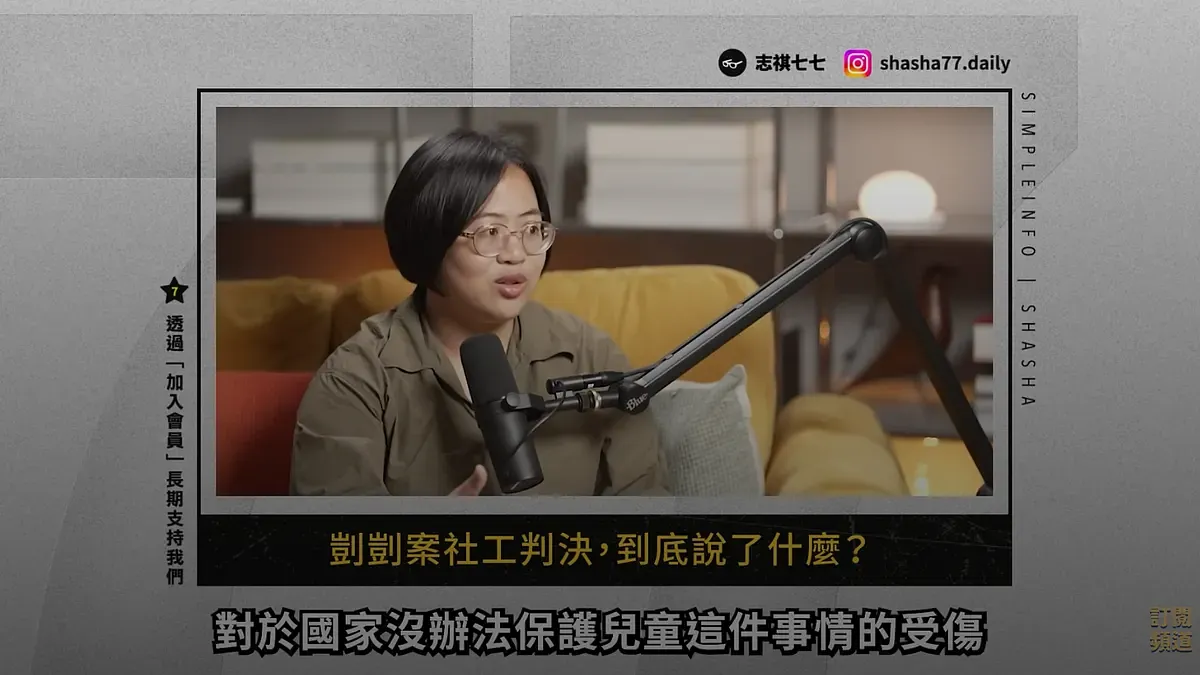
Interview Summary | What Did the Verdict in the Kai-Kai Case Say? Why Is the Social Work Community Reacting? How Should the Vulnerabilities in Taiwan's Social Safety Net Be Addressed?
Last edited: 2026-08-26
Deep Reflections After the Verdict in the Kai Kai Case: From the Guarantor Position to Systemic Vulnerabilities in the Social Safety Net
The tragedy of the Kai Kai case has deeply grieved Taiwanese society, exposing holes in the child protection net. Furthermore, the first-instance verdict sentencing the social worker to two years of imprisonment without probation has triggered a severe shockwave across both the legal and social work communities. This verdict, the first time in Taiwan's history that a social worker has been convicted of negligent homicide, is not only a punitive measure against an individual professional, but also raises a profound question: where should the boundary of legal responsibility be drawn when the state system fails?
Construction of Legal Logic: Why Did the Social Worker Become a "Guarantor"?
In criminal law, establishing an "omission offense" requires that the perpetrator holds a "guarantor position." In this case, the judge employed two pathways to construct the guarantor obligation of the social worker surnamed Chen:
- Duty to Supervise Sources of Danger: The verdict held that if a 24-hour round-the-clock babysitter faces high pressure, there is a high possibility of abuse, making them a "source of danger." Since the Child Welfare League Foundation (CWLF) contracted with the babysitter, the frontline social worker executing the task bore the obligation to supervise this source of danger.
- Duty as a Voluntarily Assumed Protector: The judge determined that when the social worker surnamed Chen communicated with the social worker from the New Taipei City Social Welfare Center, she verbally promised, "I'll just go make the home visit." This tacit understanding and consensus in task division were viewed as voluntarily assuming the responsibility of protecting Kai Kai.
In addition, the court emphasized "information exclusivity," arguing that the social worker held the babysitter's contact channels, Kai Kai's medical records, and the biological family's background, making her the only person capable of piecing together the truth of child abuse, and therefore she must bear legal responsibility.
Dilemmas of Professional Practice: When the Law Meets the Social Work Frontline
However, the social work community's backlash against this verdict is not a denial of responsibility, but a concern that legal standards have detached from practical realities. In practice, social workers typically view licensed babysitters with qualified credentials as professional partners rather than "sources of danger." If social workers are positioned as monitors who must maintain a high degree of suspicion at all times like detectives, it will fundamentally conflict with the "relationship of trust" emphasized in social work.
The "12 Clinical Indicators for Child Abuse Presentation" cited in the verdict are also controversial. These indicators serve as reminders for physicians during examinations, and their release date was later than the dates of the social worker's initial home visits. For frontline social workers, in situations where a babysitter deliberately conceals and lies, identifying extreme child abuse based solely on weight loss or sporadic bruises remains highly challenging in professional appraisal.
Challenges to Judicial Trust: Not Just the Outcome, But the Process
JRF Executive Director Lee Ming-ju pointed out that from the improper handcuffing during the investigation stage to procedural flaws discovered during trial—such as unverified handwritten notes in the interrogation records—these deeply impacted the social work community's trust in the judiciary. Judicial justice should not be reflected solely in the final sentencing outcome, but must also be realized through a fair and realistic trial process.
The verdict shifted organizational responsibility onto grassroots individuals while ignoring the state's institutional absence. During the temporary foster care status prior to the completion of adoption, there has long been a lack of direct supervision and tracking by the public sector, which is the critical vulnerability that led to the tragedy.
Conclusion: Promoting More Comprehensive Victim Protection and Institutional Reform
Over the 31 years since its establishment, the JRF has consistently insisted on identifying systemic problems from individual cases. The Kai Kai case reflects ambiguities in cross-professional division of labor and guideline characterization within Taiwan's social safety net. We advocate:
- Fulfillment of State Responsibility: The state should become the ultimate guarantor of children's rights and interests, bringing adoption services and temporary foster care supervision back under the public sector to ensure the supervisory mechanism is foolproof.
- Revision of Victim Protection Regulations: Addressing institutional defects such as the compensation application deadline being shorter than the criminal prosecution period, the JRF is continuously promoting legal amendments to ensure that the rights of victim families are not compromised by administrative procedures.
Kai Kai's sacrifice should not merely result in the punishment of an individual; it should drive a comprehensive health check of the judicial and social welfare systems. We invite you to continue following the subsequent developments of related drafts and join us in catching every vulnerable life.
The following is a transcript of the dialogue organized from the video source:
Chih-chi: Nobody wanted to see the Kai Kai case happen. I feel that the current backlash from the social work community is actually not a denial that we could do better, or a complete claim that we bear no responsibility. Some people might not quite understand why social workers are taking to the streets, or why you are "supporting bad social workers." But I think the reaction of the social work community is more about imagining: if I were also to enter this working field, would I be able to detect this situation?
On April 16th, the first-instance verdict for social worker Chen in the Kai Kai case was handed down: two years of imprisonment without probation. This is the first time in Taiwan's history that a social worker has been sentenced for negligent homicide. The verdict immediately triggered a backlash from the social work community, which argued that this judgment ignored the practical dilemmas of social work and expressed fears that it would become the final straw breaking the profession of social workers in Taiwan. Social work groups even protested outside the Executive Yuan, criticizing the state for shifting the responsibility of a systemic failure onto frontline social workers. On the other hand, many netizens felt that as a frontline social worker who had access to Kai Kai and the babysitter, how could Ms. Chen possibly bear no responsibility at all? Even many legal professionals believed that the verdict has thoroughly and clearly articulated why she bears responsibility and why she was derelict in her duties.
To clarify this unprecedented verdict, today we have invited Lee Ming-ju, Executive Director of the Judicial Reform Foundation, who graduated from National Taiwan University's Department of Law and Graduate Institute of Social Work, and holds licenses as both a social worker and an attorney. We are going to discuss what this verdict actually said, why social workers are pushing back, and why there is such a huge gap in views between legal professionals and social workers.
Lee Ming-ju: Hello, everyone.
Chih-chi: Off camera, we also have our planner SUE who will be chatting with us.
Planner SUE: Hello, everyone, I'm SUE.
Chih-chi: To start with, we need to begin from the background of the case. From Kai Kai's biological mother first raising adoption requests in 2022 to Kai Kai's passing at the end of December 2023, more than one social worker and more than one unit actually intervened in between. Can you help us lay out the timeline?
Lee Ming-ju: In this Kai Kai case, we can indeed see that three social work units were involved. Starting in 2022, when Kai Kai's biological mother stated she could no longer care for the child, a social worker from the Shulin-Yingge Social Welfare Center referred the case to the CWLF for adoption services. However, the biological mother later disappeared, and the service was suspended. After custody was reassigned to the grandmother, who once again stated she could not care for the child, the social welfare center referred the case back to the CWLF. Entering the period with the babysitter, the Wenshan Center for Residential Child Care played the role of visiting the babysitter's care conditions and handling administrative tasks.
Social worker Chen, who was convicted, is an adoption social worker at the CWLF. After Kai Kai was placed in the babysitter's home on September 1, 2023, she conducted home visits once each in September, October, and November.
Chih-chi: Now that this verdict has come out, which of the claims circulating on the internet were ruled as guilty?
Lee Ming-ju: The prosecutor at the time prosecuted two provisions: making false entries in professional documents and negligent homicide. Currently, the former is acquitted, while the latter resulted in a two-year sentence. What the court established is that under the babysitter's lies and concealment, social worker Chen failed to exercise sensitivity to "piece together" the truth of child abuse. Looking at 2024 data, about 95% of negligent homicide cases carry sentences of under one year, so a two-year sentence is actually on the heavier side.
Chih-chi: Regarding the determination of negligence, the key lies in the "guarantor position."
Lee Ming-ju: To establish an "omission offense," the prerequisite is that the actor must have a special obligation. The judge constructed social worker Chen's guarantor position through two pathways:
- Supervision of the Source of Danger: The verdict held that if a 24-hour round-the-clock babysitter experiences heavy pressure, there is a high possibility of abuse, making them a source of danger. Since the CWLF contracted with her, the frontline social worker executing the task bore the obligation to supervise this source of danger.
- Voluntarily Assumed Protector Duty: The court considered that social worker Chen verbally agreed with the social welfare center social worker that "I'll just go make the home visit," and this tacit understanding in task division was treated as a voluntary assumption.
In addition, the court emphasized "information exclusivity," arguing that social worker Chen had the babysitter's contact information and medical records, unlike the social welfare center social worker.
Chih-chi: Is the social work community pushing back strongly against this determination of the "guarantor position"?
Lee Ming-ju: Yes. In practice, social workers do not treat babysitters holding qualified credentials as "sources of danger." What triggers the most backlash is the court's logic of shifting "organizational responsibility onto individuals." In addition, the social work community also feels that the so-called "voluntariness" was an arrangement under structural constraints rather than a choice made by individual agency.
Chih-chi: What about the determination of negligence?
Lee Ming-ju: The court cited the "12 Clinical Reminder Indicators for Child Abuse Presentation," but those were meant for doctors, and their release date (October 28, 2023) was later than the social worker's initial home visits.
Chih-chi: When ordinary people see that Kai Kai lost weight, lost teeth, and had bruises, they would feel that professionals should be able to tell.
Lee Ming-ju: Expert witness Dr. Frank Leigh Lu mentioned that identifying child abuse is highly specialized; injuries do not necessarily mean abuse, and the absence of injuries does not rule it out. The Kai Kai case was reasoned backward from the result after consulting all experts.
Chih-chi: If it cannot be discerned, how are social workers supposed to protect children?
Lee Ming-ju: It is a system. Expecting a single individual to uncover the lies of an extreme criminal is very difficult. If 100% protection is to be achieved, can society introduce the necessary costs and expenses? Some social workers worry that if they must constantly maintain high suspicion like detectives, it will destroy relationships of trust.
Chih-chi: Why did the verdict target social worker Chen individually rather than the organization?
Lee Ming-ju: The principle of criminal law is to punish natural persons.
Chih-chi: What about the responsibility of local government?
Lee Ming-ju: Lawyers mentioned institutional vulnerabilities: this case did not go through "placement" but was "temporary foster care" prior to adoption, resulting in an absence of public sector supervision. Civil society groups have advocated for years that the state should bear supervisory responsibilities before adoption is completed.
Chih-chi: As someone with a dual background, how do you view this verdict?
Lee Ming-ju: The JRF believes that "judicial trust" stems from the entire process. This case initially featured improper handcuffing, and during the trial, procedural flaws such as inaccurate records and unidentified handwritten notes were also discovered. While these may not necessarily affect the final verdict, they affect the social work community's trust in the judiciary.
Chih-chi: The slogan of social workers taking to the streets states, "The state is the true guarantor of children's rights and interests."
Lee Ming-ju: This is a policy-oriented appeal. It means that where the state was absent and thus led to the occurrence of the case, the system should be completed by the state.
Chih-chi: Why should the general public care about the dilemmas faced by social workers?
Lee Ming-ju: Social workers are distributed across elderly care, childcare, domestic violence, and other fields. Everyone faces vulnerable moments and may utilize social safety net resources. If some people in this society fall through the cracks and cannot be caught, it affects the entire community.
Chih-chi: In your view, what are the key vulnerabilities reflected by the Kai Kai case?
Lee Ming-ju: The division of labor, guidelines, and duties of care across different professions should be defined in greater detail. The government has stated it will bring adoption services back under the public sector, which is a good thing, but subsequent oversight must ensure efficiency does not compromise children's opportunities to be adopted.
Chih-chi: How can ordinary citizens show their concern?
Lee Ming-ju: By using information to understand the perspectives of different groups. Social workers taking to the streets in protest is a form of healing, premised on trauma. The JRF has monitored the judiciary for 31 years, and it is heartbreaking to see the social work profession suffer so much trauma when entering the judicial system.
Lee Ming-ju: The JRF sees institutional problems from individual cases. We have recently focused on victim protection issues, such as the compensation application deadline being shorter than the criminal prosecution period, and we are promoting relevant drafts, hoping everyone will pay attention together.
Chih-chi: Thank you, Ming-ju, for sharing. That's all for this episode, see you tomorrow, bye-bye!
This article is an AI-generated translation of the original Chinese text. In the event of any discrepancy, the Chinese version shall prevail.