

Sidelights | The Difficulty of Language: Looking at Gender-Based Harm through the Lens of Shame
Last edited: 2026-08-26
Speaker: Chang Yi-hsun / Writer
Moderator: Lin Andong / Attorney
Following the 2023 #MeToo movement, many individuals who chose to speak out were immediately swept into a massive "legal conveyor belt"—facing judicial battles that demand evidence, logic, and consistent narratives. However, the essence of gender-based harm is often fragmented, shameful, and difficult to categorize. When legal language filters out authentic feelings that do not fit "logic," victims easily fall into a state of speechlessness and secondary victimization.
The "Thought I Knew" special exhibition by the JRF Taichung Office invited renowned writer Chang Yi-hsun to converse from a literary worker's perspective with Lin Andong, a Master's student in Taiwan Literature at National Taiwan University and a pro bono attorney for the JRF Gender Group. Together, they reflected on a question: Beyond the "perfect story" demanded by the judiciary and public opinion, can we build a public language that genuinely holds harm and embraces brokenness?
Chapter One The Law Is Not Merely an Adjudicator, but a Participant in the "Environment of Language and Shame"
At the opening of the lecture, Chang Yi-hsun offered an observation that might seem counterintuitive to many literary workers: The law has never been a neutral bystander; it is itself a critical force shaping how a society talks—or refuses to talk—about sexual violence.
Chang used a news story as an entry point. In late April 2026, the European Parliament pushed for a unified definition of "rape," advocating for "consent" (affirmative consent) as its core. At first glance, basing it on "whether the parties consented" seems like common sense; however, compared to Article 221 of the Criminal Code of the Republic of China, which still centers on "contrary to will"—meaning whether the victim "expressed refusal" rather than whether both sides "actively agreed"—we can see that this common sense has yet to enter the law.
Chang illustrated the power of the law through an interview with a female police officer featured in a French documentary: Past police training required officers taking reports to ask "whether there was resistance" and "how the victim resisted." Yet with advancements in brain science, we now know that when faced with violence and extreme stress, humans experience a "freeze response"—under intense pressure, the amygdala and hippocampus in the brain almost fail to function, making it entirely impossible for a victim to act in the ways common sense dictates they "should" resist. Furthermore, a victim must first "recognize" what is happening before them in order to resist, and many victims cannot even identify the situation they are experiencing in the moment.
The female police officer stated in the interview: Ever since perspectives shifted and training content was revised accordingly, the French police no longer ask the question "Did you resist?"
Our understanding of a crime, and our understanding of how to protect the rights of victims, can change. It is not something constant and unchanging like mathematical ability. It can change—perhaps moving toward greater protection of human rights, or perhaps moving in the opposite direction.
And amidst this transformation, changes in the law directly impact people's lives.
Chang Yi-hsun
Using a diagram, Chang illustrated the tug-of-war among culture, education, and law: When the law lags behind while culture is already better equipped to care for victims' rights, culture must expend considerable effort to fill the legal vacuum; however, when a new legal concept is established, it can directly shoulder the responsibilities previously borne solely by culture. The law can be a participant in the "environment of language and shame," acting simultaneously as a variable protector or destroyer of that environment.
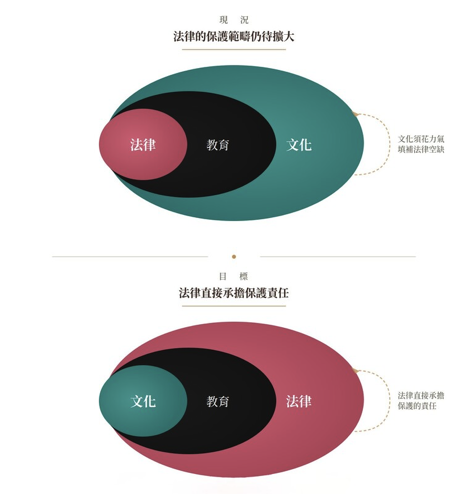
Chapter Two Three Levels of "Rape": Self-Recognition, Social Recognition, and Legal Recognition
Chang posed a question to the audience: Self-recognized rape, socially recognized rape, legally recognized rape—which one matters most to you?
The audience offered various answers. A law student believed the legal level is most important, because the law provides the basis for dialogue with society. A social worker in the audience pointed out that for the clients she supports, "how they themselves define the matter" is often most crucial—because recovery never begins with external recognition, but with self-acknowledgment.
Attorney Lin Andong responded to this question from her frontline experience. She confessed that when handling offenses against sexual autonomy, she often has to lay psychological groundwork for her clients at a very early stage:
We might fail to secure a conviction, but that does not mean nothing happened. What happened to you is real, and I also believe it is a textbook case of sexual assault—but it is possible that at the legal level, we will ultimately receive a disposition of non-prosecution.
Lin Andong
The reason this reminder must be given in advance is that judicial non-recognition is a form of denial originating from public authority; the force of this denial is immense and often works in reverse to shake the self-awareness that the victim has struggled to build, causing them to doubt: "Am I really a victim?"
Attorney Lin added: Sexual assault cases are inherently "closed-door crimes"—typically involving only the perpetrator and the victim, with conflicting accounts and very limited corroborating evidence. The victim acts as both the party involved and the witness to the crime, making the victim's testimony often the most critical source of evidence. Remaining corroborating evidence may include observations by social workers or psychologists, PTSD evaluations, or emotional shifts witnessed by family and friends. Because the victim's testimony is core, the court strictly demands consistency and matching details across statements. The problem is—traumatic memory is inherently fragmented. When trauma first occurs, the brain's defense mechanisms cause us to "forget"; upon later reflection, memory itself is not a precise system.
When victims make statements with slight discrepancies in details across different time points and interrogation settings, defense attorneys easily attack their "credibility."
This represents one of the deepest tensions between law and trauma. Attorney Lin pointed out that in recent years, some judges have gradually introduced psychological knowledge and are more willing to understand minor inconsistencies in details; yet the judiciary as a whole still presupposes that a "precise, coherent memory" is possible—a presupposition well worth reflecting upon.
Returning to the question posed by Chang, she ultimately offered two answers: The greatest significance of the legal level is, first, ensuring that perpetrators are punished—so that the initially suspended promise of "punishability" is no longer just words. She emphasized that this is also positive for perpetrators themselves, as it means reintegrating those who view themselves as living outside social norms back into society. Second, it promotes the practice and updating of related laws: Without lawsuits being filed and judgments accumulating, the entire legal system has no way to improve, and no practical interaction can develop between the law and gender human rights.
Chapter Three Inevitable and Non-Inevitable Shame
Entering the theme of "shame," Chang carefully distinguished which types of shame victims inevitably feel and which are not inevitable, but rather externally imposed due to improper cultural and institutional handling.
"It is my fault," "This is so humiliating"—these two thoughts, she believes, are relatively easy to shake loose through external assistance. If there is a lucid friend, elder, or third party nearby who can timely remind them "This is not your fault," this layer of shame can often be addressed. The problem, however, is that victims often feel too humiliated to even tell their friends; the true destructive power of shame lies in making people too afraid to speak out at all.
"Who is going to believe me?"—This layer of shame has the deepest impact and varies most from person to person. "We are animals living in groups; when others believe you, you believe in yourself more; this is a positive feedback loop. Conversely, when no one believes you, that vicious cycle occurs." Chang shared an observation that still shocks her to this day: In her early years encountering sexual assault cases, she learned from victims that perpetrators actually "select" their targets—they pick individuals whose parents are not around, students who have moved away from home to study, or those with relatively isolated social connections.
These perpetrators are no fools. They have accumulated long-term experience and know that people with stable social connections are much more likely to speak out.
Chang Yi-hsun
Next are several other sources of shame that she considers "difficult to avoid from the outset":
1. The Inherent Difficulty of Expressing the Indescribable
Matters of sexual privacy are not discussed in minute detail even among thirty-year friendships—this is human nature. Therefore, demanding that victims clearly articulate this in litigation is inherently contrary to human normality.
2. Inability to Grasp the Attacker's Intentions
Victims of sex crimes frequently face a situation of extreme information asymmetry—the perpetrator may have planned in advance and have their own rhetoric, while the victim has no idea what the other person is thinking. At this point, victims either adopt the narrative provided by the attacker (which often carries exculpatory intentions) or can only speculate—"I guess he might have because..."—both of which leave the victim's narrative open to questioning.
3. Being Scrutinized over "Strange" Conduct and Treated as Liars or Ulterior Motives
This is the most frequently imposed and least inevitable form of shame.
4. Low-Efficiency Communication—Memories Not Matching Others' Expectations
Chang shared a striking example: When she was class president in high school, a classmate reported an incident of sexual harassment. Most classmates would narrate in a flat, detached emotional tone, but one classmate smiled while narrating and suddenly burst into crying after finishing. "Why was he smiling? Because he knew all too well how likely he was to cry."
So, what constitutes an "appropriate" expression for recounting sexual harassment?—This very question reveals the problem. Our imaginative construct of a victim's "propriety" (proportional emotional responses) is extremely stringent and lacks any scientific or human basis. Lawyers are familiar with this difficulty: The court demands that victims exhibit moderate emotions, neither too agitated to understand nor too nonchalant to raise suspicions that the event did not happen to them.
"Minimizing or omitting details" may be a typical characteristic of trauma or a necessary self-protection mechanism for the victim—yet in the litigation arena, it often harms the vindication of rights. This is precisely the gray zone between inevitable and non-inevitable shame that urgently needs to be understood.
Chapter Four Transforming Language: From "He Kissed Me" to "He Sexually Harassed Me"
Chang raised a concept she considers crucial to litigation—experiential language (primary language) is not equal to rights-consciousness language (target language).
She offered a set of examples. Regarding the exact same incident, a victim might say:
He kissed me.
He gave me a kiss.
He ambushed me, kissing me when I was not paying attention and regardless of whether I consented; he sexually harassed me.
These three sentences may describe the exact same event, but their effects are entirely different. Chang pointed out: What a victim is most likely to blurt out is the first sentence—because that is the most direct experiential description. The problem with the first sentence, however, is that it carries no markers of "rights consciousness"; stripped of context, "he kissed me" could describe a child being kissed, a romantic relationship, or an assault—the language itself has failed to mark it.
The third sentence is used only by those with legal training and rights consciousness—yet Chang reminded the audience that this language is typically used for "outsiders" (lawyers, police, judges), whereas friends do not speak to one another this way.
The most interesting and easily misunderstood is the middle sentence—"He gave me a kiss."
This sentence sounds odd, refined, and unlike everyday speech. Why would a victim express it this way? Chang's observation is: Because this victim "is not complex enough to use the third sentence," yet feels the first sentence is "too intimate," thus borrowing an external, distancing phrasing to narrate—often serving as the victim's self-protection mechanism to "avoid re-experiencing" the event. However, this phrasing is highly likely to be misunderstood in court as the party having "gladly accepted" it.
From this, Chang advanced two vital propositions:
Transforming Language Does Not Equal Dishonesty, Nor Does It Mean Abandoning "One's Own Words"
Moving from experiential language to rights-consciousness language is a learning process, much like learning a new foreign language—it helps you express yourself more clearly, but it does not mean you have betrayed your original feelings.
Transforming Language Should Not Be the Sole Responsibility of the Victim
Society as a whole should jointly study and learn. If society gains greater awareness of linguistic differences and better understands the gap between experiential and target languages through literary works, then a victim's brief learning becomes possible, giving lawyers, social workers, and psychologists more tools to assist.
Chang also reminded the audience of an often-overlooked advance in culture: The emergence of terms like "offenses against sexual autonomy" and "sexual harassment" is itself a form of protection—allowing victims to convey the core message "I have been violated" at the very outset without needing to use specific vocabulary involving sexual organs. Yet this double-edged sword comes with a price: When you use general umbrella terms like "sexual harassment," listeners may fail to grasp "why this matter is so terrifying." Between precision and protection, victims are frequently forced into a dilemma.
Regarding the relationship between pain and language, Chang added an observation she has pondered for years:
The essence of pain possesses characteristics of being languageless, or untranslatable by language. Allowing pain to pass through language, although it diminishes the "intensity" of pain, also grants pain the possibility of being properly retained, communicated, and transmitted.
From painful shame to primary language, and then to the language of rights, this is a series of compromises—but such compromises are not retreats and submissions; they also carry the potential to turn around and protect the user of language.
Chang Yi-hsun
Chang added with a firm tone: "The courtroom can help people understand 'a part of the self,' but it may not be the most suitable environment." This is why she believes the functions of the courtroom should be decentralized and divided among other societal roles—we cannot heap all forms of support entirely onto the judiciary.
Chapter Five Changes in Hermeneutic Power in Literary History
This is a field Chang has studied for years. She provided a comparative table mapping the positions various literary works occupy on the issue of "(offenses against) sexual autonomy." Chang specifically reminded the audience: Writing centered truly on victims as subjects is a direction that emerged very late; the positions long occupied by literary tradition have mostly been gender-blind, intentionally or unintentionally sacrificing the existence of victims.
Using several works as examples, Chang illustrated the historical trajectory of this transformation in hermeneutic power:
Shimazaki Tōson, *Shinsei (New Life)*Japan | 1918–19 | Naturalism
A master of Japanese naturalism. Based on his incestuous personal experience with his niece, this serialized novel openly exposed "self-shaming." In this work, rape is treated as an entrance to the perpetrator's unfortunate destiny and self-awareness—although the author considered the victim innocent and pitiable and intended to save his niece through "love and literature," the entire affair was handled as an internal "private" matter within a patriarchal family.
It is worth remembering: Shimazaki Komako, the niece of Shimazaki Tōson, published writings opposing the novel's depiction of "consent" between the two; this critique was later picked up and expanded by other female writers. This represents an early, important record of victims speaking out.
Chang noted that what is most worth discussing in literary terms about this work is not whether the author was "brave," but how it accidentally exposed the core problem of sexual violence—"to speak or not to speak." Family members claimed it did not matter, told her not to talk about it and not to bring shame, resulting in the victim's letters being burned and her voice suppressed—thus male privilege was repeatedly consolidated within this structure of "prohibition of speech."
Tayama Katai, "Futon (The Quilt)"Japan | 1907 | Included in The Maiden's Illness
A foundational work of the I-novel genre. "Confession and Despicableness"—exposing the potential victim's complete ignorance of the "protector's" premeditation, presenting two entirely parallel worlds.
Shiga Naoya, A Dark Night's PassingJapan | 1937
Revered by numerous novelists, yet Chang pointed out that the work exhibits a conflict between reason and emotion regarding "accepting victims"—rape is handled as the distress of persons related to the victim (rather than the victim herself), while the victim is portrayed toward the mold of a "Madonna." This condescending posture was severely criticized by Dazai Osamu, author of No Longer Human and "The Tale of the Flounder."
Sartre, NauseaFrance | 1938 | Existentialism
An existentialist novel containing two "sexual assault" episodes where the narrator periodically blends with the perpetrator and the victim, along with a "progressively minded" same-sex sexual harasser. This inclination to "sanctify" or "philosophize" sexual marginals (perpetrators) was later also seen in the works of Ōe Kenzaburō and Chu Tien-hsin (with Ōe developing a technique to burlesque this inclination).
Hardy, Tess of the d'UrbervillesUK | 1891 (Note: Year corrected contextually) | Hardy as Representative Poet-Novelist
A poet-novelist sympathetic to feminism, slightly pessimistic and fatalistic. Hardy's targets of critique are not merely surface perpetrators, but also those who consider themselves progressive and value equality—who, due to their own preconceptions, ultimately fail to accept the victim and push Tess toward an even darker plight.
The prejudices held by egalitarians themselves led to the cruel abandonment of Tess.
Chang surmised that Eileen Chang may have been influenced by Hardy, and she believes Wang Ting-kuo's condemnation literature (such as "Failing to Visit a Friend") shares similarities with Hardy.
Eileen Chang, Half a Lifelong RomanceChinese | 1948
"We can never go back" became a famous line. Among Eileen Chang's numerous works, this one occupies a more marginal status yet holds profound significance: Individual independent women are insufficient to combat sexual violence. A strong woman still momentarily "married a rapist"—demonstrating that while a victim's psychological capital is not weak, if social capital is close to negative existence, it will conversely devour psychological capital.
Morrison, The Bluest EyeUSA | 1970 | Nobel Prize in Literature
Nobel laureate and representative work of African American feminist literature. In this work, the terror experienced by the assaulted cannot be presented in compliant language. Even "ordinary" words are saturated with destructiveness. Morrison uses the abolition of punctuation to express this phenomenon of "language disuse."
This article is an AI-generated translation of the original Chinese text. In the event of any discrepancy, the Chinese version shall prevail.