
Press Release | Thirty Years of Judicial Reform: Civil Society Gathers to Chart the Next Step of Reform
Last edited: 2026-08-26
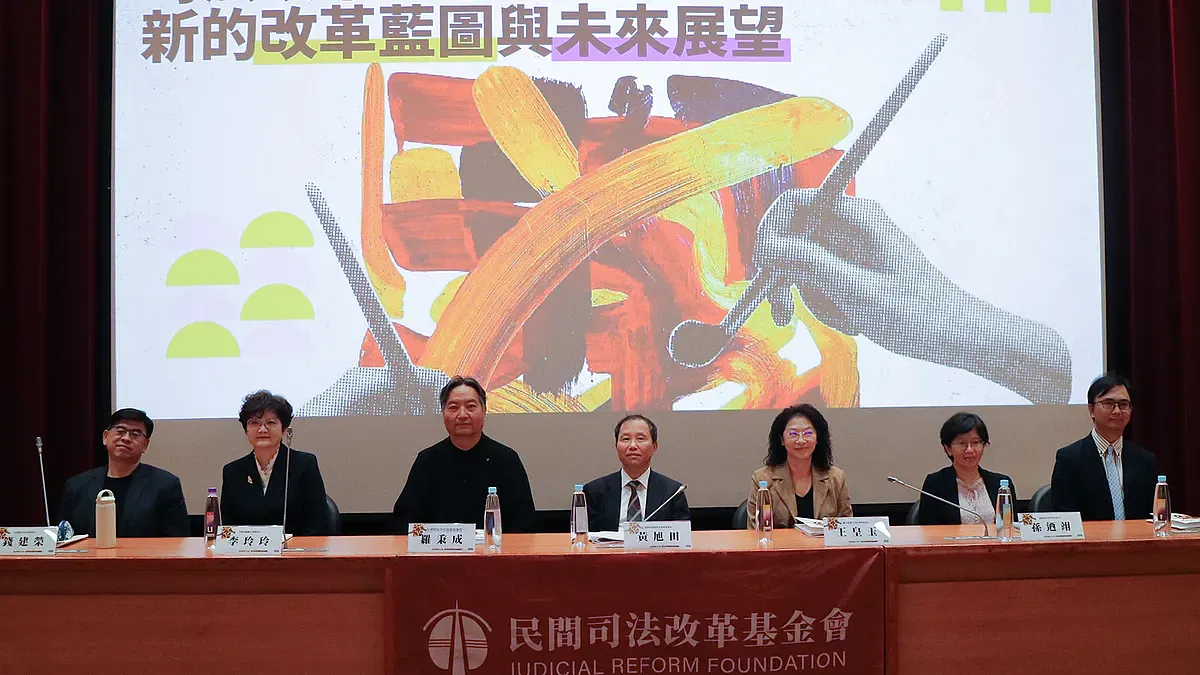
On May 9, 2026, the Judicial Reform Foundation hosted the academic symposium "Thirty Years of Judicial Reform: New Reform Blueprint and Future Outlook" at the National Taiwan University College of Law, releasing the draft of the "Second-Generation Judicial Reform Blueprint" and inviting critique and guidance from experts and scholars across all sectors to continue advancing reform.
When the Judicial Reform Foundation was established in 1995, recognizing the complex and multifaceted nature of Taiwan's judicial problems, former Chairperson and Attorney John Chen formed a committee and released the "First-Generation Judicial Reform Blueprint" in 1997 as a benchmark for long-term struggle. In early 2009, marking the tenth anniversary of the blueprint's proposal, discussions were held to formulate a new generation blueprint to review the reform proposals from a decade prior; however, due to the immense scale of the undertaking, it was not completed, and discussions resumed in 2013. Subsequently, due to the "Presidential Office National Customs on Judicial Reform" in 2017, the relevant reform concepts were expressed externally on separate occasions.
The year 2025 marked the 30th anniversary of the Foundation's establishment, and the implementation of resolutions related to the National Consultations on Judicial Reform came to a temporary close. When the Foundation took stock of the reform agenda for the next phase, 60 items could be clearly evaluated as achieved, representing an achievement rate of 56%. Important systems such as the Constitutional Court, the Judges Act, the evaluation of judges and prosecutors, and legal aid have all been legislated, and the problems they face have also transformed. In addition, many assertions have shifted due to differences in social conditions and institutional development. In response to this, Chairperson Huang Hsu-tien re-initiated the deliberation work for the "Second-Generation Judicial Reform Blueprint" in 2025, aiming to build upon the past and forge into the future to continuously advance judicial reform.
The draft of the "Second-Generation Judicial Reform Blueprint" spans 31 pages and is divided into 10 chapters, covering themes including "Court Organization and the Judicial System," "Ministry of Justice, Prosecutorial Organization, and the Prosecutorial System," "The Attorneys System," "The Police System," "Civil Procedure," "Criminal Procedure," "Penal Execution and Correctional Reform," "Administrative Litigation," and "Human Rights Protection." Among these, the chapter on "Human Rights Protection" further touches upon multiple dimensions such as "Protecting the Rights and Interests of Crime Victims," "Establishing a Gender-Friendly Judicial Environment," "Promoting Rule of Law Construction in the Digital Age," "Perfecting the State Compensation System," and "Actively Implementing International Human Rights Standards." Compared to the "First-Generation Judicial Reform Blueprint," both the breadth and granularity of the issues have increased significantly, illustrating the importance and necessity of continuing to advance reform.
This symposium presented the aforementioned draft blueprint to serve as a catalyst for discussion and to forge consensus on judicial reform within the professional community and the general public alike. Regarding the criticisms and guidance from the symposium and all sectors of society, the Foundation will also continue to review and collect various reform opinions, hoping to contribute to the protection of people's rights and interests and the improvement of the judicial environment. In addition to inviting numerous experts and scholars to conduct thematic seminars on various topics, the symposium also invited Chairperson Lo Ping-cheng of the Taiwan Association for Innocence, Chairperson Chien Chien-jung of the Judicial Glimmer Foundation, Chairperson Lee Ling-ling of the Taiwan Bar Association, Dean Wang Huang-yu of the National Taiwan University College of Law, Professor Sun Nai-yi, convener of the law discipline at the National Science and Technology Council, and Professor Yu-Wei Hsieh, executive director of the Taiwan Criminal Law Association, to deliver remarks under the theme "Prospects for Judicial Reform," thereby providing a broader macro-direction and looking forward to the next step of reform from the perspectives of civil society and academia.
Striving forward through thirty years of grinding and sharpening, the Judicial Reform Foundation has always believed that the progress of the judiciary lies not in slogans, but in perseverance regarding the justice of every individual case. The release of the draft of the "Second-Generation Judicial Reform Blueprint" is not only a summary of the past thirty years, but also an invitation letter issued to the future. Facing new challenges such as digital transformation and the refinement of human rights protection, we invite all sectors of society to walk alongside us, converging into a substantive driving force for reform so that the judiciary can become our shared promise—a promise of a fair trial, an egalitarian culture, and a society that embodies justice.
Press Contacts
Lyu Jheng-yan, Deputy Executive Officer, Judicial Reform Foundation
Phone: 02-2523-1178#37
Email: elvin@jrf.org.tw
This article is an AI-generated translation of the original Chinese text. In the event of any discrepancy, the Chinese version shall prevail.