
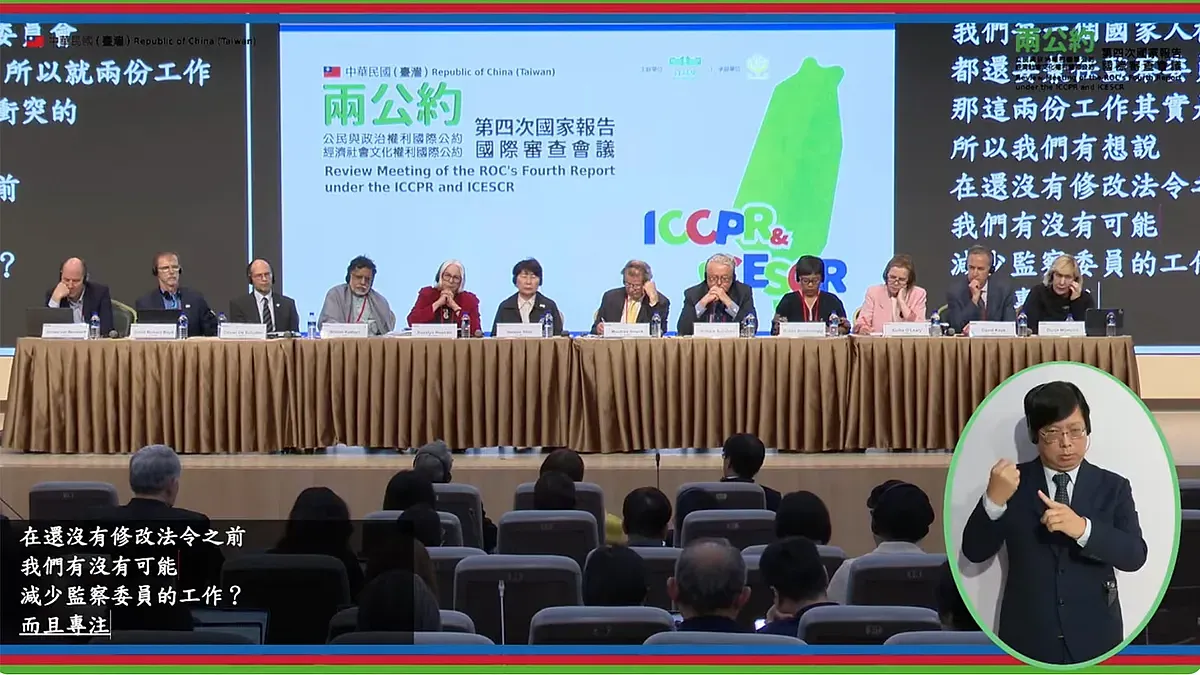
NGO Statement|International Review of Taiwan's Fourth National Reports under the Two Covenants
Last edited: 2026-08-26
Distinguished Committee Members,
Government representatives, NGO representatives,
First, we would like to acknowledge the government’s regular implementation of treaty reviews. Since the first review of the two Covenants in 2013, the Concluding Observations have served as an important driving force for legislative and policy changes in Taiwan, and for the realization of human rights. We would like to take this opportunity to thank the international experts for their efforts and contributions to human rights in Taiwan.
Taiwan’s Constitutional Court is composed of 15 Justices. Since the retirement of seven Justices in December 2024, the Legislative Yuan has rejected all nominees. At the same time, amendments to the Constitutional Court Procedure Act require a minimum of 10 Justices to be present, resulting in the Constitutional Court being paralyzed for over one year, with many important cases left unresolved. Although a ruling by five Justices has temporarily allowed the Court to resume operation, the structural problem in the Legislative Yuan remains unresolved. Similarly, due to obstruction by opposition parties, the current members of the National Human Rights Commission will see their terms expire at the end of July, and it is likely that a second term of Commissioners cannot be appointed.
The most fundamental human rights protection mechanisms are being undermined.
Under such a turbulent political situation, the ruling party, which holds executive power, should actively and visibly safeguard the core values of democracy, rule of law, and human rights in Taiwan. However, this has not been the case.
First, after two years in office, the government has not yet proposed a second National Human Rights Action Plan, reflecting a lack of action. The Convention against Torture and Other Cruel, Inhuman or Degrading Treatment or Punishment, the National Preventive Mechanism, a comprehensive anti-discrimination law, and refugee legislation have all been delayed for years without progress.
Second, in its political confrontation with the opposition, the government has failed to uphold the bottom line of human rights. For example, on clearly human-rights-related issues such as “life imprisonment without parole,” the government has not taken a firm stance.
Third, there is a lack of a comprehensive narrative and vision for human rights. Human rights are not only about protecting minorities; they also include the protection of economic and social rights for everyone. There is a high demand among the public for social services, yet the government consistently responds with minimal resource allocation. As a result, frontline workers—including nurses, social workers, prison officers, and clerks in courts and prosecutors’ offices—are facing serious shortages of personnel and resources.
Therefore, we expect the government to present a comprehensive human rights framework and to reaffirm the fundamental national policy of building a state based on human rights.
Second, several important human rights bills have stalled, and there are even regressive legislative trends.
After Constitutional Judgment No. 113-Hsien-Pan-8 was issued, the Ministry of Justice carried out one execution. President Lai stated that, according to the Constitutional Court’s judgment, the death penalty is constitutional, and he called on the public to support the Ministry of Justice in carrying out executions in accordance with the law. Subsequently, the Ministry of Justice amended the Rules for Executing Death Sentences, making the standards for execution more lenient.
We would like to remind the government that Constitutional Judgment No. 113-Hsien-Pan-8 addressed only several specific categories of crimes, and emphasized that the death penalty may be acceptable only under strict procedural safeguards. It did not make a judgment on the death penalty as such. In addition to strengthening procedural safeguards through legislative amendments, the government still bears obligations under international human rights treaties to continue moving toward abolition of the death penalty. However, instead, the government has expanded the scope of application of the death penalty—for example, by including fatal child abuse cases—moving in the opposite direction of its treaty obligations.
Not only on the death penalty, but more broadly, opposition parties in the Legislative Yuan have proposed populist bills such as life imprisonment and corporal punishment. More concerningly, the Ministry of Justice has proposed an even stricter version of “life imprisonment without parole,” depriving detainees of any possibility of reintegration into society.
At the same time, we observe that the state rarely examines the social factors underlying criminal behavior or seeks ways to reduce crime risks. There is also insufficient support for children and youth in high-risk environments, such as timely assistance for high-risk families and early intervention measures, where resources are severely lacking.
The government remains focused on imposing harsher punishments on offenders, and is about to introduce more severe juvenile justice reforms. This is an ineffective policy. It not only violates human rights, but also contradicts social science evidence.
In addition, in response to geopolitical tensions and risks of war, the Ministry of National Defense is proposing a draft Military Trial Act to restore military trials during peacetime. However, the proposal lacks sufficient public consultation, and the plan to place military courts under the Ministry of National Defense, rather than under the Judicial Yuan, raises serious concerns regarding judicial independence.
Finally, in the face of threats from China and pressures from the evolving international order, human rights are increasingly being treated as an obstacle rather than as the foundation of the state.
We respectfully request the Committee to remind the Government of Taiwan that only by upholding the ideals of human rights can Taiwan demonstrate its unique spirit and values, and become a country that its people are willing to stand up for.
This article is an AI-generated translation of the original Chinese text. In the event of any discrepancy, the Chinese version shall prevail.